Tag: Australia

  • New Map on an Old Wall

    Three weeks ago, the entire kitchen wall in our office was filled with maps of the world. Diversity and inclusion week was being celebrated. We were asked to highlight the place we were born, by pasting coloured stickers on the map. Australian continent is deemed down under, but we placed Australia at the centre of the world. I mean, the wall.

    Last week at office, I noticed a new map of Australia on the same wall. A different one, with blurred border lines separating a huge number of “states” and “territories”, all highlighted with various colours, with new names. New, to me – a recent immigrant.

    As a child, I loved colouring maps. I was fascinated by borders, routes and names. 

    “Where are the border lines?”

    I always wondered how the boundaries of states and nations were made. I don’t remember much, but I would ask, who drew those lines and how. During trips to a temple in the adjacent south Indian state, I might have pestered my dad or an elder cousin, “Did we cross the border already?”, “Where is the line that i saw on the map?” I wonder if they might have pointed at the river and the mountain ranges as the bus entered the border town. I never understood.

    Years later, the much grown up adult me would figure it out. Those borders on the map are not real. They are a socio-political construct. Nothing to do with geography.

    “Routes that create territories”

    In the past, the invaders and colonisers used maps to discover new territories. To then change the landscape, peoples, culture, everything. They say Map is not the territory. But those conquerors used maps to make new territory. Bruno Latour says, “The great man is a little man looking at a good map”.

    We trust a map so much these days that we are lost without it. We take it literally, or almost fatally, as this German driver did (from a story I read in an old copy of Readers Digest).

    The semi-conscious middle-aged man was being questioned at the hospital after his accident, “Why did you drive your car at high speed directly at the barricades. Didn’t you notice the exit was blocked for repair. That too, on a sunny day?” His reply, “I followed the GPS on my car”.

    Names: old – new – old

    The city I grew up – Coimbatore – is near the foothills of the beautiful hill station, Ooty. Its historical name is Uthagamandalam. The British made it their summer capital of the south. The name was a mouthful though. They tried pronouncing, but made a mess of it, naming Ootacamund. The locals might have resented it, even if they couldn’t have resisted that change. Eventually, it became Ooty

    Thirty years after the British left, the local government decided to change the name to its old Uthagamandalam. Still, a few locals resisted this change. But they might have figured:

    If the names could be changed then, 

    the names could be changed now.

    The new (old?) colourful Australian Map
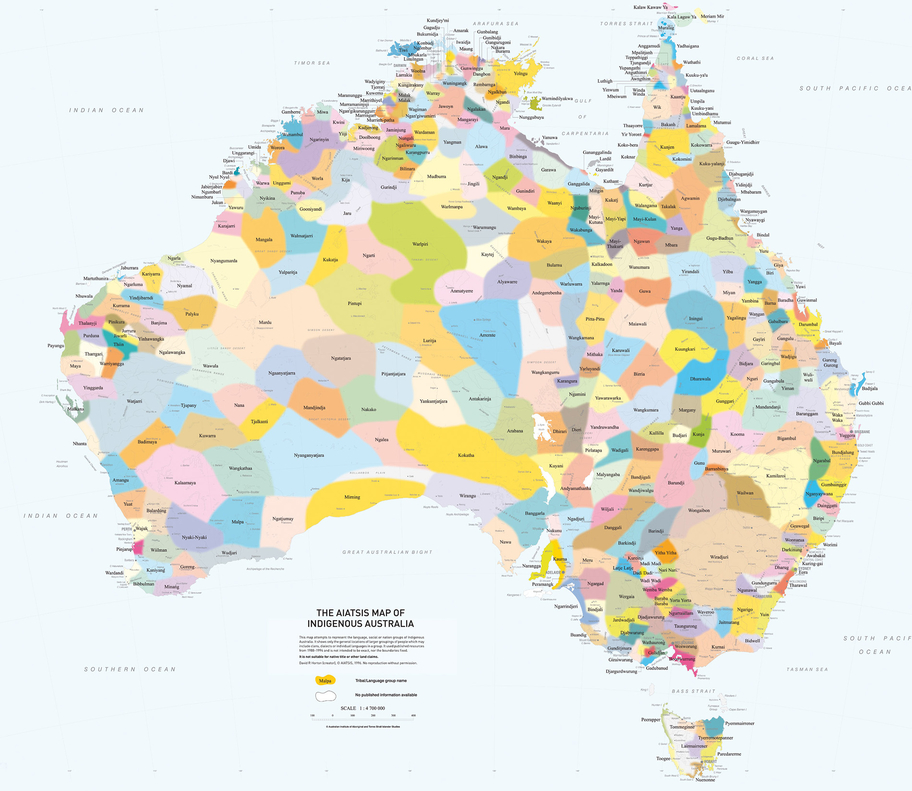
    That map on the kitchen wall last week was to mark the National Reconciliation Week. The AIATSIS map is a “visual reminder of the richness and diversity of Aboriginal and Torres Strait Islander Australia. It was created in 1996 as part of the Encyclopaedia of Aboriginal Australia project and attempts to show language, social or nation groups”.

    Maps, with its borders, routes and names, decide the way we see the world. They don’t just tell us where we are, they determine who we are.

    Perhaps, we don’t stop with a new map on the old wall.

    We bring the old map back to the new minds.

    (This is from my speech delivered last week at our Toastmasters club on the theme of National Reconciliation Week in Australia, which is all about “relationships between the broader Australian community and Aboriginal and Torres Strait Islander peoples”. Please note, while I am still learning about this important topic, my attempt was to touch on the related topic of maps, through stories, anecdotes and insights.)
  • Blank

    Blank

    I couldn’t write a blog last month. I didn’t want to. I didn’t want to write one of those self-deprecating takes on a life experience and fill it with wise-cracks. I was struggling for ideas.

    I was actually struggling for words to describe the state of my mind.

    Situation in India

    Everyone seems impacted by COVID, not just counting the unfortunate ones invaded by the virus. The visuals on TV last month were striking – ailing men and women standing in long queues to secure hospital beds, oxygen cylinders or anti-virals. Haunting scenes of bodies that lay queued up in front of a crematorium. Social media, especially twitter was abuzz with cries for help, but in equal measure, with quick and life-saving responses from strangers. The state of my mind tasted like a cocktail of despair and hope. 

    Heavenly prison

    As I talked to my parents, friends, uncles, cousins, ex-colleagues, almost anyone from the land that birthed me, I tried to listen more, but found nothing helpful to offer. My wishful words sounded empty. I watched all this nervously from a safe distance, within the safe comforts of a western country that has a much lower population, a better system, and lucky. Also, cocky. Australia conveniently closed its borders and threatened – with a jail term and a ridiculous fine – anyone trying to come back to the country. The state of mind : angry and helpless.

    Help?

    I am one of the 18 million Indian diaspora spread around the world. What can one individual do, after all ? Of course, I try to support my immediate family and friends in any which way I can – mostly monetarily, given travel restrictions.

    What else could one offer, beyond money and empty words ? I saw Indian-origin doctors offering virtual services to ailing patients in India. I saw millionaires sending flights-full of useful materials. I read about corporates vaccinating their employees. I came across inspiring stories of nameless individuals helping out strangers in dire need.

    I realised then, my craft as a software engineer is not directly useful to my people at the moment. Or maybe i don’t know what to do with my skills – beyond earning a monthly salary.

    What can i do or make?

    Eventually, I joined a small group of the Indian community here in Canberra, who organised a South Indian vegetarian food fair in the temple, to collect funds for a hospital in Coimbatore. We all prepared idlis at home and sold it at the temple. A decent collection resulted that should be helpful. Well, something necessary if not sufficient. As I did my bit around the kitchen, I wondered if this was all I could do.

    The state of mind: feeling inadequate.

    Coping strategies

    Though my family is largely unscathed (fingers crossed), my parents are yet to be vaccinated. I fear we are sitting on a time bomb. Meanwhile, life goes on; work consumes my days, leaving the night wide open for dreadful anxiety. Often in the middle of the night I wake up to check whatasapp, hoping not to catch a text or a missed call.

    When no actions are possible, I turn to distractions. Movies, sports, trivial news in social media, celebrities, anything. And books, especially on philosophy.

    Kural and Senaca

    I turned to Thirukkural – the Tamil classic text from 300 BCE, written by an unknown author (we call him Thiruvalluvar) who has written 1330 non-religious yet sacred verses or Kurals (couplets), seven words each. These kurals are like morals and commandments covering three key aspects of life: virtue, wealth and love.

    There are 10 kurals that cover how to deal with sorrow and despair, each offering a unique coping strategy. A few explain the nature of sorrow and suggest being realistic. A couple of kurals advise us to defend against the incoming trouble. But, a few kurals insist fighting back: trouble the trouble to make it run away, or something of that sort. But this kural below has the best strategy of it all, and I remember being surprised when I first learnt it:

    இடுக்கண் வருங்கால் நகுக அதனை

    அடுத்தூர்வது அஃதொப்ப தில்.

    If troubles come, laugh; there is nothing like that, to press upon and drive away sorrow. (Translation, courtesy valaitamil.com)

    Laughter is indeed the best medicine. But, the state of my mind ? Not funny.

    The Stoic’s take

    In the end, I got a better medicine from the greek stoic philosopher, Seneca, who is now getting more popular after 2000 years.

    Light griefs do speak; while

    Sorrow’s tongue is bound.

    I figured, my mind was at a state where no words or thoughts could spring.

    Blank.