Category: Influences

  • A page from a book is more than that

    I notice my family, friends and acquaintances, not reading books.

    Some of them don’t have time in their lives right now, to dedicate an afternoon to even begin to read from a book they bought many years ago. This blog is not for them.

    A few don’t like to read books, they tell me. They have apparently lost interest in the written word. I am writing this piece, directly looking at them. Yes, I know who you are.

    I am kidding. I promise, I won’t preach why you should read. Nor would I prescribe a bunch of books on this last day of the year. I am kidding again.

    This is more about two moments from my 2021 trip around the sun. One acted as an anchor, giving me a sense of what I loved doing, and another that brought out the force in me, and gave direction.

    The Greeks again

    In February this year, on a lazy Saturday afternoon, I saw a tweet by a speech consultant @JohnfBowe. His article explained how two thousand years ago, the Greeks figured out that public speaking – the art of rhetoric – is a foundational skill to be acquired by everyone. Yeah, for once, it is not all about philosophy when it comes to the ancients.

    I ended up buying his book. It begins with the story of his cousin whose life takes a dramatic turn after joining Toastmasters. The guy never left basement until he was fifty nine years old, but soon got married, and overcame shyness (not necessarily in that order), helped by the world’s largest organisation devoted to the art of public speaking.

    John’s book made me reflect on the way I do presentations. Content is king, they say. I no longer start my preparations researching for what to include. The recipient(s) of the message take centre stage, more than the message itself. Audience is king.

    I reached out to the nearest club in Canberra. I wasn’t shy, but curious. I was welcomed into the Woden Valley Toastmasters club as a guest, a pivotal moment for me this year. I soon became a member, learning how to talk more clearly, persuasively but mainly, to keep the focus on my audience, what would be valuable to them. And to ramble less.

    Incidentally, around the same time in March, I got an opportunity to present SAP’s product strategy at a customer’s town hall meeting addressing roughly 150 members of their IT team. I remember spending more time on the question: What do I want them to think and feel, when I finish talking.

    A random tweet guided me to the book about ancient Greeks, eventually taking me to the Toastmasters, on my way to a successfully delivered talk.

    Winning is the (only) way

    Later in July, I faced a sudden bout of confusion and uncertainty about the way my role was perceived at work.

    One book brought back the fighter in me. It wasn’t a random tweet this time, but a slice of podcast conversation with the NBA star Chris Bosh talking about a book that shaped his thinking: The way and the power – Secrets of Japanese Strategy. Its about how a samurai master deals with confusion and uncertainty; one who controls his mind. One who would not lose. I ordered it immediately.

    I can’t say much more. But reading a couple of chapters, it felt as if I had flipped a switch in my mind. I woke up one morning and decided to win. Not merely adapt or survive or manage a situation. To win.

    You want the whole meal, not juice

    Why bother with a book these days, if one can acquire such insights through tweets and podcasts? I sense, reading a book – even skimming through a few pages – is way different than trying to grasp ideas distilled by someone else – a secondary process. It is the difference between eating a wholesome meal and drinking a juiced up version.

    A book could change the way you think about this world. Your world.

    Three sixty five days from now, on another new year eve, I will want to hear from you about the pages and words that influenced you.
    For the ones in my cohort too busy to read: One page consumes three minutes out of one thousand four hundred and forty minutes in a day. A typical book has three hundred pages.

    I rest my case.

  • Uncategorised

    Uncategorised

    I bet you won’t continue reading this blog beyond a point, unless you find something new. Right at this moment, in your brain, a bunch of neurons are firing to figure out what this new is. I wonder if you got some ideas from the title, or some of the pictures below which your eyes cannot help scanning. I suspect you have mentally tagged this blog already – technical, boring, long. Interesting (hopefully).

    Categories

    Our brain is wired to perform instant pattern matching and categorisation. Categories have strict boundaries which help us compare a “this” from a “that”.

    This skill helped us survive as we made quick decisions under uncertainty – by differentiating between a branch of a tree and a snake; between a cold, warm or hot object. All thanks to the much evolved part of our brain: prefrontal cortex.

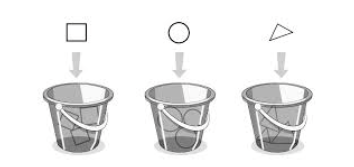
    Now during the information (delu)age, we need this skill even more, as we distribute every bit of new information to various buckets. Worse, we do pattern matching even when the data doesn’t make any sense. Lets attempt this puzzle:

    Kiki and Bouba are two nonsense words from a non-existing language. Can you suggest a match between the words and the two images below ?

    Analogies

    Cognitive scientist Douglas Hofstadter says categorisation and analogies are the way ALL thinking occurs in our brain. Watch him narrate this (15 minute into this hour long video).

    We have so little control over this process. If our mind always compares and contrasts – as we see, hear, smell, touch and so on – several downsides occur. In a rush to make a quick judgement, we often make the wrong call.

    Prejudice

    I won’t talk about serious topics like racial stereotypes and unconscious bias in this blog. But I share a recent experience at the food court, when a seemingly innocent comment from the lady at the counter made me cringe a bit.

    I sensed her watching me order rice and vegetarian curry with an additional order of papad. The many neurons in her brain didn’t have to perform heavy gymnastics to categorise me, as she suggested “so, you must be a south Indian?” I nodded. She said, feeling settled, “makes sense!”

    She wasn’t wrong this time. No harm done. (maybe my moustache was a give-away). But not all of us are right when we carry out some lazy, sub-conscious thinking. When we assume.

    Cognitive Bias

    Daniel Kahneman is considered the father of behavioural economics. In his work, he underscores the fact that humans are not rational at all while making decisions. The nobel laureatte’s book Thinking Fast, Thinking Slow has made me more aware – if not smarter – as I learnt about various cognitive biases. A sample for you: Confirmation Bias – the tendency to search for or interpret information in a way that confirms one’s preconceptions. (eg. anti-vaccinators).

    Rob Dobelli’s The Art of Thinking Clearly is another easy-read that I recommend.

    Black Swan

    Being aware of such biases helps us avoid an ontological shock.

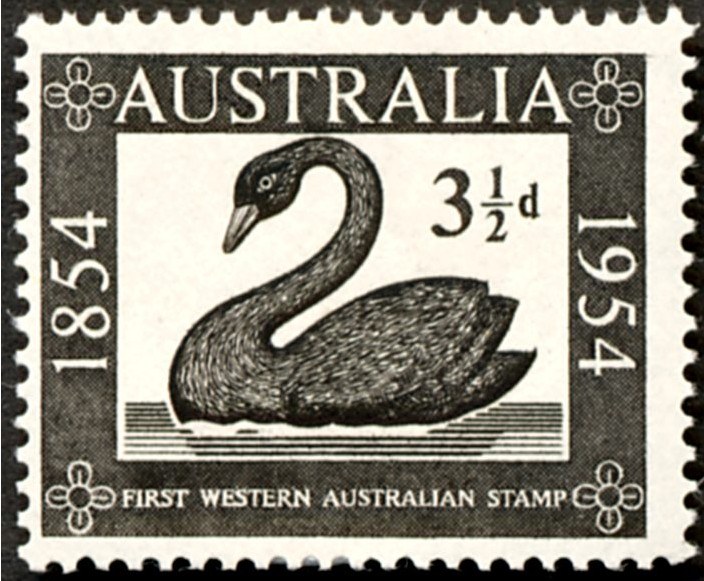
    In the 2nd century, a roman poet coined the term black swan describing an imaginary bird – since at that time, all known swans were white. That was until the 17th century, when Europeans landed in Australia, when they spotted a black swan.

    Nassim Nicholas Taleb tells this story in his book The Black Swan: The Impact of the Highly Improbable. Note, the book is not about birds, but how we struggle with things that shock us – outliers.

    I particularly loved the irony – these 17th century travellers declined to categorise that bird as a swan at all. In their mind, a swan had to be white.

    Moral of the story: be aware of how we categorise. And, when we encounter a new idea that cannot be boxed onto an existing bucket, it deserves a new category on its own.

    The Meditating Brain

    I mentioned earlier, how prefrontal cortex helps with categorisation. The picture-book “30-Second Brain”, edited by British professor Anil Seth, illustrates how meditation rewires our brain.

    Just after 4 sessions of meditation, it is found that we use less of the primitive areas of the brain, activating the prefrontal cortext that helps us perform higher orders of cognitive functions and intelligence.

    Kiki or Bouba ?

    Did you associate the word kiki with the sharp edged object? You are like the 95% of participants of a famous experiment “Bouba/Kiki effect“.

    We cannot help ourselves especially when we don’t realise we are making these associations. Are we stupid, are we wrong? Should we stop categorisation altogether ?

    I finish with the simple and slightly modified words of a famous Henry Ford quote:

    Whether you think you should, or you think you should not – you are right.

    PS: This is the part 2 of a three-part blog post “How to Think Better”.

    Check out Part 1: “How to Think Better – Externalise”

    Part 3 to be written: “How to Think Better – Explore

  • Checkmate, Stress!

    Remember that weird state of your mind when you woke up many years ago, totally unprepared for a test? Or while suffering through an impossible and never-ending project that had a huge bearing on your career. And what Federer might have dealt with as he was clutching at straws facing a seventh match point at the Australian Open last month (you might say, his wife Mirka was more at pain, with her hands clasped and eyes closed in a quiet prayer).

    Stress is a bad word. It is so vague, it means everything and nothing at the same time. Im no expert in psychology and have no intention to write a “how to beat stress” blog. I thought of narrating a few personal insights and a lot of borrowed learnings that helped me deal with this beast.

    When i picked up Mind Master – Winning Lessons from a Champion’s Life, i expected World Chess champion Viswanathan Anand’s book to contain sophisticated mental strategies for career growth. The now fifty year old master was once a child prodigy. I am only half way though the fascinating book, but Anand opens up like a friendly mentor. He portrays his vulnerable self when facing a daunting opponent like Gary Kasparov and appears an emotional wreck after a jolting defeat. Beyond his insights on risk taking, persevering towards goals, contextual memory and developing curiosity, i loved the emotional human behind the intellectual genius.

    There are solid lessons from the seemingly quirky, nail-biting warrior’s many duels – most, against his own mind.

    Dealing with Emotions and being fearless

    He talks about how emotions come in the way of clear thinking and decision making. Especially, “After a defeat, it pays to completely change my surroundings, find something new and compelling”. “The mind only recovers emotionally when it can replace an old memory with a new, more pleasant one.”

    He then narrates how different Kasparov was in dealing with a similar situation. The all time great champion was struggling one day in 1987 during his match against Karpov. “Instead of striking his head against the washboard over his predicament, Kasparov spent the entire night playing cards”. The next day, he woke up late, had a lazy lunch and told himself he was just going to keep going.

    As i read this, i got reminded of a similar story narrated by the Sri Lankan cricket captain Arjuna Ranatunga, about his team’s state of mind on the eve of the 1996 world cup finals against the mighty Australians. His team were the underdogs but had played a fearless brand of cricket all through the tournament. Staying in the same hotel in Lahore along with their opponents, he noticed the Australian team having a quiet dinner, while his troops were no were to be seen. When he later found many of them shopping carpets and sarees for their wives, he comforted himself, the cup was theirs: A team so relaxed, cannot lose. And they didn’t.

    Around a year before this match, i was faced with an anxiety attack on the eve of my year 12 chemistry exam. I was hoping to refresh my memory of all things chemistry during the two day break after the physics test. I had to get close to 200/200 in each of physics, chemistry and maths, to have any chance to getting into the tier-1 engineering college in South India.

    I had toiled the whole year on physics, but i messed up a twelve-marks question. Returning home, i felt defeated even as my dad tried to calm me down. The two days before the chemistry test felt like eternity. After spending forty of the forty eight hours self-loathing, fretting and fuming, the fear of failure made me hopeless. But with just a night to pass before the test, i suddenly felt better since i had lost already. I told myself, “I won’t get into the university i yearned for. Let me just have some fun”. I still remember, i was one of the very few who had a smile in the face before, during and after that three hour test.

    Viswanathan Anand too explains how his occasional shift in attitude – embracing fearlessness – landed him spectacular victories. “i have played my most inspired games when my enthusiasm for the sport resurfaced, without the bindings of titles or wins or ratings”…”to play a good game”..”excited about learning something new”.

    My battle was no way comparable to his. Still, when the results came two months after my exams, i shocked myself and my chemistry teacher, scoring a perfect 200/200 – a tough feat at that time, especially in my school.

    From Checkmating to Note taking

    Anand’s suggestion in taking notes as a means to deal with emotions and stress is another revelation. “putting down my observations right after a defeat when the pain was raw and the sting was fresh, I stumbled upon the solutions I had seen but didn’t act upon or the ones I had overlooked.”

    I am no big achiever yet, but i can vouch for this. For the last couple of years, i have been diligently writing down notes in a daily (sometimes, hourly) journal. I make a note of what’s in my mind, what i’m thinking, more importantly, the raw emotion at that moment – feeling fearful, inadequate, blessed, clueless, bored etc.

    Poring over these notes – a treasure trove – i have become a lot more objective, grounded and relaxed. (many of my blogs were born out of those).

    As Anand says about his 40+ years of notes, “without that”…”my experience [is] almost incomplete.”

    Second Brain

    A zillion things go on in our mind at any moment. Offloading much of that – thoughts, ideas, shopping lists, pending tasks – to another system is a stress buster. For the uninitiated, David Allen’s book/methodology Getting things Done is a great place to start. Along the way, i discovered, Tiago Forte’s Building the Second Brain (BASB) techniques quite useful. If you are looking for a contemporary note taking app/tool, i suggest Roam Research – this has been a game changer for me.

    Don’ts

    A few physical techniques like simple exercises, breathing techniques etc, can be transformative no doubt (eg. Paul Taylor’s Mind Body Performance Institute), and i’m not even venturing into the possibilities in the spiritual realm.

    For me, confronting the raw emotion face to face has been an effective way to conquer it.

    One thing i learnt not to do when your loved ones are feeling it, is to suggest, “please don’t be stressed”.

    It is as useless as saying, “please don’t have a headache”.

  • Bookshelf tales – Hard landing on a Tipping point

    (This is part 2 of my Bookshelf tales. For part 1, click this link).

    All the preparations didn’t go in vain. I passed the interview and received my first job offer. With a lot of excitement, I moved to a new city to begin my career with Baan (a great company) along with three of my classmates and forty others in that batch (a great company).

    The day we landed, I noticed my friend unpacking more books than clothes from his luggage. He filled out half the wardrobe shelf with his books. Seven Habits of Highly effective People was one of the first books I borrowed from him. I remember feeling inadequate at that moment – after having ignored a friend’s dad’s advice before I left home. He was reminiscing on his bachelor days in Hyderabad many years ago and suggested that I avoid eating out and to do a lot of reading. I perhaps paid more attention to be one own’s cook than to pick up a book.

    Eventually, I began collecting (and reading) some books. I write about three of those, that provide colour and context to my first four years.

    The Goal” (…and how my trainer eliminated the job of a canteen clerk)

    “What is the goal of a company?”. Mr. Karan Rastogi, the trainer asked us as he began unravelling the concepts of Enterprise Resource Planning (ERP). Most of the answers were around producing goods that are useful to society or something in those lines. Mr. Rastogi clarified however, the main goal of any enterprise was to make money.  To be accurate, to create value – for shareholders, employees, and the society at large. It was all going over my head anyway. To make it easier for us, he narrated a story from his management consulting days.

    He was once asked by a major manufacturing company in the northern part of India to identify ways to reduce cost of operations. He learnt that all employees were provided subsidised food and tea at their canteen. A clerk was employed to manage tokens and the cash register. Initially, the workers were quite happy – being able to buy a meal for less than 50% of the cost outside. Soon there were complaints about the quality of food and the long queues in front of the billing counter. Mr. Rastogi initially performed a lot of algorithmic calculations based on Operations Management but soon came to a simple conclusion: it is best to fire the clerk and eliminate his job function, and provide free meals. The loss of revenue was more than made up by the increased employee morale (when they pay nothing, they didn’t complain even when the food was terrible).

    He suggested that we read a novel by Eliyahu M. Goldratt: The Goal, which is rated as one of the top 25 books in Business Management. Read how the central character in the book learns complex concepts like Theory of Constraints, Bottlenecks etc, from real life experiences as he resurrects his career as a struggling Shopfloor Manager. In particular, I enjoyed the part where he goes on a mountain hike with his children and their friends, as they follow each other in a sequence on the way up. Hours later, he finds the last few kids arriving much later than others – due to a fat kid in the middle who slowed down everyone behind. With the insight: “A chain is only as strong as its weakest link”, he goes back to work and fixes his production chain, thereby reducing inventory and increasing profit, thereby keeping his job and getting back with his wife.

    The Tipping Point

    As I was browsing through a book shop, I picked up this book that was at the end of the shelf and about to fall. What an odd (but appropriate) title, I thought. Tipping Point. A tip is a point after all. And the author’s last name is Gladwell. Well, I didn’t regret buying it though. It introduced me to the world of social sciences, especially how influential ideas spread virally in a social network (long before the age of Facebook). And more importantly, to non-fiction books that are as gripping as novels.

    “The Power of now”

    A bit of hard landing occurred in the first job as I struggled to deal with expectations. It was much easier to shine as a topper in a class room but not so in the real world. I also had to deal with a literal hard landing.

    One morning, I found myself flat on a hard, newly laid tar road, thrown from my Yamaha RX 135 bike as I narrowly avoided colliding with a patient exiting from an eye hospital, riding his bicycle across the road (he was still carrying some bandages in his face). I had four seconds to respond and I thought I did well not to kill him, even when he unknowingly tried his best to come straight at me with a single eye.

    In an eerie sort of coincidence, I had bought this book “Power of Now” only a couple of weeks before. While I was recovering from a surgery to my broken wrist, I thought it wouldn’t a bad idea to dip into this book about mindfulness and stuff. I couldn’t resist wondering why this happened to me. What if I had joined my friend in his bike that day. What if I had paid more attention during those four seconds. Or maybe earlier.

    A colleague tried to assuage me, “in our roads, even if you are 100% careful, you are only 50% safe.” That made me laugh while still at pain. My uncle’s friend saw me reading this book and said, “Kid, you have many years to go before you indulge in philosophy stuff. You need to do earthly things and struggle in life first.”

    That rang a bell. A year later, I was married and it was many months before I touched any book, especially philosophical ones.

  • Bookshelf tales – the first few pages

    Bookshelf tales – the first few pages

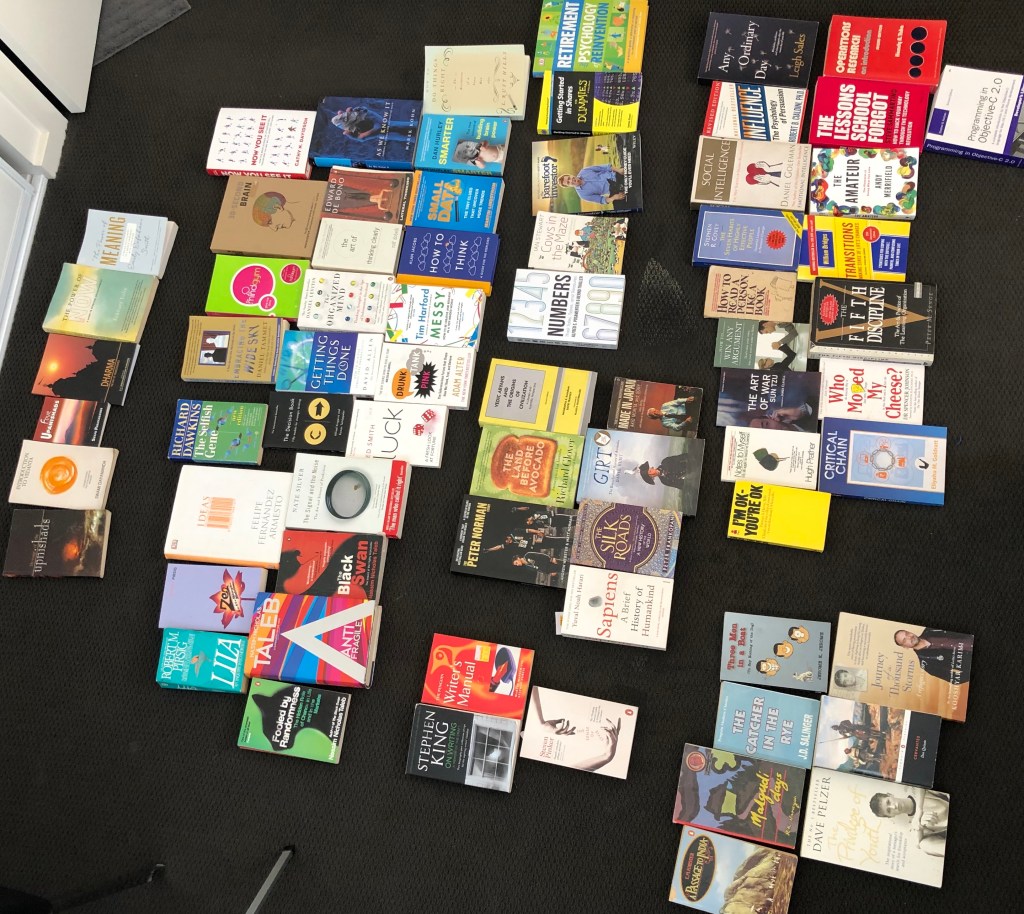
    A friend asked me if I could recommend some of the interesting books I have read over the years. I used that chance to finish an activity I had been running away from – to sort and categorise the books in my shelf. After a nice breakfast on the new year’s eve, I spread all books down on the floor. Looking over them, I wondered how I ended up with such a wide collection of bound pages containing many others’ thoughts and ideas, that I must have inhaled via tens of thousands of words over many a quiet afternoon. Some of these books were gifted to me; a few, I bought on friends’ recommendation; a lot were picked up at random, while waiting to board a train or a flight. Many of the pages are still to be read. A few, to be re-read.

    A couple of hours later, I ended up with a much cleaner bookshelf. And with a dust-triggered-repeated-sneezing-and-running-nose. Also with a mind-refresh of some hilarious but life-defining experiences associated with these books. I share some of these stories as a blog series, starting with this one.

    These books helped me once hide my insecurities and inferiority complex, pass a job interview, to converse better with strangers and to broaden my thinking. Also, to brag about stuff from time to time. More importantly, they made me = me++.

    Urgent: improve your personality. Interviews are coming!

    I look back at myself – Ramanathan of 1998. An eager but shy university student in Coimbatore, anxious about the upcoming season of job interviews. I was shaping up to be good engineering graduate alright, but I struggled to finish speaking a sentence in English – especially when standing in front of my class. We were expecting a couple of IT companies to visit our college to hire final-year graduates. They were going to test us on our math, analytical and verbal skills. They might also check if we were good at engineering. Most of us were worried about getting exposed on our (lack of) communication skills.

    As part of preparations, a bunch of enthusiastic class mates got together to organise group discussions. Candidates are seated in a group and given a topic to talk about. They are judged on what they spoke, but also the way they influenced the group’s final decision on the topic. While my smarter companions debated complex topics like Kyoto protocol, democracy, impact of foreign aid, etc. with ease, I would find myself blabbering nervously. I didn’t just struggle for words. I would often mis-pronounce even when I fished out a word for the occasion. Often, I didn’t have much to say, as I felt out of my depth on many worldly matters.

    It was clear. The “test” was not just going to be about one’s measure of arithmetic, vocabulary or ideas. It was a judgement on the whole personality. And here I was, a clumsy, slouching lean fellow who wouldn’t shave very often, bite nails when nervous. That was most of the time.

    Once I was in an activity where each one had to speak on any topic for two minutes. The group would take notes and provide feedback for improvement. I chose an easy topic: Time Management. I had made notes while I waited for my turn and when I spoke, I was able to explain the various techniques like planning, keeping a sense of time etc. They said I spoke reasonably well but were brutal in their assessment of my appearance: I was dibbling my finger, didn’t look at the audience and they also pointed out that I overshot my allotted time by three minutes as I laboured on about time management.

    My friends shared some tips and tricks, and alerted me about my annoying habits. For instance, it took a whole month of practicing to avoid retorting with “aaaah?” or “whaat?” instead of “Pardon, me?”.

    A class mate suggested that we organise a Personality Training Session for the whole class and gave me a reference of Mr. Suresh Punjabi, an expert who (even this day) conducts trainings for students in Coimbatore. We decided to try this first on our second year juniors. I got permission from our shy and equally nervous professor – he possessed enough weirdness to qualify as typical nutty-professor (would write a separate blog series on him one day). When Mr. Punjabi arrived at our college, I observed that he didn’t wear a turban. I also observed my professor being more eager to introduce him to our newly joined Principal. I wasn’t sure. I had not met this new principal yet and was pretty sure that would be the case with my professor too.

    Soon, we both welcomed our guest and ushered him into our principal’s room. The four of us were standing but no one said anything for a good five minutes, each waiting for some one else to break the silence. I assumed the principal waited for either me or the professor to tell him who the stranger is. Mr. Punjabi looked at me. I was looking at my professor who appeared shy, nervous and embarrassed at the sudden attention that he created for himself. With a quiet voice, still facing down, he threw these words towards the principal, pointing his finger roughly towards a direction between me and our esteemed guest. “Sir, please meet Mr. Suresh Punjabi”. The principal looked at me and shook my hand, “Thanks for coming, Mr. Punjabi”.

    Eventually, when we let him begin his session in the classroom, Mr. Punjabi took us through some of the basics of communication, appearance, manners and stuff. He also emphasised on learning how to wear a tie. Conversing with him on the way back, I felt more assured about myself. I vowed to never let the principal-room-situation occur again: to never be that invisible. To never stand there just blinking and being tentative.

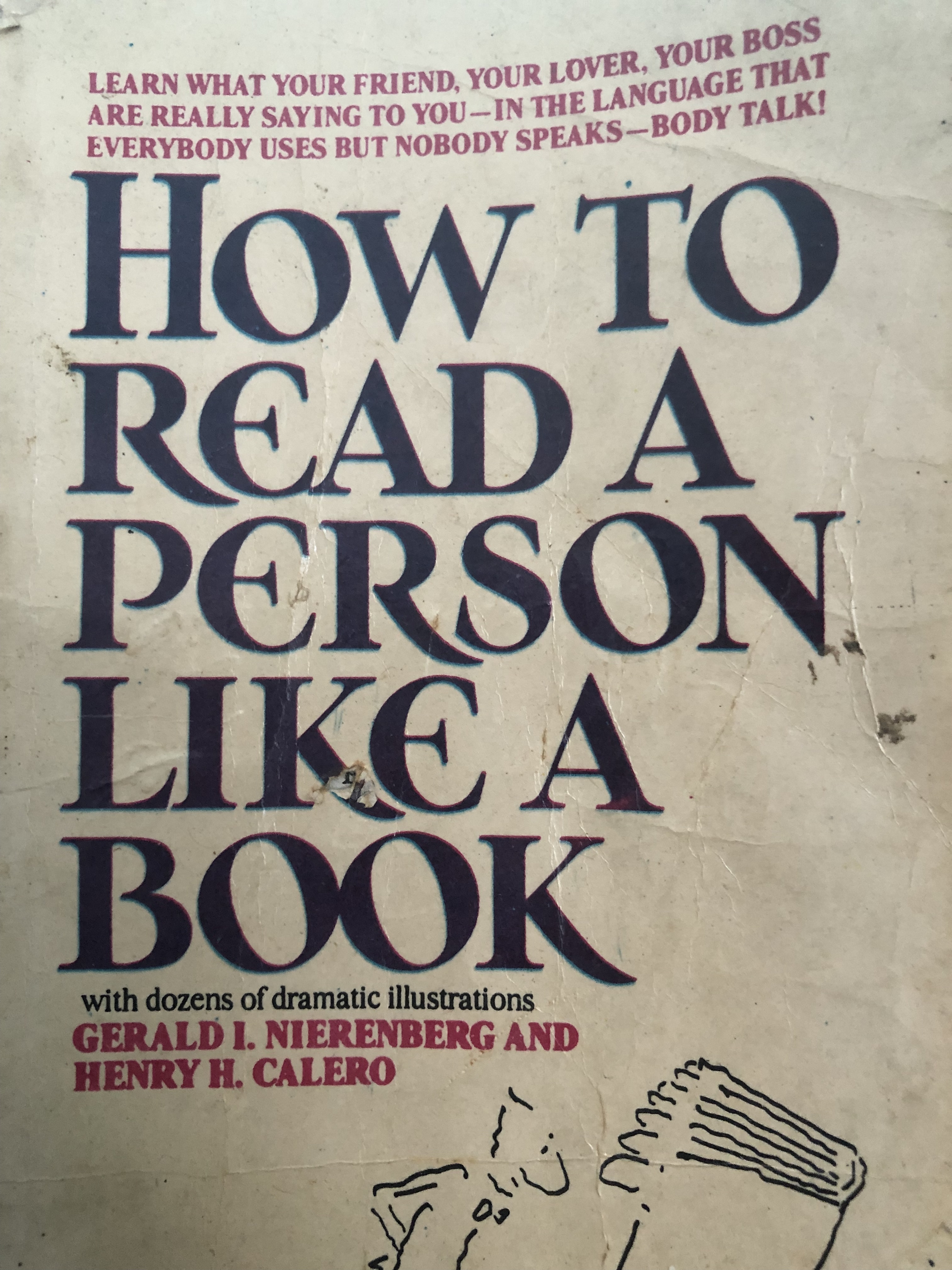
    Around the same time, I found an interesting book in my father’s bookshelf that usually had a collection of Dale Carnegie’s books and old copies of Readers Digest. How to Read a Person like a Book, was all about non verbal communication, body language – and the mastery of it. It had all the answers for me.

    img_1447

    Twenty years on, I still preserve this book. Yeah, the pages are rugged but the lessons are fresh, and still being learnt. Few years ago, when I switched roles from being in product development, to more of customer-facing project management, I paid the price for forgetting some of these lessons.

    While at a customer site, representing a group of engineers, I was annoyed by the customer who mistook my colleague as the project lead, talking to him most of the time, while I was left to wait for emails. It took a while to figure out: my colleague would always present himself in a suit and a tie, while I would often land in a semi-formal attire with a casual demeanour. That was a game-changer moment for me.

    But in 1998, this book enabled me to punch above my weight.

    When my class mates arranged for another round of preparatory group discussion, I felt I would fare better. Partly because the topic sounded easier, Also, by then, I had avoided keeping my hands nervously in my pocket when speaking; I no longer feared making eye-contact with class mates and didn’t bother if they faced me with a smirk. I slowly began opening up.

    I remember the feedback from the class mate – the designated judge that day. “Your gestures were awesome. You listened very well, often nodding your head positively, encouraging your opponents to speak. You didn’t interrupt anyone but, you didn’t say anything till the end”.

  • Bulk Fiction

    “You are losing the ability to focus on things closer to you”.

    The optometrist’s diagnosis for my recurring headache sounded rather philosophical. As he prescribed reading glasses, he assured me that my eyesight is alright and this is all quite normal in the forties, and I needed to wear them only for reading.

    A couple of days later, I realised I didn’t remove them except when at sleep. It struck me then, “reading” encapsulates plenty of things one does during the day: looking at numbers and texts on my PC when at work, catching a glimpse of the twitter feed on iPhone, reading books over the weekend. Even watching TV/movies involves a bit of reading (subtitles).

    Its not just the insane amount of blue-light exposed to my eyes that was worrying. All the stuff I inhale into my mind each day. what’s going on ? And, whats going in? Beyond work, how do i control the intake of the non-essential content? I began applying some mental filters.

    Fiction vs Non-Fiction

    We could classify all the TV programs, movies, books, social media that we consume into these two buckets: fiction vs non-fiction. Imagined stuff vs reality. To be blunt, the false vs the truth.

    Why do we love watching movies when we know most of them aren’t real? Motion pictures were a revolution in the last century, as disconnected and disadvantaged people were suddenly exposed to a world full of people they had never encountered, of stories never heard before, of places they may never visit. And the information flow that would have not occurred otherwise, though laced with myths, exaggerations and influences.

    But in this age of information overflow, why do we flood our grey cells with fiction? Agreed, imagined stories are fun while most documentaries are boring. We seek drama, meaning, pleasure and escape from reality. Movies and novels deliver those.

    There is another reason why acclaimed writers prefer fiction. Arundhati Roy, a Man Booker Prize winner and a fearless political activist, says she gets more creative liberty (and less trouble from the mob) as she indulges in fiction to tell a real story. In that sense, she claims fiction isn’t untruth. The reader is smart enough to relate to and reflect on the characters and derive their own meanings.

    No wonder these imagined movies and novels leave us emotionally richer and mentally relaxed. Albert Einstein wanted us to remember, “Imagination is more important than knowledge”, and sure enough, many sci-fi novels and movies paved the way for real scientific breakthroughs.

    How about we dabble with a bit of reality? Alas, we are surrounded by the cacophony of news, political events, wedding announcements of celebrities, and cat videos. The irrelevant and ugly truth presented to us each day are the very reasons we run away to a fictitious, imagined world.

    True Stories

    However, it is important to run into the real world from time to time, not away from it. Its not a strain, believe me. There are heaps of true, inspiring stories in the form of documentaries, biographies, podcasts and news. You could start with any domain: sports, science, lives of ordinary, unknown people.

    I indulge in watching test match cricket and tennis(especially when Federer plays). I love the commentary, particularly the way Ian Chappell brings better words to describe the same event I had witnessed. And the words and perspectives of the film critic Baradwaj Rangan are more entertaining than the movie itself.

    A few years ago, i enjoyed watching the documentary, making of Lagaan (Oscar-nominated movie) as much as the movie itself, if not more. The reel drama about a bunch of villagers achieving the impossible bet of winning a cricket match against the British officials, is more than matched by the real life struggle of a passionate (and crazy) team attempting to make a movie in an unforgiving desert.

    If you are intimidated by the term quantum mechanics or multiple universe, watch this fantastic animation story about the famous Young’s double-slit experiment about the nature of light. God, if such videos were available during our school-years. If you want a more entertaining science story, check this out: the story of how man walked from the jungles of Africa all the way across different parts of the world.

    There is this uplifting story of an ordinary bloke, Barry “Nugget” Rees, who never played cricket as such but became accepted as part of the Australian cricketing fraternity, that makes you look at these cricketers in such a positive light (this was before the sand-paper scam).

    Living in the age of fake news, we are permeated by maya(Sanskrit for illusion). The more we filter out the trivial stuff and focus on the what-if’s and aha-moments, the richer we become.

    I came across this quote some time ago: Small minds discuss People; Average minds discuss Events; Great minds discuss Ideas.

  • Chasing faint memories from a distant past

    These days, im spending more time in the past. Not sure if that’s due to reduced anxiety levels I have about the future. As you might have noticed from my blogs, I’m a sucker for nostalgia. The further I travel to the left of the timeline however, the more intriguing and demanding it becomes, since it is a struggle to recall events from the baby years of my life.

    It strikes me that I don’t think much about my (paternal) grand father these days. Maybe since my grandma filled the space – she continued the journey with us for thirty three more years. I don’t even have his picture at my new home.

    I feel compelled to write about him. For the sake of my kid who will otherwise know much less about her ancestors. And for my own sake. I borrowed his name, after all.

    I will start with what I have. A few incidents and images of him are indeed registered in my head.

    I remember him walking me from the school. Wait. No, he is lifting me up on his hips as he collects me from the primary school, walking back home along the road. He does not talk much. I remember him being tall. When you are a kid, everyone else looks taller. Gee! I don’t recall much more of him.

    Then, I get flashed with another image: We are somewhere a temple in Ernakulam, standing on the elevated slab / base which has a big tree. I see my aunt (his daughter) teasing him to jump to the ground. My grandpa ignores the challenge stating he could have readily done that, if he was a bit younger.

    Now, that is amazing. I don’t think anyone narrated this incident to me. When you really scratch your head, the grey cells do play out a scene from the past. If you think I am hallucinating (I hope I am not), take a look at the recent breakthroughs in neuroscience, about the way we remember the past and recollect from our memory.

    But I cannot forget the day he passed away. I was just seven years old. In the morning, I was sent to school and don’t remember if I had said “bye” to him. Later, I watched my uncle walk in to the classroom requesting my teacher to let me go home early. I saw a crowd of relatives and neighbours in the very small living room. I see “him” lying on the floor. There were many other aspects of that day that clouds my memory, but I remember this weird feeling, as clear as sky: I tried to cry like everyone else, but couldn’t.

    He was not known for displaying his emotions. A shy and often silent person that he was, he had a tough life. I try to recall the narrations I have heard as a child from my father, about his dad’s life:

    My grandpa’s family owned a restaurant near the bus station in Erode. As an independent adult, he ran the kitchen in the weekly train between Erode and Ernakulam and must have impressed a certain gold merchant who decided to get his last daughter married to this tall and handsome man.

    Moving to the city of the bride, he sets up his own restaurant in the main streets of Ernakulam. Not much later, he faces revolt within the larger family which unfortunately leads to the sale of his only asset. With cooking as his only skill and, faced with limited opportunities in that small city, he takes up the job of the chief-cook in the same shop.

    I wonder how he felt that day he was downcast as an employee from being an employer . It must have crushed him. Not surprising then to learn that he packed his bags, took his wife and son (my dad) to a bigger city:Coimbatore. There he would work for many hotels and eateries – some of them still thriving even today. He has made dosas in Bombay Ananda Bhavan, spun jelabis during Diwali, delivered pooris to students by 6 am, served the canteen at the famous Central theatre, together with a coffee specialist who later became a famous restaurateur.

    I asked my father why grandpa had to change so many jobs. It seems he flinched and revolted often against people in the kitchen who were lazy and indifferent about quality and hygiene. He once threw an entire vessel of sambar down the drain when he spotted a floating insect. The next dish he cooked was weeks later, in a different hotel, several kilometres away which he had to cover by foot. Those long walks continued for some years.

    My grandma somehow managed to run the show during intermittent job “breaks”. The four children growing up and taking odd jobs even as they were finishing studies, also helped.

    The only regret we all have is, by the time the family clawed back to the middle class level, he had left us. He didn’t see the first black-and-white TV we bought. He wasn’t around when we watched our first movie at home at 10 pm (African Safari). He didn’t get a chance to push a button on a machine that would crush rice and deliver flour in an hour – relieving him from the physical pain of handling a manual stone mill grinder. And he didn’t answer the first phone call we would receive at home. He missed the convenient motor bike rides. He didn’t sit in my car.

    I feel guilty from not retaining him in my mind. But it is actually worse: I miss the chance of a meaningful conversation with him. That would have added some colour to the teenage years of me and my sister. Even for today, as I deal with tricky questions on career and life as such. A man who lived for 67 years, migrated to various cities, walked much distance, silently and on barefoot, fed hundreds of thousands of mouths, would definitely have something to offer. It feels like I am missing an important book from my library.

    I will need to explore, talk to uncles and aunts. A bit more about my grandpa’s lineage might be even more interesting. The ancestry might be traced to one of the agraharams (village) in Palakkad. I vaguely recall an incident narrated by my dad about someone (grandpa’s uncle?), a police constable who lost his hands while trying to arrest illicit-liquor vendors during a night raid. That explains why grandpa, his brothers and cousins chose to arm themselves with cutlery instead.

    TN Seshan, a famous son of the Palakkad soil, the man who revolutionised the way elections are conducted in India, says, “Palakkad is famous for producing cooks, crooks and civil servants”.

    My grandfather was a cook. My father retired as a civil servant. That leaves me in a strange predicament.

  • How to survive a meeting

    When I started working (I mean, working as opposed to the many months of training sessions) in my first job, I noticed people in the team spending a lot of time inside meeting rooms than at their desks. The work assigned to me involved coding a piece of software – at least that’s what I thought; soon it became clear to me that without talking to the seniors and colleagues i cannot get anything done. Not that it was unexpected but it astounded me that i spent more time writing emails and talking than coding. Worse was when i struggled to obtain availability of meeting rooms and subject matter experts. Thus it was evident that communication skills were as relevant as computer skills, especially when one tries to share ideas and seek improvements to make a collective decision.

    I should have seen that coming. It was during the final years of college as we were preparing for job interviews that I encountered this construct called Group Discussion.

    We had to debate on a topic and you are judged on how well you make your point. We were given the controversial one: to agree on the most effective form of government (in the subcontinent): democracy or dictatorship. I was still struggling to put my views across, mainly in English and was intimidated by the bunch of guys who waxed eloquence on the principles of democracy, while being struck by the plain and simple logic evoked by the other group who championed dictatorship. I was still waiting for my friend to open his mouth yet – I knew him as a sharp and fierce communicator – when I was prodded to speak. I kept fumbling along and made a mess of the only speaking opportunity. I was in a 50-50 mode mentally, but could not express that at all.

    Formally, a meeting is defined as a situation when two or more people meet, by chance or arrangement. Effective interactions and collaboration among workers are the building blocks of successful organisations. The power of collective human consciousness is unparalleled. It is quite important to structure such gatherings since otherwise, they quickly degenerate into a platform for egoistical arguments and cacophony.

    There are many simple rules for running meetings which I think are not so simple. There are companies that take it very seriously. Last week, i read about Jeff Bezos’ rules of running any meeting at Amazon, which included no power point presentations apart from insisting everyone to silently read memos for the first half of the meeting. That reminded me of a suggestion I made to my team many years ago. I was still a rookie but I had the gumption to strongly recommend that the entire team be forbidden from talking to each other for the first three ‘silent’ hours in the morning. I was not the most popular person in the team.

    While I m not criticising the very purpose of social interactions in a corporate environment as such, I want to draw your attention to the fact that a typical knowledge worker in this age has less time for him/herself. More than 70% of my work time gets spent on meetings. They come in various terms and forms: discussion, idea generation, design thinking, status update, issue tracking, planning, synch up, stand up, get together, morning prayers, kitchen cabinets and what not. I read this somewhere: “a meeting is a chance for people to share their own confusion with a broader audience, contributing to the collective chaos.”

    How to survive such meetings? How to conduct one? Enumeration can come to the rescue. When you make a simple list of items to be addressed and stick to that, you can at least complete the meeting if not solve world hunger. The real challenge is to come up with such a list.

     I remember a particular issue-tracking meeting that occurred during a critical phase of the project. My manager asked the team about the progress of resolving defects which were pending for weeks. “We have made very good progress in the last two weeks; many of the issues are resolved; some of the remaining ones are being corrected; most of the corrected issues will be tested by tomorrow”. It took a whole thirty minutes for the boss to determine the list of issues in the first place.

     Can we try to be more objective and mainly focus on data, facts and actions, while ignoring the emotions involved? At your peril. You see, meetings are also occasions where people vent out their frustrations, and real human connect occurs only when you let others express themselves. My own inadequacies in the listening front is well documented in my previous blogs. Having said that, I believe it is cruel to let someone go on in their line of argument when everyone realises it is a rabbit hole, especially with the time constraints we live with.

    Ideally, a meeting is just a means to an end. An end outcome that moves the team forward. Actions are assigned and a direction emerges. In reality though, meetings need not always be so serious and I will run out of space writing about many funny episodes. For instance, I have seen people rushing to point at others as action owners, often at those who were absent.

    But many a meeting occurs in a hostile/political environment where unwritten rules manifest and items not in the agenda dominate the proceedings. In such situations, a significant amount of time is spent post-meeting to minute the discussions and document actions which gives an opportunity for the host to shape the outcome of the meeting even as he was unable to influence it while it occurred.

     Though one should not treat a meeting like a war zone, it is fascinating to see people trying to have the last word. But usually the ones who are able to listen to differing view points, forge relationships and offer creative alternatives emerge as real change makers. They make everyone think and realise it was worthwhile spending time away from their desks.

     My college friend demonstrated that many years ago, when finally his turn arrived during the group discussion. As the crowd was already dissected into democracy advocates and dictatorship worshippers, our man got this to say. “I think we should try democratically electing a dictator”.

  • How to spot your friendly neighbourhood Mentor

    “Who is a Mentor?”, asked the trainer from The Smith Family – a charity organization that helps children from struggling background – as part of a corporate program I recently signed up to. I realised I had been too self-centred and decided it was high time I did something more than work, at work. If selected, I would be a mentor for a couple of school terms, spending an hour a week doing Q&A with students.

    Indian culture has had a word for this: Guru, which is loosely translated to the term Teacher. But a mentor is not just a teacher; a role model, a guide who helps us navigate this complex world. Co-traveller sounds more apt to me, since no one knows everything for sure. We just need to help each other out with what we learn along the way.

    I ended up answering her, “A mentor is someone who acts as a good reference point for others to emulate and learn”.

    I came away feeling nostalgic, reflecting on my own reference points during the growing up years. Would start with my parents who lived their ideals, working hard and keeping it simple. While I remember my mom helping me and my sister with homework during the primary school years, my father was instrumental in me venturing beyond regular academic stuff. He enrolled me for karate and Hindi lessons and later when I finished high school, he put me onto a personality development workshop conducted by an inter-religious organisation. Those were unheard of in the 1990s in a city like Coimbatore.

    I also remember being tutored by members of our large extended family when I was much younger. The many uncles and aunts who lived close by, the cousins who were in high school already were more helpful than my teachers at school, as I struggled with the spelling of King Dhritarashtra, perplexed with English grammar, confused by negative numbers, mugging up the definition of the species spirogyra. One of the summer vacation trips turned out to be an academic tour, with my cousin tasked with helping me pass an upcoming Hindi exam. And later when I was appearing complacent in my first job, my cousin brother alerted me about the Java wave that swept the IT world. I still remember trying to copy his elegant way of presenting himself for work, especially those blue stripped formal shirts.

    Neighbours turned out to be excellent teachers. Not the ones next to our house who were the quarrelling type. Im talking about the passionate Maths Vaathiyaar, who also taught Chemistry as a private tutor when he was not working for the government. He was more a family friend than a teacher; he was the one who instilled pride and confidence in my work. He also helped me score a 100 in Math and Chemistry. In fact my aspiration to get into a premier engineering institute was fuelled and fostered by such neighbours – and dad’s colleague’s son who was already studying there.

    Friends and colleagues teach a lot by not teaching. I owe my English speaking skills to a bunch of mates – one of them a neighbour too, whose terrace was our joint. Another friend’s friend even offered his house for more preparations as we pruned our linguistic skills for the job interview. Later, I got inspired to take reading as a serious hobby from my room mate who famously brought more bags of books than clothes to live in a new city as we started our careers together.

    We spend a third of our life time at work and thus it is important to recognise the formal and unconscious learning and positive influences we receive from colleagues, subordinates and bosses. I have learnt as much from people who I managed as from the many seniors I worked for.

    It is a tough mental exercise to list all my mentors in one go. I feel I have missed mentioning many more reference points. Our journey is shaped by the many masters we may never fully acknowledge. The true way to repay (Guru Dakshana) though, is for us to walk the path along these points, live a good life.

    Reminds me of a quote attributed to Dalai Lama: The Buddha says, “I am a finger pointing to the moon. Don’t look at me; look at the moon.”