Tag: learning

  • A bit of karma…

    After a nice lunch at our cousins’ place in Sydney, the mind wavered back to the events of the recent, intense weeks. Two episodes came to the surface that led me philosophising. One, involving a series of incidents at work that might refine the way I look at my role and, the other, a learning experience watching my daughter go through a bout of high school assignments and assessments.

    First, about the school assignment in this blog. (I will need more than a nice lunch to pen down the office stuff, which I will do in my next blog).

    Two weekends ago, it was quite easy for me to comfort my daughter grappling with her English assignment: to write a creative essay about a character from the book they were reading at class. Peer pressure and high levels of expectations set on her was telling, as she asked me for some advice. I gave her tips and tricks but encouraged to write it in her own style.

    She drafted it quickly and read it back to us. It sounded well as I heard her narrate, while munching on snacks, congratulating myself on how I let her do it by herself. A few days later she came home with a strange look on her face. While the teacher’s comments were positive on many aspects of the essay, he was critical on grammar and punctuation. He had gone on to state that a bit of proof reading at home could have made the result better.

    I felt guilty. I chided myself for just being observant and not getting involved in her homework. Instead of lecturing her while sitting on a couch, I should have sat down with her to work on sentences and structure. My wife politely reminded me of how I take blogging more seriously than helping with homework and wondered out loud, how one could be so casual about it.

    I then had a chance to redeem myself during the subsequent assignment about writing further on the character. This time, I spent a good couple of hours with my daughter (the wife looking over my shoulders). We researched about gothic style of fiction writing. It felt good about learning something new. After she finished her draft, I verified it, suggested corrections and ideas.

    I also expanded on how to not worry about what the teacher might think of her essay and only focus on her own effort and preparation. This was not me preaching her about do-your-karma-without-expectations (Bhagavad Gita) but more of trying to be a helpful dad, offering a logical explanation: we can only control what we do (effort) and can never be sure about the result.

    I got a pat on the back from wife once she read the final draft. It was our best effort.

    The teacher’s feedback arrived few days later. He praised her for the creative elements in the narrative. I noticed a comment in the end. “The essay would have turned out better if you had done a bit of proof reading.”

  • How to spot your friendly neighbourhood Mentor

    “Who is a Mentor?”, asked the trainer from The Smith Family – a charity organization that helps children from struggling background – as part of a corporate program I recently signed up to. I realised I had been too self-centred and decided it was high time I did something more than work, at work. If selected, I would be a mentor for a couple of school terms, spending an hour a week doing Q&A with students.

    Indian culture has had a word for this: Guru, which is loosely translated to the term Teacher. But a mentor is not just a teacher; a role model, a guide who helps us navigate this complex world. Co-traveller sounds more apt to me, since no one knows everything for sure. We just need to help each other out with what we learn along the way.

    I ended up answering her, “A mentor is someone who acts as a good reference point for others to emulate and learn”.

    I came away feeling nostalgic, reflecting on my own reference points during the growing up years. Would start with my parents who lived their ideals, working hard and keeping it simple. While I remember my mom helping me and my sister with homework during the primary school years, my father was instrumental in me venturing beyond regular academic stuff. He enrolled me for karate and Hindi lessons and later when I finished high school, he put me onto a personality development workshop conducted by an inter-religious organisation. Those were unheard of in the 1990s in a city like Coimbatore.

    I also remember being tutored by members of our large extended family when I was much younger. The many uncles and aunts who lived close by, the cousins who were in high school already were more helpful than my teachers at school, as I struggled with the spelling of King Dhritarashtra, perplexed with English grammar, confused by negative numbers, mugging up the definition of the species spirogyra. One of the summer vacation trips turned out to be an academic tour, with my cousin tasked with helping me pass an upcoming Hindi exam. And later when I was appearing complacent in my first job, my cousin brother alerted me about the Java wave that swept the IT world. I still remember trying to copy his elegant way of presenting himself for work, especially those blue stripped formal shirts.

    Neighbours turned out to be excellent teachers. Not the ones next to our house who were the quarrelling type. Im talking about the passionate Maths Vaathiyaar, who also taught Chemistry as a private tutor when he was not working for the government. He was more a family friend than a teacher; he was the one who instilled pride and confidence in my work. He also helped me score a 100 in Math and Chemistry. In fact my aspiration to get into a premier engineering institute was fuelled and fostered by such neighbours – and dad’s colleague’s son who was already studying there.

    Friends and colleagues teach a lot by not teaching. I owe my English speaking skills to a bunch of mates – one of them a neighbour too, whose terrace was our joint. Another friend’s friend even offered his house for more preparations as we pruned our linguistic skills for the job interview. Later, I got inspired to take reading as a serious hobby from my room mate who famously brought more bags of books than clothes to live in a new city as we started our careers together.

    We spend a third of our life time at work and thus it is important to recognise the formal and unconscious learning and positive influences we receive from colleagues, subordinates and bosses. I have learnt as much from people who I managed as from the many seniors I worked for.

    It is a tough mental exercise to list all my mentors in one go. I feel I have missed mentioning many more reference points. Our journey is shaped by the many masters we may never fully acknowledge. The true way to repay (Guru Dakshana) though, is for us to walk the path along these points, live a good life.

    Reminds me of a quote attributed to Dalai Lama: The Buddha says, “I am a finger pointing to the moon. Don’t look at me; look at the moon.”

  • “Are you smart?”

    I still remember the blue coloured poster on the wall of my ninth grade teacher’s office.  The innocuous query, “Are you smart?” continues to taunt me. I had been a class topper most of my life and a lot of people saw me as a bright, diligent young boy. But smart ? Probably not.

    It was during the final years of my engineering studies that it dawned on me – rote learning and great scores will only take me so far. Let me admit this: I was more immersed in the theoretical world and never indulged in anything practical. Never helped my dad to fit the fan upon the ceiling; didn’t play much sports – though I have spent many hours watching cricket and tennis. I didn’t have a hobby as such and kept myself to academics most of the time. I didn’t grow up to be an introvert but turned out to be socially awkward. I still had a bunch of mates but couldn’t confidently claim many of them as friends.

    A classmate and I were chosen to make a trip to Bangalore to invite software companies to our college for recruitment. His uncle’s family was gracious to host me for a couple of days. I still remember cutting a sorry figure as I made a mess of their sofa by spilling coffee on it. We hired an auto rickshaw for the day and for the first time I saw the (fare) meter at work. One of the first duties of a passenger was to turn the flag (handle) upside down – the bell inside gives a ting, signalling the commencement of the ride.

    My friend asked me if I would do the honours. I blinked. I still wanted to give it a try but was fumbling along – rotating it more than once. By then the driver turned around to give me a stern look. As he firmed up the fare handle in its place, my friend wondered out loud “Man, I can’t believe you don’t have any common sense”.

    I survived the lab classes and practical tests – mainly on my reputation as a rank student. Almost. An internship stint at the R&D lab of a yarn company exposed me. The project chief was explaining the design of the yarn quality monitoring system to everyone. It involved writing software – which appealed to me more than the yarn sensors and motors connected. At one point, he signalled to me “can you please bring in that motor?” pointing me to the far end of the room. As I was turning around lifting the feather light equipment, I heard a huge roar of laughter from everyone. Except from the chief who was red by then – his hopes of ever finishing the project perhaps evaporated as he realized he is dealing with a useless guy who missed the real electric motor for a plastic replica. (I redeemed myself by writing a clever piece of C program that simulated results visually better than the actual yarn quality.)

    I eventually got a job offer while still finishing the final year. Felt ecstatic, and also had a few sleepless nights. I now had to deal with the real world where my rank and marks would cease to buoy me up.

    My real learning occurred in the first job. (It warrants a dedicated blog series). Meeting people, being in a corporate environment – and moving to a new city were fun. The actual work though was dreadful. I guess the HR guys went by merit, as I found myself assigned to the team working on a contemporary technology (it was 1999 and I’m talking about web technologies). But I struggled to cope up with the basics that everyone else seemed to absorb super quick. The training session on socket programming for instance was a real drag. Turns out they were not referring to the (physical) socket that I had in my mind. Later, when a fellow team member logged off from his yahoo email account and closed the Internet Explorer window to give me my turn in that shared PC, I yelled back at him, “Man, you didn’t have to close the internet. Now, I do I get inside the internet?”. He couldn’t mask the irritation in his voice as he tried to verify if I was indeed part of the team developing internet applications.

    Feeling stupid, I resorted to the only thing I knew. Books. And, some websites too. Also, Google was coming along nicely at the time. Howstuffworks.com was a revelation. I no longer had to ask weird questions in front of others. Scores of self help books filled my shelves too, as I tried to become more social and confident.

    I feel I have come a long way compared to those early years. It is ironical though, that my path towards attaining some level of practical knowledge of the world, is paved by a lot of reading. The book “Zen and the art of Motor cycle maintenance” is a case in point. A misleading title – this classic is an essence of modern day philosophy.

    And philosophy doesn’t help fix even simple things at home – like changing batteries in the heating appliance or replacing the punctured tyre. But hey, youtube is a saviour.

    Recently, I had the challenge of having to fit curtains for the windows of our new home. The quote from the blinds designer was exorbitant and I ended up doing it myself – measuring, buying tools, hanging the rods in the correct angles etc. While the do-it-yourself kits of Ikea did help, the real motivation was my wife teasing me, “You studied engineering, right ?”

  • Algebra for the faint hearted

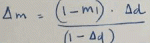
    Solve:

    equation

    Don’t worry, you have come to the right webpage and I promise this is not a treatise on mathematics. Be honest though, did you not sense a chill down your spine, when you glimpsed this algebraic equation? Even if you had been a bright student cracking such equations with aplomb, I bet you might have wondered, “Is this ever going to be useful in my real life?”

    Pressure instead of pleasure

    Most of us were fed such equations every day at school, when, all we wanted to do was to catch tadpoles. Especially when growing up in India, it was impossible for me to escape the scrutiny of teachers, parents and even neighbours when it came to scoring marks in maths exams. It was seen as the ultimate measure of one’s intelligence. I am not saying that learning maths was underwhelming nor am I questioning its purpose and application. As a matter of fact, there are many sites and blog posts illustrating the usage of such algebraic equations, trigonometry and the like.

    My argument is, we scare the kids and inflict pain on them with the way we introduce such concepts, when it could be actually so much fun for the kids to discover and learn intuitively.

    I share my recent experience – and the sheer pleasure – when I introduced the concept of algebra to my daughter, who will finish her primary school this year.

    Intuition vs techniques & short cuts

    Before getting into algebra, I wanted to ensure that her intuitive understanding of arithmetic is strong. For instance, she should be able to appreciate that the arithmetic operation of division (and thus fractions) is the same as the intuitive act of dividing a pizza and sharing the slices among us. I didn’t ask her that simple a question. I asked her this:

    Divide 50 by half.

    Did you have the number 25 flashing in your mind ? She too fell for it. Well, the answer is 100. The usual mathematical approach to explain the solution has been:

    Dividing 50  by (1/2) is the same as (50/1) x (2/1). Thus the answer is 50 x 2 = 100.

    However an intuitive way to understand this, is to use a real life example. Imagine 50 chocolate bars and consider you have to share those with a lot of children by cutting each chocolate by half. Now did 100 flash in your mind? I guess you didn’t have to strain your mind. Intuition. Which is our natural gift to learn maths (or anything) with a bit of fun.

    Understand infinity by intuition

    For instance, the concept of infinity is not easy to grasp by intuition. But let us try the same approach as above: If you slice an orange by half, you get two portions. If you slice it by one-thirds instead, you would get 3 portions. If you cut that fruit into thinner and thinner pieces (one-hundredth or even one millionth) you will be left with a large number of slices. Now attempt a thought leap to cut it into almost invisible slides (thinness=zero), you would get an infinite number of pieces.

    Thus 1/0 = ∞

    Marcus du Sautoy explains this and much more in his brilliant BBC TV series The Story of Maths. He narrates how the whole world, east and the west, have contributed to the evolution of mathematics across centuries.

    Algebra: plums, peaches, weights and the scale

    The word Algebra is derived from Arabic “al=jabr” meaning “re-union of broken parts” (source: Wikipedia). Marcus narrates how Chinese traders used an intuitive way to solve real world problems in the ancient times. One such problem is to determine the weight of a plum and a peach while they had the following situation:

    One plum and three peaches weigh 15 grams. Whereas, two plums and one peach together would weigh 10 grams. Their approach is as follows:

    The trader would place one plum and three peaches on one side of the scale, balancing with 15 grams on the other.  Now he would double on both ends of the scale by adding one more plum and three more peaches, which requires 30 grams to balance. Then he would go ahead and remove both the plums as well as one peach from the scale. Left with five peaches on one end, he would find that it takes 20 grams to balance the scale. Thus a peach would weigh 4 grams. It is then straightforward to deduct that a plum would be 3 grams in weight.

    This was a fun, intuitive way to solve a real world problem.

    Contrast this with the mechanical way of solving equations that I would have to teach her:

    Let a be the weight of a plum;

    Let b be the weight of a peach:

    Equation one:      a + 3b = 15

    Equation two:    2a +  b  = 10

    multiply equation one by 2:

    Equation three: 2a + 6b = 30

    Subtracting two from three gives us, 5b = 20, thus b = 4 and then you can use equation one to deduce a = 3

    Though this method would not torment her as such, I guess she would have little clue on what was accomplished in the end. At least with plums and peaches approach, even if she fails to solve the problem, she is only going to run away, with a healthy snack in hand!

    Maths by story tellers:

    I found Dan Meyer‘s blogs and Salman Khan‘s videos to be quite popular. They are some of the the new age gurus who have brought about a paradigm shift in the way maths is taught. When I assumed that this transformation is restricted to the US and developed countries, it was inspiring to watch the story of a math teacher in Morocco (Math in Morocco: Where Math Grows on Trees) which shows the passion with which he teaches an array of mathematical concepts by taking the children through a journey of growing olive trees in the school, measuring its produce, carrying the olives to a nearby traditional olive press powered by a camel.

    Must admit, I find myself immersed and lost in these stories a lot more than in teaching her any maths.

    We both love stories. Maths can wait!