Tag: Influences

  • Bookshelf tales – Hard landing on a Tipping point

    (This is part 2 of my Bookshelf tales. For part 1, click this link).

    All the preparations didn’t go in vain. I passed the interview and received my first job offer. With a lot of excitement, I moved to a new city to begin my career with Baan (a great company) along with three of my classmates and forty others in that batch (a great company).

    The day we landed, I noticed my friend unpacking more books than clothes from his luggage. He filled out half the wardrobe shelf with his books. Seven Habits of Highly effective People was one of the first books I borrowed from him. I remember feeling inadequate at that moment – after having ignored a friend’s dad’s advice before I left home. He was reminiscing on his bachelor days in Hyderabad many years ago and suggested that I avoid eating out and to do a lot of reading. I perhaps paid more attention to be one own’s cook than to pick up a book.

    Eventually, I began collecting (and reading) some books. I write about three of those, that provide colour and context to my first four years.

    The Goal” (…and how my trainer eliminated the job of a canteen clerk)

    “What is the goal of a company?”. Mr. Karan Rastogi, the trainer asked us as he began unravelling the concepts of Enterprise Resource Planning (ERP). Most of the answers were around producing goods that are useful to society or something in those lines. Mr. Rastogi clarified however, the main goal of any enterprise was to make money.  To be accurate, to create value – for shareholders, employees, and the society at large. It was all going over my head anyway. To make it easier for us, he narrated a story from his management consulting days.

    He was once asked by a major manufacturing company in the northern part of India to identify ways to reduce cost of operations. He learnt that all employees were provided subsidised food and tea at their canteen. A clerk was employed to manage tokens and the cash register. Initially, the workers were quite happy – being able to buy a meal for less than 50% of the cost outside. Soon there were complaints about the quality of food and the long queues in front of the billing counter. Mr. Rastogi initially performed a lot of algorithmic calculations based on Operations Management but soon came to a simple conclusion: it is best to fire the clerk and eliminate his job function, and provide free meals. The loss of revenue was more than made up by the increased employee morale (when they pay nothing, they didn’t complain even when the food was terrible).

    He suggested that we read a novel by Eliyahu M. Goldratt: The Goal, which is rated as one of the top 25 books in Business Management. Read how the central character in the book learns complex concepts like Theory of Constraints, Bottlenecks etc, from real life experiences as he resurrects his career as a struggling Shopfloor Manager. In particular, I enjoyed the part where he goes on a mountain hike with his children and their friends, as they follow each other in a sequence on the way up. Hours later, he finds the last few kids arriving much later than others – due to a fat kid in the middle who slowed down everyone behind. With the insight: “A chain is only as strong as its weakest link”, he goes back to work and fixes his production chain, thereby reducing inventory and increasing profit, thereby keeping his job and getting back with his wife.

    The Tipping Point

    As I was browsing through a book shop, I picked up this book that was at the end of the shelf and about to fall. What an odd (but appropriate) title, I thought. Tipping Point. A tip is a point after all. And the author’s last name is Gladwell. Well, I didn’t regret buying it though. It introduced me to the world of social sciences, especially how influential ideas spread virally in a social network (long before the age of Facebook). And more importantly, to non-fiction books that are as gripping as novels.

    “The Power of now”

    A bit of hard landing occurred in the first job as I struggled to deal with expectations. It was much easier to shine as a topper in a class room but not so in the real world. I also had to deal with a literal hard landing.

    One morning, I found myself flat on a hard, newly laid tar road, thrown from my Yamaha RX 135 bike as I narrowly avoided colliding with a patient exiting from an eye hospital, riding his bicycle across the road (he was still carrying some bandages in his face). I had four seconds to respond and I thought I did well not to kill him, even when he unknowingly tried his best to come straight at me with a single eye.

    In an eerie sort of coincidence, I had bought this book “Power of Now” only a couple of weeks before. While I was recovering from a surgery to my broken wrist, I thought it wouldn’t a bad idea to dip into this book about mindfulness and stuff. I couldn’t resist wondering why this happened to me. What if I had joined my friend in his bike that day. What if I had paid more attention during those four seconds. Or maybe earlier.

    A colleague tried to assuage me, “in our roads, even if you are 100% careful, you are only 50% safe.” That made me laugh while still at pain. My uncle’s friend saw me reading this book and said, “Kid, you have many years to go before you indulge in philosophy stuff. You need to do earthly things and struggle in life first.”

    That rang a bell. A year later, I was married and it was many months before I touched any book, especially philosophical ones.
  • Bookshelf tales – the first few pages

    Bookshelf tales – the first few pages

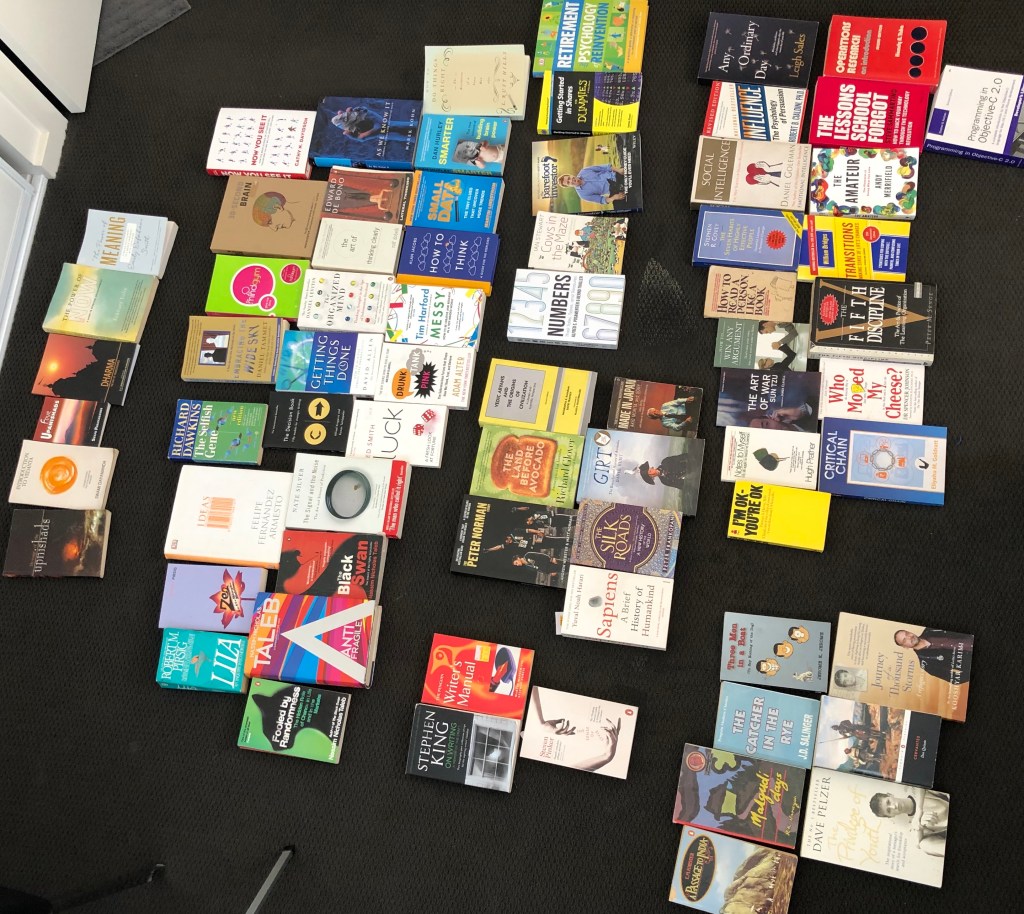
    A friend asked me if I could recommend some of the interesting books I have read over the years. I used that chance to finish an activity I had been running away from – to sort and categorise the books in my shelf. After a nice breakfast on the new year’s eve, I spread all books down on the floor. Looking over them, I wondered how I ended up with such a wide collection of bound pages containing many others’ thoughts and ideas, that I must have inhaled via tens of thousands of words over many a quiet afternoon. Some of these books were gifted to me; a few, I bought on friends’ recommendation; a lot were picked up at random, while waiting to board a train or a flight. Many of the pages are still to be read. A few, to be re-read.

    A couple of hours later, I ended up with a much cleaner bookshelf. And with a dust-triggered-repeated-sneezing-and-running-nose. Also with a mind-refresh of some hilarious but life-defining experiences associated with these books. I share some of these stories as a blog series, starting with this one.

    These books helped me once hide my insecurities and inferiority complex, pass a job interview, to converse better with strangers and to broaden my thinking. Also, to brag about stuff from time to time. More importantly, they made me = me++.

    Urgent: improve your personality. Interviews are coming!

    I look back at myself – Ramanathan of 1998. An eager but shy university student in Coimbatore, anxious about the upcoming season of job interviews. I was shaping up to be good engineering graduate alright, but I struggled to finish speaking a sentence in English – especially when standing in front of my class. We were expecting a couple of IT companies to visit our college to hire final-year graduates. They were going to test us on our math, analytical and verbal skills. They might also check if we were good at engineering. Most of us were worried about getting exposed on our (lack of) communication skills.

    As part of preparations, a bunch of enthusiastic class mates got together to organise group discussions. Candidates are seated in a group and given a topic to talk about. They are judged on what they spoke, but also the way they influenced the group’s final decision on the topic. While my smarter companions debated complex topics like Kyoto protocol, democracy, impact of foreign aid, etc. with ease, I would find myself blabbering nervously. I didn’t just struggle for words. I would often mis-pronounce even when I fished out a word for the occasion. Often, I didn’t have much to say, as I felt out of my depth on many worldly matters.

    It was clear. The “test” was not just going to be about one’s measure of arithmetic, vocabulary or ideas. It was a judgement on the whole personality. And here I was, a clumsy, slouching lean fellow who wouldn’t shave very often, bite nails when nervous. That was most of the time.

    Once I was in an activity where each one had to speak on any topic for two minutes. The group would take notes and provide feedback for improvement. I chose an easy topic: Time Management. I had made notes while I waited for my turn and when I spoke, I was able to explain the various techniques like planning, keeping a sense of time etc. They said I spoke reasonably well but were brutal in their assessment of my appearance: I was dibbling my finger, didn’t look at the audience and they also pointed out that I overshot my allotted time by three minutes as I laboured on about time management.

    My friends shared some tips and tricks, and alerted me about my annoying habits. For instance, it took a whole month of practicing to avoid retorting with “aaaah?” or “whaat?” instead of “Pardon, me?”.

    A class mate suggested that we organise a Personality Training Session for the whole class and gave me a reference of Mr. Suresh Punjabi, an expert who (even this day) conducts trainings for students in Coimbatore. We decided to try this first on our second year juniors. I got permission from our shy and equally nervous professor – he possessed enough weirdness to qualify as typical nutty-professor (would write a separate blog series on him one day). When Mr. Punjabi arrived at our college, I observed that he didn’t wear a turban. I also observed my professor being more eager to introduce him to our newly joined Principal. I wasn’t sure. I had not met this new principal yet and was pretty sure that would be the case with my professor too.

    Soon, we both welcomed our guest and ushered him into our principal’s room. The four of us were standing but no one said anything for a good five minutes, each waiting for some one else to break the silence. I assumed the principal waited for either me or the professor to tell him who the stranger is. Mr. Punjabi looked at me. I was looking at my professor who appeared shy, nervous and embarrassed at the sudden attention that he created for himself. With a quiet voice, still facing down, he threw these words towards the principal, pointing his finger roughly towards a direction between me and our esteemed guest. “Sir, please meet Mr. Suresh Punjabi”. The principal looked at me and shook my hand, “Thanks for coming, Mr. Punjabi”.

    Eventually, when we let him begin his session in the classroom, Mr. Punjabi took us through some of the basics of communication, appearance, manners and stuff. He also emphasised on learning how to wear a tie. Conversing with him on the way back, I felt more assured about myself. I vowed to never let the principal-room-situation occur again: to never be that invisible. To never stand there just blinking and being tentative.

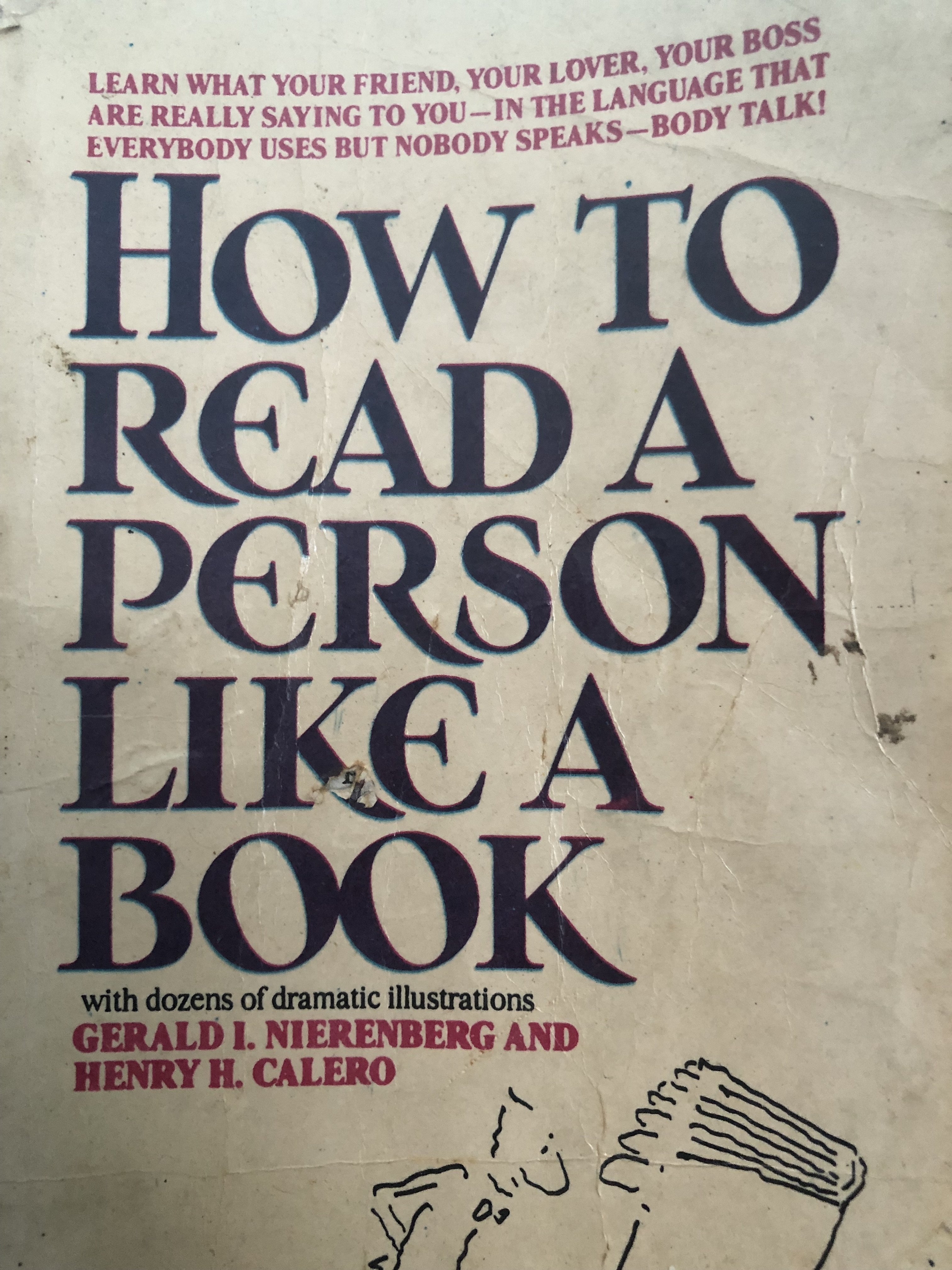
    Around the same time, I found an interesting book in my father’s bookshelf that usually had a collection of Dale Carnegie’s books and old copies of Readers Digest. How to Read a Person like a Book, was all about non verbal communication, body language – and the mastery of it. It had all the answers for me.

    img_1447

    Twenty years on, I still preserve this book. Yeah, the pages are rugged but the lessons are fresh, and still being learnt. Few years ago, when I switched roles from being in product development, to more of customer-facing project management, I paid the price for forgetting some of these lessons.

    While at a customer site, representing a group of engineers, I was annoyed by the customer who mistook my colleague as the project lead, talking to him most of the time, while I was left to wait for emails. It took a while to figure out: my colleague would always present himself in a suit and a tie, while I would often land in a semi-formal attire with a casual demeanour. That was a game-changer moment for me.

    But in 1998, this book enabled me to punch above my weight.

    When my class mates arranged for another round of preparatory group discussion, I felt I would fare better. Partly because the topic sounded easier, Also, by then, I had avoided keeping my hands nervously in my pocket when speaking; I no longer feared making eye-contact with class mates and didn’t bother if they faced me with a smirk. I slowly began opening up.

    I remember the feedback from the class mate – the designated judge that day. “Your gestures were awesome. You listened very well, often nodding your head positively, encouraging your opponents to speak. You didn’t interrupt anyone but, you didn’t say anything till the end”.

  • How to survive a meeting

    When I started working (I mean, working as opposed to the many months of training sessions) in my first job, I noticed people in the team spending a lot of time inside meeting rooms than at their desks. The work assigned to me involved coding a piece of software – at least that’s what I thought; soon it became clear to me that without talking to the seniors and colleagues i cannot get anything done. Not that it was unexpected but it astounded me that i spent more time writing emails and talking than coding. Worse was when i struggled to obtain availability of meeting rooms and subject matter experts. Thus it was evident that communication skills were as relevant as computer skills, especially when one tries to share ideas and seek improvements to make a collective decision.

    I should have seen that coming. It was during the final years of college as we were preparing for job interviews that I encountered this construct called Group Discussion.

    We had to debate on a topic and you are judged on how well you make your point. We were given the controversial one: to agree on the most effective form of government (in the subcontinent): democracy or dictatorship. I was still struggling to put my views across, mainly in English and was intimidated by the bunch of guys who waxed eloquence on the principles of democracy, while being struck by the plain and simple logic evoked by the other group who championed dictatorship. I was still waiting for my friend to open his mouth yet – I knew him as a sharp and fierce communicator – when I was prodded to speak. I kept fumbling along and made a mess of the only speaking opportunity. I was in a 50-50 mode mentally, but could not express that at all.

    Formally, a meeting is defined as a situation when two or more people meet, by chance or arrangement. Effective interactions and collaboration among workers are the building blocks of successful organisations. The power of collective human consciousness is unparalleled. It is quite important to structure such gatherings since otherwise, they quickly degenerate into a platform for egoistical arguments and cacophony.

    There are many simple rules for running meetings which I think are not so simple. There are companies that take it very seriously. Last week, i read about Jeff Bezos’ rules of running any meeting at Amazon, which included no power point presentations apart from insisting everyone to silently read memos for the first half of the meeting. That reminded me of a suggestion I made to my team many years ago. I was still a rookie but I had the gumption to strongly recommend that the entire team be forbidden from talking to each other for the first three ‘silent’ hours in the morning. I was not the most popular person in the team.

    While I m not criticising the very purpose of social interactions in a corporate environment as such, I want to draw your attention to the fact that a typical knowledge worker in this age has less time for him/herself. More than 70% of my work time gets spent on meetings. They come in various terms and forms: discussion, idea generation, design thinking, status update, issue tracking, planning, synch up, stand up, get together, morning prayers, kitchen cabinets and what not. I read this somewhere: “a meeting is a chance for people to share their own confusion with a broader audience, contributing to the collective chaos.”

    How to survive such meetings? How to conduct one? Enumeration can come to the rescue. When you make a simple list of items to be addressed and stick to that, you can at least complete the meeting if not solve world hunger. The real challenge is to come up with such a list.

     I remember a particular issue-tracking meeting that occurred during a critical phase of the project. My manager asked the team about the progress of resolving defects which were pending for weeks. “We have made very good progress in the last two weeks; many of the issues are resolved; some of the remaining ones are being corrected; most of the corrected issues will be tested by tomorrow”. It took a whole thirty minutes for the boss to determine the list of issues in the first place.

     Can we try to be more objective and mainly focus on data, facts and actions, while ignoring the emotions involved? At your peril. You see, meetings are also occasions where people vent out their frustrations, and real human connect occurs only when you let others express themselves. My own inadequacies in the listening front is well documented in my previous blogs. Having said that, I believe it is cruel to let someone go on in their line of argument when everyone realises it is a rabbit hole, especially with the time constraints we live with.

    Ideally, a meeting is just a means to an end. An end outcome that moves the team forward. Actions are assigned and a direction emerges. In reality though, meetings need not always be so serious and I will run out of space writing about many funny episodes. For instance, I have seen people rushing to point at others as action owners, often at those who were absent.

    But many a meeting occurs in a hostile/political environment where unwritten rules manifest and items not in the agenda dominate the proceedings. In such situations, a significant amount of time is spent post-meeting to minute the discussions and document actions which gives an opportunity for the host to shape the outcome of the meeting even as he was unable to influence it while it occurred.

     Though one should not treat a meeting like a war zone, it is fascinating to see people trying to have the last word. But usually the ones who are able to listen to differing view points, forge relationships and offer creative alternatives emerge as real change makers. They make everyone think and realise it was worthwhile spending time away from their desks.

     My college friend demonstrated that many years ago, when finally his turn arrived during the group discussion. As the crowd was already dissected into democracy advocates and dictatorship worshippers, our man got this to say. “I think we should try democratically electing a dictator”.

  • How to spot your friendly neighbourhood Mentor

    “Who is a Mentor?”, asked the trainer from The Smith Family – a charity organization that helps children from struggling background – as part of a corporate program I recently signed up to. I realised I had been too self-centred and decided it was high time I did something more than work, at work. If selected, I would be a mentor for a couple of school terms, spending an hour a week doing Q&A with students.

    Indian culture has had a word for this: Guru, which is loosely translated to the term Teacher. But a mentor is not just a teacher; a role model, a guide who helps us navigate this complex world. Co-traveller sounds more apt to me, since no one knows everything for sure. We just need to help each other out with what we learn along the way.

    I ended up answering her, “A mentor is someone who acts as a good reference point for others to emulate and learn”.

    I came away feeling nostalgic, reflecting on my own reference points during the growing up years. Would start with my parents who lived their ideals, working hard and keeping it simple. While I remember my mom helping me and my sister with homework during the primary school years, my father was instrumental in me venturing beyond regular academic stuff. He enrolled me for karate and Hindi lessons and later when I finished high school, he put me onto a personality development workshop conducted by an inter-religious organisation. Those were unheard of in the 1990s in a city like Coimbatore.

    I also remember being tutored by members of our large extended family when I was much younger. The many uncles and aunts who lived close by, the cousins who were in high school already were more helpful than my teachers at school, as I struggled with the spelling of King Dhritarashtra, perplexed with English grammar, confused by negative numbers, mugging up the definition of the species spirogyra. One of the summer vacation trips turned out to be an academic tour, with my cousin tasked with helping me pass an upcoming Hindi exam. And later when I was appearing complacent in my first job, my cousin brother alerted me about the Java wave that swept the IT world. I still remember trying to copy his elegant way of presenting himself for work, especially those blue stripped formal shirts.

    Neighbours turned out to be excellent teachers. Not the ones next to our house who were the quarrelling type. Im talking about the passionate Maths Vaathiyaar, who also taught Chemistry as a private tutor when he was not working for the government. He was more a family friend than a teacher; he was the one who instilled pride and confidence in my work. He also helped me score a 100 in Math and Chemistry. In fact my aspiration to get into a premier engineering institute was fuelled and fostered by such neighbours – and dad’s colleague’s son who was already studying there.

    Friends and colleagues teach a lot by not teaching. I owe my English speaking skills to a bunch of mates – one of them a neighbour too, whose terrace was our joint. Another friend’s friend even offered his house for more preparations as we pruned our linguistic skills for the job interview. Later, I got inspired to take reading as a serious hobby from my room mate who famously brought more bags of books than clothes to live in a new city as we started our careers together.

    We spend a third of our life time at work and thus it is important to recognise the formal and unconscious learning and positive influences we receive from colleagues, subordinates and bosses. I have learnt as much from people who I managed as from the many seniors I worked for.

    It is a tough mental exercise to list all my mentors in one go. I feel I have missed mentioning many more reference points. Our journey is shaped by the many masters we may never fully acknowledge. The true way to repay (Guru Dakshana) though, is for us to walk the path along these points, live a good life.

    Reminds me of a quote attributed to Dalai Lama: The Buddha says, “I am a finger pointing to the moon. Don’t look at me; look at the moon.”