Tag: day dream

  • To carry an oil lamp to buy a trash bin

    The task was simple that evening, many years ago. We were four classmates beginning a new chapter in our lives: out of home, first job, new city, new apartment and the world to conquer. Two of us had to go get a trash bin for the house. The shop wasn’t far away and I wouldn’t complain anyway since this guy is quite a talker. He can explain the planets and cosmos while in the same breath turn philosophical or venture into the weird ways of the human mind. He once asked me, “think, what if you vanish one day and no one in this world remebered you”. We start walking the 300 metres to the bazaar. We see a small temple on the side of the road and he beings to wonder why religions exist in this world. I try to tell him we better hurry up before it rains.

    The small road leads to the bigger road at the intersection. We only had to cross the signal to get to the home furnishing shop. But then we see this new music shop crop up on our left and we walk right into it. This guy had introduced the western pop genre to me. And as someone used to listening mainly south Indian film music, the name savage garden sounded more like a filthy place full of violent beasts than a music album (until I fell in love with the animal song). With a couple of new music cassettes (it was 1999; CDs will come much later) as we started walking back home, we both realized our folly. We started telling each other how stupid it felt to be forgetful and wandering away from the simplest task of buying a waste bin . We discussed the root causes while at the same time began fearing the ridicule from the other two waiting for us.

    Why do we forget things and miss out on simple tasks or goals? Are we not serious enough? I am not even talking about life changing goals. Simple tasks that doesn’t need much thinking or planning. The office receptionist was laughing at me the other day, while making alternative arrangements as I had lost my id card and car park access card on consecutive days. I still don’t know where I kept them but I do recollect the thought stream in which I was drowned in during those days.

    Life as a tourist:

    Nassim Taleb has popularised the french word flâneur which loosely means wandering, idling or being explorative. It describes a tourist (who does not have a fixed itinerary) as opposed to a tour guide (who has mapped out a plan). Taleb explains the need to have a variety of options in life, career etc., so that you can take decisions opportunistically at every step, revising schedules or changing destinations. In the words of Yogi Berra “if you don’t know where you are going, you will end up somewhere else.” What if “somewhere else” turns to be more interesting and lucky?

    I feel strange when people talk about a one-year goal, three-year vision, five-year target etc. I never thought I would be in an IT job even a year before joining my first job when I was only worried about getting good grades in the electronics degree. You have no clue where you going most of the time but you usually have some sense of direction. I used to be quite stressed out about not being able to control the outcomes and worry about slipping away from the “plan”. These days, I only keep a view on the high level goals and leave the steps to its own dynamics.

    It feels like freedom as I go unstructured and unplanned once in a while, loosing myself into the world of new information, people, random corridor conversations, unexpected outcomes etc. It is OK since it feels more human and real. There is a parable about a guru teaching his disciple about methods of focussing the mind. He hands him a lamp brimming with oil that could spill if shaken even a tiny bit, and instructs him to walk around the temple. When the student succeeds at the daunting task, the guru asks him if he had a chance to marvel at the scenery: chirping of the birds in the tree, the smell of fresh flowers in the pond or the aesthetics of the temple. The student blinks as the guru points out the ultimate skill: the need to experience the world around as we focus on the task at hand.

    But 19 years ago, as my friend and I were walking on a road to buy a trash bin, we didn’t have to carry an oil lamp. As we were talking, we soaked-in the sights, smells and the sounds and lost ourselves in them. The trash bin remained in the shop.

    The other two roomies couldn’t control their laughter as we narrated our yet another failure to “get things done”. We told them how much we had been cursing at ourselves for being so absent-minded. Until when one of them wondered out loud, “when you guys started self-pitying, why didn’t it occur to you to just turn around, cross the road and walk into that bin shop?”

    Please visit the Home Page to read my other blogs…
  • How to get ready and miss a flight

    How to get ready and miss a flight

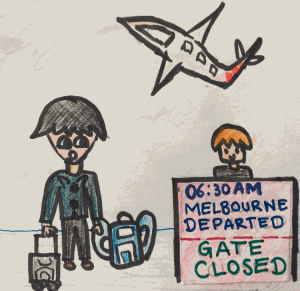
    “Get up and get ready! Don’t you have a flight to catch ?”, yelled my morning alarm at 4:00 am. I say, Snooze. But hey, you can’t snooze your wife, can you ?

    All I had to do that day, was to reach Melbourne (from Canberra, where I live) in time for the workshop. The hour long flight departs at 6:30, which gives enough time some breakfast before the 9:30 am start. And if you know a bit about Canberra and its airport, you would know, you cannot miss your flight. Unless you start too late. There are no usual challenges like in other cities: bad traffic, long queues in the airport, etc. You find more staff in the airport than the travellers. And if there is no check-in luggage, it is sufficient to reach 30 minutes prior to the departure. (it takes just 15 from my place in the taxi).

    I was ready at 5, called a taxi at 5:45. And I missed the flight. For the first time in my life.

    Why didn’t I leave early? What was i doing (watching TV!). I never missed a deadline when I was in a rush. But this time it was different: I was ready well ahead of time but took it easy and kept pushing forward the task of calling the taxi.

    Under-estimation. Over-confidence. Sheer laziness. Lack of common sense. Un-professional. I cursed myself for basically, being dumb.

    It dawned upon me that this not the only occasion where I was late or being in a terrible rush. I had always been fascinated by the Just-in-time technique that was introduced to us as part of the training at my first job. However, I had been overlooking the effects of the ensuing uncertainty when you live on the edge. Joining a meeting on the dot, dropping off the kid at school gate just before the bell rings, completing my tasks at work in a hurry etc.

    But then, I have been reasonably successful at education and career. Having said that, all through my school and university days, I recalled, I never managed to stick to a schedule. Last minute revisions, late night push to cover more units before the exams, were typical. The nervous energy and the adrenaline rush contributed as much to my results as the preparation itself. Which begs the question: how did I survive when I had been so un-organized ?

    I procrastinate. Though it sounds better than saying I postpone things, it basically “is the avoidance of doing a task” (Wikipedia “pro”: forward; “cras”: tomorrow). Researching further, I was lead into a world of interesting people. Found this list of famous and highly successful procrastinators: The Dalai Lama, Victor Hugo, Leonardo da Vinci among others. Da Vinci in particular “had the reputation as a daydreamer who never actually finished anything”. His most famous work Monalisa took 16 years in the making. When he died, he was heard appealing to God, “Tell me if anything ever was done”.

    I didn’t have to paint Monalisa, though. Just had to perform well in the exams, pass an interview, get a job and complete my work assignments. I did day-dream (Google came about when my career started) and laze around while still getting the job done. Boy, it was always stressful trying to finish when you start so late!

    Further exploration on this subject lead to some bizarre stuff. Stanford Professor John Perry has written a whole book about this embarrassing behavior and ended up being awarded the Ig Nobel prize. I say, anyone who set the title of his book as “Art of Procrastination : A Guide to Effective Dawdling, Lollygagging, and Postponing, Including an Ingenious Program for Getting Things Done by Putting Them Off” deserves an award.

    He basically suggests to make a list of tasks that you have to do and keep that “Important” task aside. This suddenly eases the mind but he asks us to do any of the other tasks from the list. A nice trick to actually do things when we are busy procrastinating. He explains, “With this sort of appropriate task structure, the procrastinator becomes a useful citizen” and “an effective human being.” I like that.

    It makes sense. When we continue to avoid doing something we planned, perhaps it is worth listening to our instincts and question the purpose, motivation and relevance of that task. When we actually want to do something, we never delay.

    I chanced through this funny TED talk by Tim Urban “Inside the mind of a master procrastinator”, where he espouses the idea that we often fall for visible deadlines as the most important things in our life. While we completely overlook (he calls it long-term procrastination) “all kinds of important things outside of your career that don’t involve any deadlines, like seeing your family or exercising and taking care of your health, working on your relationship” etc.

    I eventually reached Melbourne with the next flight, missing the first session of the workshop and the breakfast. But I felt well-nourished that day.