Category: Uncategorized

  • Sound situations at work

    The soundscape at my work is made up of talking and music. I have to communicate a lot – talking in particular. My job as a bridge person between sales and delivery, only accentuates that. Apart from meetings and discussions in the office, I dial into many conference calls with people I may not have met, holding animated and robust conversations.

    I also like listening to music, as I (used to) write code and (now) crunch numbers. In fact, I’m listening to Zen meditation music as I write this blog. Music (and random noise?) has also played a part in me getting in and out of certain tricky situations at work.

    My team member once forgot to switch his personal phone into silent mode before a conference call with our stakeholder from another country. He was already stressed out, being in the spotlight with most number of defects found in his code. Exactly at the moment he was asked, “Can you please present the root cause analysis?”, his phone rattled with an unusual ring tone – of a film song prefixed with a dialogue: “Start music!”. This became a case of lost-in-translation since the guy at the other end had no clue about the interrupting phone call and had assumed he was being yelled at!

    I’m sure you have had to request – during conference calls – someone to go on mute when they inadvertently add an echo or an irritating background noise. I sometimes wonder if people dial into calls while binge-watching Netflix :). I too was a culprit on an occasion. No, I wasn’t enjoying a movie. Working from home that day, I forgot to mute myself as I got into an important call hosted by our vice president. I was standing on my balcony facing my neighbour’s house being renovated. The clattering noise of metal agonized the leader on the other end. At one point, he gave up and said, “Someone please mute. I hope this is not the sound of our customers hammering us”.

    It’s not just my phone that I want to mute. Mostly, I struggle to listen during conversations, often interrupting with my own ideas and arguments. While I don’t want to offer any excuses, my role does require me to act as a catalyst and perform a certain level of moderation. I could do better for sure.

    I recently learnt about the communication tactic of using pauses in a business discussion, from this BBC article  the subtle power of uncomfortable silences. In a negotiation, such “a pause between someone speaking and your response can be a surprisingly power tool”. It talks about how silences are valued differently based on cultural contexts, for instance, how the “Chinese negotiators are very, very aware that Americans like to fill silences” with something and “possibly make concessions without the Chinese having to do anything”. And how it can help us “get beyond the emotional response and to start thinking cognitively”.

    I also liked a Business Insider article describing how Steve Jobs used an 8 second pause while he responded to an insulting question about his strategy, with a deep and empathetic response.

    I figured, calming music is all fine but it is still a distraction. Silence and stillness is what I yearn. I remember being introduced to meditation as a child but I failed to attain any level of focus or calmness. I should try again, more sincerely.

    Perhaps I should start with depriving myself of any sound. The other day, I was tempted to buy the noise-cancelling headphone offered at a good discount. It was still expensive, so I gave up that thought of buying. Not before trying it out though. And I realized, even the $499 Bose equipment would only come close to – without actually delivering what I was hoping to attain in those few seconds. Absolute silence.

    Maybe sleep would deliver it. As I finish writing this blog, I look forward to some sound sleep.

    Only to be woken by an alarm.

  • Hi, who are you ?

    Embarrassing.  It felt worse than what this word suggests. He was not a friend – merely an acquaintance,  but we used to travel to school together, waiting endlessly for the bus to arrive, jumping into it even before it came to a halt, rushing to grab the best seat. But at that time when he spotted me in the same bus, it had been three years after school and we were going to different colleges and never had a chance to catch up.

    His name ? I just couldn’t get it.

    He caught me blinking even as he excitedly shook my hands and enquired about the new phase of my life. I still managed to have a full thirty minute conversation without having to refer to his name. That was until when my new friend turned up and I had to introduce the strangers to each other. “Meet my school mate, ummmm…”.

    Oops.

    Eventually, I discovered my erstwhile fellow bus traveller as Gopi – the name I struggled to fetch and the one he had to announce it himself. It was awkward. Yeah, that’s the word.

    I have good memory. Anyone who has passed their exams from an Indian University during the 90’s would be never found wanting on that aspect. But I have always struggled to remember names of people. I have tried various techniques – to picture film stars of similar names, or to understand its meaning and co-relate to their personality etc. It all went for a toss, when I began networking at the work place, meeting so many people from different cultures and countries. Add to that, the challenges in pronouncing them correctly.

    Turns out, that are some good reasons why this happens. An article from the Daily Mail explains why the brain struggles to retain a name – a random information with little connection or correlation to the person. One of the reasons it says is that we may not be so interested in the person and hence the brain would hardly make an attempt. I wonder if it is also due to the enormous amount of data feed that goes into us every day.

    I saw an old interview of the veteran Tamil film actor, late Poornam Viswanathan who was once a news reader with All India Radio. He recalled his broadcasting days – he had the great privilege in announcing India’s independence in his Tamil bulletin. At 5:30 am on the morning of August 15, 1947, swelling with pride, he had begun, “All India Radio…seithigal vaasippathu (news read by) ……….”. He forgot his name! After a few excruciating seconds, he recovered from the brain fade and went on to declare his name followed by the most important news that he ever presented.

    These days, I employ this trick which works well in some occasions: I ask for their last name, appearing to store their contact details in my phone book. Most of them go on to say their full name. Even when they don’t, its OK since that’s more than half of the information.

    Recently, when I spotted an ex-colleague at the far-end table of a restaurant, I used linkedin profile search to confirm my guess, before walking up to greet him by his name. It worked.

    But he was still struggling to recognize me at all.

  • Grand lessons from a simple life

    Grand lessons from a simple life

    When the lady from the neighbourhood came to our home to formally invite us for her son’s wedding, my grandmother was very gracious as a host. At her late sixties then, she had been quite popular in the housing unit – of close to five hundred houses – by being a friendly, helpful, wise old being. On that occasion though, she surprised the lady who believed my grandma was her best friend, by declining to attend the event citing a reason that was too difficult for her to digest. “At this age, I have decided to attend only important events. The other issue is, you see, the weekly water supply occurs at the time of the wedding”.  It was embarrassing for me since the lady’s second son was my play mate.

    I never had to read any other book to learn the art of saying No.

    My grandma always chose to speak her mind even at the risk of appearing rude. Once, being tired of listening to a young mother lamenting about the fact that her child wouldn’t eat properly, she quipped “Don’t worry. The child will start eating more as you start preparing tasty food everyday”.

    She did have a peculiar sense of humour. For instance, when I proudly announced to her about my first car, her sarcasm left me stumped.

    But she had a tough life. She was the last child in a rich family of jewellers in Ernakulam and when she married my grandfather – who ran a restaurant – she was just a teenager. She faced one of her first challenges when the restaurant had to be closed down and they had to migrate to Coimbatore, in the adjacent state of Tamil Nadu. Reduced to a lower-middle-class life and faced with new language, culture and people, she dealt with life very well. She raised her four children instilling values of discipline, hard work and mental toughness. My grandfather gave her good company, until he passed away due to heart ailment and she was still in her fifties. And we the thirteen grandchildren filled up the space.

    And, about my car, she had this to say: “I’m happy for you. But even if you tell me you bought an aeroplane, I won’t be excited. I have seen it all”.

    Cricket and Cinema

    My primary school was situated just a few yards from the local cinema. There have been many days when my sister and I would return home to see her getting ready for the evening show. The next thing we knew, we were ushered into the movie hall, left to watch a boring family feud unfold for three hours. She was clever to attract us with a bait of the triangle-shaped vegetable samosa, served before and during the film interval.

    And boy, did she love cricket! She would happily collude with me in bunking school to watch a game of cricket in our black-and-white TV. Whenever the commentary was in Hindi – a language she wouldn’t understand – she would quickly mute the TV, switch on the local radio to match the visuals with the narration in Tamil. Together we have watched Sunil Gavaskar retire, Sachin get his first hundred and Dhoni lift the world cup. And every single India-Pakistan match.

    I always picture her when I reel under uncertainty or the fear of the unknown. When she was close to seventy, she suddenly decided to visit her niece in Bombay – 1200 Kms away and did not wait for my father who offered to apply leave and take her on the two day long train journey. She was happy to join my cousin who happened to travel around the same time. She then made a 2000 km train trip across the country to the east, to meet her cousin in Calcutta – all by herself and with no clue of the lingua franca. When she eventually returned home she had completed a big triangle, but she was unfazed.

    She travelled a lot more. And while I could not join her in those trips, I feel blessed to have been a part of her journey.

    Couple of weeks ago, my grandmother aged 91, passed away peacefully in her bed, having lived a complete life. All through, she kept it simple: spoke her mind, never skipped a meal, washed her clothes by hand, walked to the temple in the mornings, watched a movie/TV for a few hours and befriended tons of people.

    She was born rich, lost it all, got most of it back, maybe more – but never felt poor.

  • Honest, almost.

    Honest, almost.

    “You could have told me he was younger. I wouldn’t have known the difference!”. The ticket seller at the carousel tells the father of a boy who has just crossed the free-ticket-age-limit of 5 years, while giving away two tickets. The father who had the choice of buying just one, is seen replying with a lot of pride, pointing at the boy “But, he would have known”. Honesty is not the only principle highlighted in this UOB Private Bank ad.

    Most of us would have lied as children. “Did you share the other chocolate with your brother?”. The usual reply, “oh yes” from the child is never taken at face value. In fact, the face reveals it all.

    However we don’t fear this as an act of dishonesty. The child is expected to grow up to be a mature adult, groomed to behave appropriately in a social context. Well, almost.

    I am not feeling proud as i share a couple of episodes of dishonesty from my own life. I must have been 8 years old when one day, the class teacher was narrating a story, while all of us where seated around her. I had this habit of rapidly scrolling through the pages of the book, making this sound effect which was quite addictive. Interrupted by the annoying noise, the teacher looked in its direction and when she could not spot the culprit (I was too quick in taking my hands off the book to get caught), asked us to come forward and admit it. I don’t lie and I’m a good student of moral science and all that, but on that occasion I was too afraid of losing my reputation. My neighbour who was a friend until this incident happened, was punished. But it was me who felt the shame.

    Turns out, I didn’t do much better as a teenager. I was caught dozing off in the class, not by the teacher but by a fellow student, who could not stop laughing at the way my head was dancing in the air. I remember waking up to the utterance of my name – the poor chap attempted to explain his way out of trouble by naming me. Not very successful though, since by then I had become alert and put up an act of a bright student fully engrossed in the pages of the book. Once again, my reputation as a good student was instrumental in saving me from the outside and shaming me inside.

    The opposite is true as well. The fear of losing reputation can make people more honest.

    Honesty Box

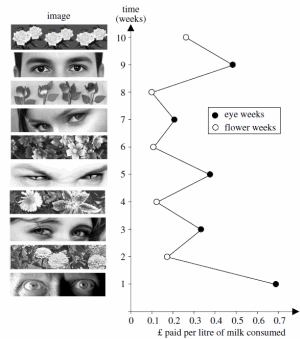
    When the students in a UK university coffee room saw a “voluntary” collection box as they got their coffee and tea, little did they know that they were guinea pigs of a psychology experiment! It was actually a “Honesty” box – meant to test how many of them paid for their drinks. The box was not the main tool in that experiment – there was this poster placed on the cupboard door above, which is right at the face of the person. Pictures of flowers were used as a poster for a week, but when it was replaced with a close up shot of menacing eyes, the collections increased dramatically. “People paid nearly three times as much for their drinks when eyes were displayed rather than” the flower image, writes Melissa Bateson in this study. See below, the results of the collection across weeks as the pictures were altered to mild mannered eyes in subsequent weeks! Though no one was watching (no CCTV cameras!), “the images exerted an automatic and unconscious effect on the participants’ perception that they were being watched”.

    honestybox

    The study concludes that the concerns of about reputation is a crucial factor when people decide to be honest.

    Many little cheaters

    We hit a threshold level for dishonesty which is not just influenced by our fear of losing reputation but also by our internal sense of integrity. This is the highlight of experiments on morality as described by the psychologist Dan Ariely in his famous book The Honest Truth about Dishonesty. Watch this TED talk if you are too busy to read the book.

    Participants were asked to write a math test and were allowed to verify the answers by themselves. They had to self-declare the results to the test conductor and were even encouraged to dispose the answer sheet in a paper shredder. Even when they had a good chance to cheat, only a small percentage of participants had stated they got all correct – the big cheaters. A vast majority of the participants indicated their answer count to be (only) slightly above their actual score (you see, the organizers knew the actual results; paper-shredding thing was just a trick). Even when the reward for the score was greatly increased, cheating levels of this large group of “little cheaters” did not increase much.

    Finally some facts: I have never cheated in my exams; I have paid all my taxes and have been (brutally) honest with my family, friends and my colleagues. My moral code has been mostly intact.

    But as I reflected on the ad, picturing the kid’s eyes light up with awe as he looks at his father, it dawned upon me that it is a blessing to be someone who is looked up, followed and watched, since we have a huge stake to lose by being dishonest.

  • None of the above

    None of the above

    The two hours around dinner time during the weekend are easily the most agonizing times for me, as we sit in front of the TV to find a good movie to watch as a family. The labor of sifting through the films across many genres, considering the preferences of the three of us – me, the missus and the pre-teen – is daunting in itself. And then to choose the movie of the week is a responsibility I don’t get excited about.

    Choice. The act of choosing between two or more possibilities. Sold to us as the boon of the civilized world. The word cleverly used to disguise as a gift before one realizes the burden accompanying it. When we exercise a choice, we invariably make a statement about ourselves.

    You think I’m complicating things here. Fair enough. I even dread at the prospect of having to choose a “good” curry off the dinner menu for my colleagues.

    This happened many years ago and I am giggling as I write this: When food was served at our dinner table, a colleague who arrived late spotted a dish with an unusual aroma and wondered out loud, “who the hell ordered this dish!?”. The awkward silence that ensued was broken by our new manager’s reply, “I did. Is there a problem?”. He was obviously worried about the popularity of his choice. Four more awkward seconds. “Great choice! Looks exciting”, was my colleague’s attempt to avoid the embarrassment. He thought he salvaged the situation until when our manager asked, “Cool, shall I order one more?”.

    A similar incident occurred at work but it was not funny. My team toiled for months, working closely with the client team, going through multiple iterations of the visual screen design. The client team was tasked by their project sponsor to replace their legacy system with a state-of-the-art IT system. However during the final presentation, the sponsor was seen grappling with the dilemma: while the prototype looked exactly like what he asked for, he simply did not like it. The whole exercise had to be repeated. The team was disappointed but we took solace in these words from the book Are your lights on ?, “In spite of appearances, people seldom know what they want until you give what they ask for.”

    Is it easier when you have to choose something for yourself ?

    Not necessarily. Since a lot of mental energy and resources are required to make a choice, you have to be very clear about the context, even if it is as straightforward as deciding to donate your organ. This is due to the Default Effect as they refer it in psychology. For instance, “in countries such as Austria, laws make organ donation the default option at the time of death, and so people must explicitly “opt out” of organ donation. In these so-called opt-out countries, more than 90% of people donate their organs. Yet in countries such as U.S. and Germany, people must explicitly “opt in” if they want to donate their organs when they die. In these opt-in countries, fewer than 15% of people donate their organs at death.”, as described in this Stanford University paper.

    This is leveraged in many domains especially in user interface design of apps. You will always find a default choice say, “Save” or a “Pay” button instead of “Cancel”. The other obvious example is the social media. You are constantly fed information tailored to you, to effectively keep you in your bubble.

    Then how can we be really free to make the right choices in our lives ? A couple of mind hacks could help. One of them is based on the Via negativa approach, extended further in his book Anti-fragile, by the maverick thinker Nassim Nicholas Taleb. He advises us to figure out what to subtract from our life. Debt, tobacco, bad company are obvious examples. It gets interesting when he quotes Steve Jobs of being “proud of the things we haven’t done as the things I have done. Innovation is saying no to 1,000 things”. He then illustrates the “less is more” approach for dealing with life’s more important but difficult decisions (diet, investments, career choices etc.).

    The other technique is to stay still and resist exercising any of the options presented to us. I’m not advocating any form of Zen thinking here. What if status-quo is a better option? For instance, during penalty shootouts, soccer goalkeepers usually either jump to their left or the right but never stand still. However, a 2007 study of “286 penalty kicks in top leagues and championships worldwide” indicates “the optimal strategy for goalkeepers is to stay in the goal’s centre”! This is called the Action Bias which explains why people prefer to do something even if it is counter-productive, as opposed to doing nothing. They do not want to be ridiculed for failing to act.

    The movie was awesome. My wife liked the drama, the kid liked the sports bit and I got the necessary inspiration for the upcoming week. Rudy turned out to be a perfect choice in the end!

  • Algebra for the faint hearted

    Solve:

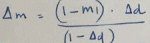
    equation

    Don’t worry, you have come to the right webpage and I promise this is not a treatise on mathematics. Be honest though, did you not sense a chill down your spine, when you glimpsed this algebraic equation? Even if you had been a bright student cracking such equations with aplomb, I bet you might have wondered, “Is this ever going to be useful in my real life?”

    Pressure instead of pleasure

    Most of us were fed such equations every day at school, when, all we wanted to do was to catch tadpoles. Especially when growing up in India, it was impossible for me to escape the scrutiny of teachers, parents and even neighbours when it came to scoring marks in maths exams. It was seen as the ultimate measure of one’s intelligence. I am not saying that learning maths was underwhelming nor am I questioning its purpose and application. As a matter of fact, there are many sites and blog posts illustrating the usage of such algebraic equations, trigonometry and the like.

    My argument is, we scare the kids and inflict pain on them with the way we introduce such concepts, when it could be actually so much fun for the kids to discover and learn intuitively.

    I share my recent experience – and the sheer pleasure – when I introduced the concept of algebra to my daughter, who will finish her primary school this year.

    Intuition vs techniques & short cuts

    Before getting into algebra, I wanted to ensure that her intuitive understanding of arithmetic is strong. For instance, she should be able to appreciate that the arithmetic operation of division (and thus fractions) is the same as the intuitive act of dividing a pizza and sharing the slices among us. I didn’t ask her that simple a question. I asked her this:

    Divide 50 by half.

    Did you have the number 25 flashing in your mind ? She too fell for it. Well, the answer is 100. The usual mathematical approach to explain the solution has been:

    Dividing 50  by (1/2) is the same as (50/1) x (2/1). Thus the answer is 50 x 2 = 100.

    However an intuitive way to understand this, is to use a real life example. Imagine 50 chocolate bars and consider you have to share those with a lot of children by cutting each chocolate by half. Now did 100 flash in your mind? I guess you didn’t have to strain your mind. Intuition. Which is our natural gift to learn maths (or anything) with a bit of fun.

    Understand infinity by intuition

    For instance, the concept of infinity is not easy to grasp by intuition. But let us try the same approach as above: If you slice an orange by half, you get two portions. If you slice it by one-thirds instead, you would get 3 portions. If you cut that fruit into thinner and thinner pieces (one-hundredth or even one millionth) you will be left with a large number of slices. Now attempt a thought leap to cut it into almost invisible slides (thinness=zero), you would get an infinite number of pieces.

    Thus 1/0 = ∞

    Marcus du Sautoy explains this and much more in his brilliant BBC TV series The Story of Maths. He narrates how the whole world, east and the west, have contributed to the evolution of mathematics across centuries.

    Algebra: plums, peaches, weights and the scale

    The word Algebra is derived from Arabic “al=jabr” meaning “re-union of broken parts” (source: Wikipedia). Marcus narrates how Chinese traders used an intuitive way to solve real world problems in the ancient times. One such problem is to determine the weight of a plum and a peach while they had the following situation:

    One plum and three peaches weigh 15 grams. Whereas, two plums and one peach together would weigh 10 grams. Their approach is as follows:

    The trader would place one plum and three peaches on one side of the scale, balancing with 15 grams on the other.  Now he would double on both ends of the scale by adding one more plum and three more peaches, which requires 30 grams to balance. Then he would go ahead and remove both the plums as well as one peach from the scale. Left with five peaches on one end, he would find that it takes 20 grams to balance the scale. Thus a peach would weigh 4 grams. It is then straightforward to deduct that a plum would be 3 grams in weight.

    This was a fun, intuitive way to solve a real world problem.

    Contrast this with the mechanical way of solving equations that I would have to teach her:

    Let a be the weight of a plum;

    Let b be the weight of a peach:

    Equation one:      a + 3b = 15

    Equation two:    2a +  b  = 10

    multiply equation one by 2:

    Equation three: 2a + 6b = 30

    Subtracting two from three gives us, 5b = 20, thus b = 4 and then you can use equation one to deduce a = 3

    Though this method would not torment her as such, I guess she would have little clue on what was accomplished in the end. At least with plums and peaches approach, even if she fails to solve the problem, she is only going to run away, with a healthy snack in hand!

    Maths by story tellers:

    I found Dan Meyer‘s blogs and Salman Khan‘s videos to be quite popular. They are some of the the new age gurus who have brought about a paradigm shift in the way maths is taught. When I assumed that this transformation is restricted to the US and developed countries, it was inspiring to watch the story of a math teacher in Morocco (Math in Morocco: Where Math Grows on Trees) which shows the passion with which he teaches an array of mathematical concepts by taking the children through a journey of growing olive trees in the school, measuring its produce, carrying the olives to a nearby traditional olive press powered by a camel.

    Must admit, I find myself immersed and lost in these stories a lot more than in teaching her any maths.

    We both love stories. Maths can wait!

  • How to get ready and miss a flight

    How to get ready and miss a flight

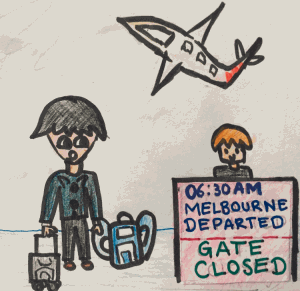
    “Get up and get ready! Don’t you have a flight to catch ?”, yelled my morning alarm at 4:00 am. I say, Snooze. But hey, you can’t snooze your wife, can you ?

    All I had to do that day, was to reach Melbourne (from Canberra, where I live) in time for the workshop. The hour long flight departs at 6:30, which gives enough time some breakfast before the 9:30 am start. And if you know a bit about Canberra and its airport, you would know, you cannot miss your flight. Unless you start too late. There are no usual challenges like in other cities: bad traffic, long queues in the airport, etc. You find more staff in the airport than the travellers. And if there is no check-in luggage, it is sufficient to reach 30 minutes prior to the departure. (it takes just 15 from my place in the taxi).

    I was ready at 5, called a taxi at 5:45. And I missed the flight. For the first time in my life.

    Why didn’t I leave early? What was i doing (watching TV!). I never missed a deadline when I was in a rush. But this time it was different: I was ready well ahead of time but took it easy and kept pushing forward the task of calling the taxi.

    Under-estimation. Over-confidence. Sheer laziness. Lack of common sense. Un-professional. I cursed myself for basically, being dumb.

    It dawned upon me that this not the only occasion where I was late or being in a terrible rush. I had always been fascinated by the Just-in-time technique that was introduced to us as part of the training at my first job. However, I had been overlooking the effects of the ensuing uncertainty when you live on the edge. Joining a meeting on the dot, dropping off the kid at school gate just before the bell rings, completing my tasks at work in a hurry etc.

    But then, I have been reasonably successful at education and career. Having said that, all through my school and university days, I recalled, I never managed to stick to a schedule. Last minute revisions, late night push to cover more units before the exams, were typical. The nervous energy and the adrenaline rush contributed as much to my results as the preparation itself. Which begs the question: how did I survive when I had been so un-organized ?

    I procrastinate. Though it sounds better than saying I postpone things, it basically “is the avoidance of doing a task” (Wikipedia “pro”: forward; “cras”: tomorrow). Researching further, I was lead into a world of interesting people. Found this list of famous and highly successful procrastinators: The Dalai Lama, Victor Hugo, Leonardo da Vinci among others. Da Vinci in particular “had the reputation as a daydreamer who never actually finished anything”. His most famous work Monalisa took 16 years in the making. When he died, he was heard appealing to God, “Tell me if anything ever was done”.

    I didn’t have to paint Monalisa, though. Just had to perform well in the exams, pass an interview, get a job and complete my work assignments. I did day-dream (Google came about when my career started) and laze around while still getting the job done. Boy, it was always stressful trying to finish when you start so late!

    Further exploration on this subject lead to some bizarre stuff. Stanford Professor John Perry has written a whole book about this embarrassing behavior and ended up being awarded the Ig Nobel prize. I say, anyone who set the title of his book as “Art of Procrastination : A Guide to Effective Dawdling, Lollygagging, and Postponing, Including an Ingenious Program for Getting Things Done by Putting Them Off” deserves an award.

    He basically suggests to make a list of tasks that you have to do and keep that “Important” task aside. This suddenly eases the mind but he asks us to do any of the other tasks from the list. A nice trick to actually do things when we are busy procrastinating. He explains, “With this sort of appropriate task structure, the procrastinator becomes a useful citizen” and “an effective human being.” I like that.

    It makes sense. When we continue to avoid doing something we planned, perhaps it is worth listening to our instincts and question the purpose, motivation and relevance of that task. When we actually want to do something, we never delay.

    I chanced through this funny TED talk by Tim Urban “Inside the mind of a master procrastinator”, where he espouses the idea that we often fall for visible deadlines as the most important things in our life. While we completely overlook (he calls it long-term procrastination) “all kinds of important things outside of your career that don’t involve any deadlines, like seeing your family or exercising and taking care of your health, working on your relationship” etc.

    I eventually reached Melbourne with the next flight, missing the first session of the workshop and the breakfast. But I felt well-nourished that day.