Category: Musings

  • A bit of karma…

    After a nice lunch at our cousins’ place in Sydney, the mind wavered back to the events of the recent, intense weeks. Two episodes came to the surface that led me philosophising. One, involving a series of incidents at work that might refine the way I look at my role and, the other, a learning experience watching my daughter go through a bout of high school assignments and assessments.

    First, about the school assignment in this blog. (I will need more than a nice lunch to pen down the office stuff, which I will do in my next blog).

    Two weekends ago, it was quite easy for me to comfort my daughter grappling with her English assignment: to write a creative essay about a character from the book they were reading at class. Peer pressure and high levels of expectations set on her was telling, as she asked me for some advice. I gave her tips and tricks but encouraged to write it in her own style.

    She drafted it quickly and read it back to us. It sounded well as I heard her narrate, while munching on snacks, congratulating myself on how I let her do it by herself. A few days later she came home with a strange look on her face. While the teacher’s comments were positive on many aspects of the essay, he was critical on grammar and punctuation. He had gone on to state that a bit of proof reading at home could have made the result better.

    I felt guilty. I chided myself for just being observant and not getting involved in her homework. Instead of lecturing her while sitting on a couch, I should have sat down with her to work on sentences and structure. My wife politely reminded me of how I take blogging more seriously than helping with homework and wondered out loud, how one could be so casual about it.

    I then had a chance to redeem myself during the subsequent assignment about writing further on the character. This time, I spent a good couple of hours with my daughter (the wife looking over my shoulders). We researched about gothic style of fiction writing. It felt good about learning something new. After she finished her draft, I verified it, suggested corrections and ideas.

    I also expanded on how to not worry about what the teacher might think of her essay and only focus on her own effort and preparation. This was not me preaching her about do-your-karma-without-expectations (Bhagavad Gita) but more of trying to be a helpful dad, offering a logical explanation: we can only control what we do (effort) and can never be sure about the result.

    I got a pat on the back from wife once she read the final draft. It was our best effort.

    The teacher’s feedback arrived few days later. He praised her for the creative elements in the narrative. I noticed a comment in the end. “The essay would have turned out better if you had done a bit of proof reading.”

  • How to survive a meeting

    When I started working (I mean, working as opposed to the many months of training sessions) in my first job, I noticed people in the team spending a lot of time inside meeting rooms than at their desks. The work assigned to me involved coding a piece of software – at least that’s what I thought; soon it became clear to me that without talking to the seniors and colleagues i cannot get anything done. Not that it was unexpected but it astounded me that i spent more time writing emails and talking than coding. Worse was when i struggled to obtain availability of meeting rooms and subject matter experts. Thus it was evident that communication skills were as relevant as computer skills, especially when one tries to share ideas and seek improvements to make a collective decision.

    I should have seen that coming. It was during the final years of college as we were preparing for job interviews that I encountered this construct called Group Discussion.

    We had to debate on a topic and you are judged on how well you make your point. We were given the controversial one: to agree on the most effective form of government (in the subcontinent): democracy or dictatorship. I was still struggling to put my views across, mainly in English and was intimidated by the bunch of guys who waxed eloquence on the principles of democracy, while being struck by the plain and simple logic evoked by the other group who championed dictatorship. I was still waiting for my friend to open his mouth yet – I knew him as a sharp and fierce communicator – when I was prodded to speak. I kept fumbling along and made a mess of the only speaking opportunity. I was in a 50-50 mode mentally, but could not express that at all.

    Formally, a meeting is defined as a situation when two or more people meet, by chance or arrangement. Effective interactions and collaboration among workers are the building blocks of successful organisations. The power of collective human consciousness is unparalleled. It is quite important to structure such gatherings since otherwise, they quickly degenerate into a platform for egoistical arguments and cacophony.

    There are many simple rules for running meetings which I think are not so simple. There are companies that take it very seriously. Last week, i read about Jeff Bezos’ rules of running any meeting at Amazon, which included no power point presentations apart from insisting everyone to silently read memos for the first half of the meeting. That reminded me of a suggestion I made to my team many years ago. I was still a rookie but I had the gumption to strongly recommend that the entire team be forbidden from talking to each other for the first three ‘silent’ hours in the morning. I was not the most popular person in the team.

    While I m not criticising the very purpose of social interactions in a corporate environment as such, I want to draw your attention to the fact that a typical knowledge worker in this age has less time for him/herself. More than 70% of my work time gets spent on meetings. They come in various terms and forms: discussion, idea generation, design thinking, status update, issue tracking, planning, synch up, stand up, get together, morning prayers, kitchen cabinets and what not. I read this somewhere: “a meeting is a chance for people to share their own confusion with a broader audience, contributing to the collective chaos.”

    How to survive such meetings? How to conduct one? Enumeration can come to the rescue. When you make a simple list of items to be addressed and stick to that, you can at least complete the meeting if not solve world hunger. The real challenge is to come up with such a list.

     I remember a particular issue-tracking meeting that occurred during a critical phase of the project. My manager asked the team about the progress of resolving defects which were pending for weeks. “We have made very good progress in the last two weeks; many of the issues are resolved; some of the remaining ones are being corrected; most of the corrected issues will be tested by tomorrow”. It took a whole thirty minutes for the boss to determine the list of issues in the first place.

     Can we try to be more objective and mainly focus on data, facts and actions, while ignoring the emotions involved? At your peril. You see, meetings are also occasions where people vent out their frustrations, and real human connect occurs only when you let others express themselves. My own inadequacies in the listening front is well documented in my previous blogs. Having said that, I believe it is cruel to let someone go on in their line of argument when everyone realises it is a rabbit hole, especially with the time constraints we live with.

    Ideally, a meeting is just a means to an end. An end outcome that moves the team forward. Actions are assigned and a direction emerges. In reality though, meetings need not always be so serious and I will run out of space writing about many funny episodes. For instance, I have seen people rushing to point at others as action owners, often at those who were absent.

    But many a meeting occurs in a hostile/political environment where unwritten rules manifest and items not in the agenda dominate the proceedings. In such situations, a significant amount of time is spent post-meeting to minute the discussions and document actions which gives an opportunity for the host to shape the outcome of the meeting even as he was unable to influence it while it occurred.

     Though one should not treat a meeting like a war zone, it is fascinating to see people trying to have the last word. But usually the ones who are able to listen to differing view points, forge relationships and offer creative alternatives emerge as real change makers. They make everyone think and realise it was worthwhile spending time away from their desks.

     My college friend demonstrated that many years ago, when finally his turn arrived during the group discussion. As the crowd was already dissected into democracy advocates and dictatorship worshippers, our man got this to say. “I think we should try democratically electing a dictator”.


  • How to spot your friendly neighbourhood Mentor

    “Who is a Mentor?”, asked the trainer from The Smith Family – a charity organization that helps children from struggling background – as part of a corporate program I recently signed up to. I realised I had been too self-centred and decided it was high time I did something more than work, at work. If selected, I would be a mentor for a couple of school terms, spending an hour a week doing Q&A with students.

    Indian culture has had a word for this: Guru, which is loosely translated to the term Teacher. But a mentor is not just a teacher; a role model, a guide who helps us navigate this complex world. Co-traveller sounds more apt to me, since no one knows everything for sure. We just need to help each other out with what we learn along the way.

    I ended up answering her, “A mentor is someone who acts as a good reference point for others to emulate and learn”.

    I came away feeling nostalgic, reflecting on my own reference points during the growing up years. Would start with my parents who lived their ideals, working hard and keeping it simple. While I remember my mom helping me and my sister with homework during the primary school years, my father was instrumental in me venturing beyond regular academic stuff. He enrolled me for karate and Hindi lessons and later when I finished high school, he put me onto a personality development workshop conducted by an inter-religious organisation. Those were unheard of in the 1990s in a city like Coimbatore.

    I also remember being tutored by members of our large extended family when I was much younger. The many uncles and aunts who lived close by, the cousins who were in high school already were more helpful than my teachers at school, as I struggled with the spelling of King Dhritarashtra, perplexed with English grammar, confused by negative numbers, mugging up the definition of the species spirogyra. One of the summer vacation trips turned out to be an academic tour, with my cousin tasked with helping me pass an upcoming Hindi exam. And later when I was appearing complacent in my first job, my cousin brother alerted me about the Java wave that swept the IT world. I still remember trying to copy his elegant way of presenting himself for work, especially those blue stripped formal shirts.

    Neighbours turned out to be excellent teachers. Not the ones next to our house who were the quarrelling type. Im talking about the passionate Maths Vaathiyaar, who also taught Chemistry as a private tutor when he was not working for the government. He was more a family friend than a teacher; he was the one who instilled pride and confidence in my work. He also helped me score a 100 in Math and Chemistry. In fact my aspiration to get into a premier engineering institute was fuelled and fostered by such neighbours – and dad’s colleague’s son who was already studying there.

    Friends and colleagues teach a lot by not teaching. I owe my English speaking skills to a bunch of mates – one of them a neighbour too, whose terrace was our joint. Another friend’s friend even offered his house for more preparations as we pruned our linguistic skills for the job interview. Later, I got inspired to take reading as a serious hobby from my room mate who famously brought more bags of books than clothes to live in a new city as we started our careers together.

    We spend a third of our life time at work and thus it is important to recognise the formal and unconscious learning and positive influences we receive from colleagues, subordinates and bosses. I have learnt as much from people who I managed as from the many seniors I worked for.

    It is a tough mental exercise to list all my mentors in one go. I feel I have missed mentioning many more reference points. Our journey is shaped by the many masters we may never fully acknowledge. The true way to repay (Guru Dakshana) though, is for us to walk the path along these points, live a good life.

    Reminds me of a quote attributed to Dalai Lama: The Buddha says, “I am a finger pointing to the moon. Don’t look at me; look at the moon.”

  • “Are you smart?”

    I still remember the blue coloured poster on the wall of my ninth grade teacher’s office.  The innocuous query, “Are you smart?” continues to taunt me. I had been a class topper most of my life and a lot of people saw me as a bright, diligent young boy. But smart ? Probably not.

    It was during the final years of my engineering studies that it dawned on me – rote learning and great scores will only take me so far. Let me admit this: I was more immersed in the theoretical world and never indulged in anything practical. Never helped my dad to fit the fan upon the ceiling; didn’t play much sports – though I have spent many hours watching cricket and tennis. I didn’t have a hobby as such and kept myself to academics most of the time. I didn’t grow up to be an introvert but turned out to be socially awkward. I still had a bunch of mates but couldn’t confidently claim many of them as friends.

    A classmate and I were chosen to make a trip to Bangalore to invite software companies to our college for recruitment. His uncle’s family was gracious to host me for a couple of days. I still remember cutting a sorry figure as I made a mess of their sofa by spilling coffee on it. We hired an auto rickshaw for the day and for the first time I saw the (fare) meter at work. One of the first duties of a passenger was to turn the flag (handle) upside down – the bell inside gives a ting, signalling the commencement of the ride.

    My friend asked me if I would do the honours. I blinked. I still wanted to give it a try but was fumbling along – rotating it more than once. By then the driver turned around to give me a stern look. As he firmed up the fare handle in its place, my friend wondered out loud “Man, I can’t believe you don’t have any common sense”.

    I survived the lab classes and practical tests – mainly on my reputation as a rank student. Almost. An internship stint at the R&D lab of a yarn company exposed me. The project chief was explaining the design of the yarn quality monitoring system to everyone. It involved writing software – which appealed to me more than the yarn sensors and motors connected. At one point, he signalled to me “can you please bring in that motor?” pointing me to the far end of the room. As I was turning around lifting the feather light equipment, I heard a huge roar of laughter from everyone. Except from the chief who was red by then – his hopes of ever finishing the project perhaps evaporated as he realized he is dealing with a useless guy who missed the real electric motor for a plastic replica. (I redeemed myself by writing a clever piece of C program that simulated results visually better than the actual yarn quality.)

    I eventually got a job offer while still finishing the final year. Felt ecstatic, and also had a few sleepless nights. I now had to deal with the real world where my rank and marks would cease to buoy me up.

    My real learning occurred in the first job. (It warrants a dedicated blog series). Meeting people, being in a corporate environment – and moving to a new city were fun. The actual work though was dreadful. I guess the HR guys went by merit, as I found myself assigned to the team working on a contemporary technology (it was 1999 and I’m talking about web technologies). But I struggled to cope up with the basics that everyone else seemed to absorb super quick. The training session on socket programming for instance was a real drag. Turns out they were not referring to the (physical) socket that I had in my mind. Later, when a fellow team member logged off from his yahoo email account and closed the Internet Explorer window to give me my turn in that shared PC, I yelled back at him, “Man, you didn’t have to close the internet. Now, I do I get inside the internet?”. He couldn’t mask the irritation in his voice as he tried to verify if I was indeed part of the team developing internet applications.

    Feeling stupid, I resorted to the only thing I knew. Books. And, some websites too. Also, Google was coming along nicely at the time. Howstuffworks.com was a revelation. I no longer had to ask weird questions in front of others. Scores of self help books filled my shelves too, as I tried to become more social and confident.

    I feel I have come a long way compared to those early years. It is ironical though, that my path towards attaining some level of practical knowledge of the world, is paved by a lot of reading. The book “Zen and the art of Motor cycle maintenance” is a case in point. A misleading title – this classic is an essence of modern day philosophy.

    And philosophy doesn’t help fix even simple things at home – like changing batteries in the heating appliance or replacing the punctured tyre. But hey, youtube is a saviour.

    Recently, I had the challenge of having to fit curtains for the windows of our new home. The quote from the blinds designer was exorbitant and I ended up doing it myself – measuring, buying tools, hanging the rods in the correct angles etc. While the do-it-yourself kits of Ikea did help, the real motivation was my wife teasing me, “You studied engineering, right ?”

  • “What makes you an expert, Sir ?”

    “What makes you an expert, Sir ?”

    My only trip to the United States occurred in the year 2014, as I was visiting my colleagues in Philadelphia for a very short business trip. I have heard fascinating stories about the behaviour and the line of questioning faced by first time visitors – even the well travelled ones – from the immigration officials.

    My encounter was brief. I was asked to explain the purpose of my visit, which I did. I was then asked to explain my role which read Project Expert. With a face that did not hide the smirk and a voice blatantly sarcastic, the official asked me,

    “What makes you an expert, Sir?”

    On the way to the hotel, I could not stop thinking hard about this question. I had carried out multiple roles – engineer, tester, manager etc., and acquired fancy titles and glorious designations along the way. I started my career as an Associate Software Engineer – and when I eventually climbed the first step in the corporate ladder to become a Software Engineer, it already felt like having shed some burden away. At a later point in my career, I was called a Development Specialist before becoming a Project Expert.

    Associate, Specialist, Generalist, Expert, Analyst, Professional. These titles can be quite misleading. For instance, while the title Area Product Owner referred to someone who managed many Product Owners, a lot of people misunderstood the APO as an associate under a PO.

    Mostly, the actual role performed by someone bears little resemblance to the designation. Once when we included the senior vice-president of our line of business in a conversation with a customer, he – being demonstrative of his proud roots – introduced himself, “I am a developer!”. Though he meant he was still an engineer at heart, I could already see the frown in the face of this business leader at the customer end – who seemed terribly disappointed at being introduced to a mere mortal.

    I stopped taking these labels seriously after a while. Whenever I got a new title, I went along happily – accepting a step change to my career which also came with additional responsibilities (and pay hikes).

    But did I become an expert ?

    What makes someone an expert after all ? Me thinks, it is by learning – doing – learning – doing – this goes on and on. Putting in thousands of hours of work, honing our skills, working under the guidance of mentors, being trivialized and challenged by peers and subordinates, failing multiple times, reflecting on those debacles and being able to feel confident about the stuff we do. That’s a not a crisp definition but hey, I’m not an expert to talk about that.

    Recently, I found myself struggling to convince my daughter to stop relying on google for her school assignments. I tried to explain that the content from a published book – written by an expert, could be trusted more than a fuzzy search engine. She pushed back: how come you trust this author but not the person who contributed to the web content. I went on to say a lot of things about the difference between an amateur and a professional, body of knowledge etc, but she was unimpressed. Eventually, I got her to listen when I asked her if she was going to take the risk of false information.

    I have to admit however, I have been doing a lot of my own learning from google, especially during my professional life. But then the actual doing part validates every bit of learning. Also, I have been lucky to have carried out varied tasks and responsibilities and have a general sense of being an IT engineer. The breadth of knowledge is equally important to the depth of skills and expertise in a particular area.

    My answer to the immigration official evoked a genuine smile from him: “When you spend fifteen years doing something, it is inevitable that you become some sort of an expert, don’t you?”

    You just have to be mindful of not getting into a rabbit hole, however. Apparently Gandhi has said, “The expert knows more and more about less and less until he knows everything about nothing”.

  • Gifting a surprise

    Gifting a surprise

    The kid is growing up. She just completed another year circling the sun and it was pertinent that a gift is chosen. The wife had plans drawn for months now, just that I didn’t know. In parallel, the kid wrote a wish list on the fridge – I never noticed it.

    Here I was – one week before the birthday without any ideas for the gift. I quickly turned towards the wife for some soothing words that did not include “I have been telling you…”. It was a quick and easy call that was made: we promptly purchased the ear rings that she had been planning to gift our kid. That was done. What about the wish list on the fridge?

    Shopping for a birthday gift – one that is not going to be a surprise anymore – wasn’t going to be that interesting. The only mystery that we managed to add was to dramatize the whole thing: we made fun of her asking for such childish things even at this age, which made her resign to the fact that she won’t receive them.

    Made me think about the concept behind gifts in general – the sense of expectation that surrounds us as we unwrap them – and the whole idea that we get something for free. (The word free derives from the Sanskrit word priya – which means “dear” or “love”. Yes, when we give out something to others without an ensuing transaction, it ought to be with some love.)

    Choosing vs being surprised:

    It seems obvious that most people love a pleasant surprise as opposed to fully knowing what they are going to receive. Not necessarily.

    My previous company had an annual ritual: useful things like water heaters and glass bowls were nicely packed, gift-wrapped and presented to each of the 400 odd employees every year around the festive season. But during one of the monthly forums with the MD, a section of the crowd pushed for a change of approach. Most of us were still single and had little excitement to receive a kitchen utensil at this phase of our lives. The suggestion was to either being able to order a gift (from a catalogue) or collect equivalent cash.

    The MD was struggling for words to describe the conflict between the original intent and how it ended up being perceived. But he was bang-on as he finished, “A gift is given and not chosen”.

    Eventually, we managed to buy the items in the list without her knowledge and she had an unknown gift box in front of her on the day. Surprise.

    Or was it ? Well, in her own words, the kid felt doubly happy about collecting the items in her wish list – especially after not expecting them.

    PS: Turns out, the wife had advised the kid to make the wish list all along. I learnt about it after writing this piece. Now, that was a surprise.

  • Take your seat

    Take your seat

    Prior to relocating as an employee of our Canberra office, I had made a few short business trips to meet the team and the customers here. I had a fair idea of what to expect in the new place. That was three years ago. The role was going to be different but I was mentally well prepared for everything. Almost.

    Ours is a small office and at any point of time there would be a max of 50 people around. Others would be either working from home or with customers, I would think. The office space is organized into named desks  (name printed on a steel name plate atop the mounted desk screen), hot desks (anyone – usually travellers – can occupy, temporarily) and meeting rooms.

    I used to randomly take a hot desk when I was a visitor. Now, moving in as an employee of this office, it felt strange when I learnt there wouldn’t be a permanent desk for me. Should that affect me ? After all, I had spent many years in this company working in different offices, travelling to various places, working from airport lounges, customer offices and from home too. And what is my work anyway: read mails, take calls, meet people and occasionally get to do some inspiring stuff. Should a permanent desk matter ?

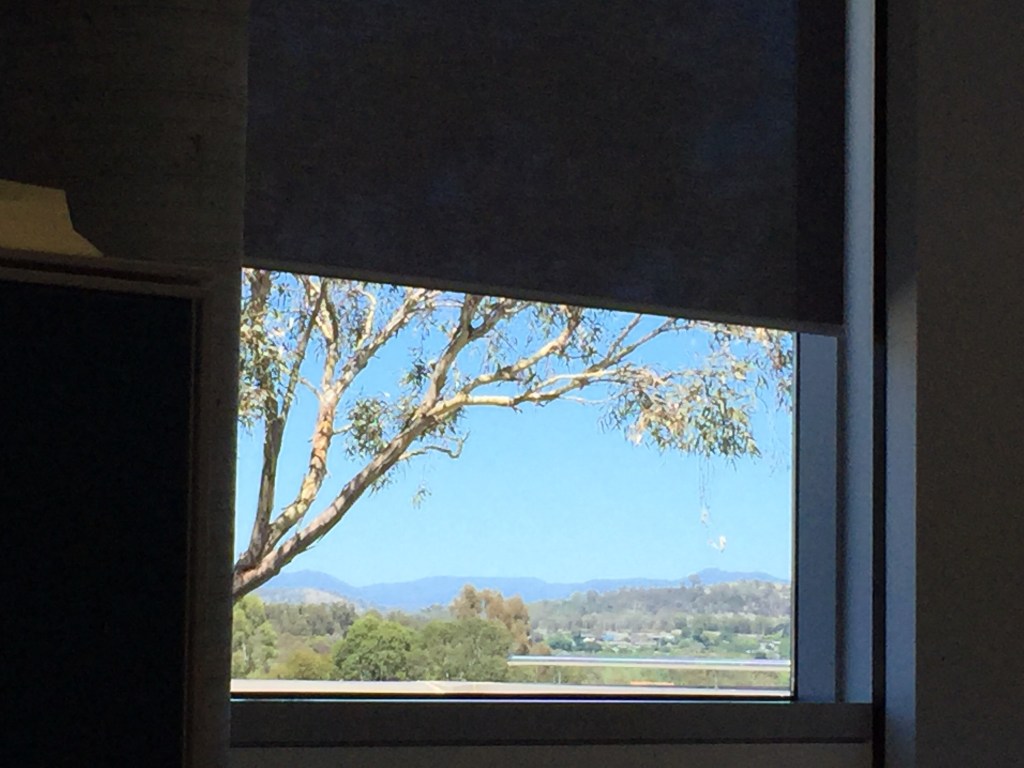
    I found a spot. It was in a corner, facing the window with a nice view of the traffic-less street surrounded by other buildings and a bunch of eucalyptus and maple trees. The next day too, I managed to position myself there. The third day though, I was late. When I found another guy settled down nicely in my (?) desk, I felt like a child whose candy was snatched away.

    Berating myself for being silly, I quietly occupied the next available hot desk. It was a dull place far way from the window. No scenic view to provide any inspiration – unless you count the potted indoor plants. The desk was messy too. You are expected to clean the desk when you go, especially if it is not yours. Then it became clear to me. That was some clever guy who knew how to mark his territory. Fair enough. I moved away.

    In the meantime, work kept me engaged. I made quite a few acquaintances, new connections in the office and outside. The new role turned out to be fascinating. The family too, settled in nicely in a new country.

    While I worked on many business cases and helped secure deals, I also managed to secure a permanent desk, eventually. It did not matter that the steel name plates ran out of stock. I settled for a simple print out of my name on a piece of paper (bold font, though), perched on the mounted partition of the desk. My desk. Or my portion of that long desk that houses three others as well.

    I decided to sprawl the desk with things. I got my daughter to make a couple of crafts for display, and the usual stuff: coffee mug to keep pencils I never use, print outs that should have been fed to the shredder long ago and the many wires and chargers.

    Recently, I reflected on this behaviour and did some googling too. There are two opposing schools of thought regarding this question: Should employees have their own private space or be part of an open environment that encourages dynamism and collaboration. I think however, our primal instinct to secure a physical territory far outweighs the need to be socially connected.

    It is funny and silly. Only until you find your desk taken away by some stranger, leaving you to look for a spot near the window with a view.

  • Catching the Bus

    Yes I remember that very well. Every day from when I was 11 until joining college, I went through this routine which was painful but necessary part of the day.

    Catching the bus. Entering it; finding your spot; and more importantly, getting out unscathed.

    No, it was not simple.

    The first day to the high school – around 10 kms from home – was also my first ever bus trip by myself. Standing amidst a crowd of busy people at the bus stop – school kids big and small, families, and irritated, lonely office goers – I remember feeling anxious but proud of being on my own.

    Imagine the 80’s in India. A typical bus stop at a middle class neighbourhood. No mobile phones. You have to chat with strangers otherwise the wait for the bus would feel much longer. Usually I was with friends and occasionally my parents would decide to start early to office and give me company.  But mostly I found myself among a crowd of unfamiliar people.

    Suddenly there was a jostling. I look towards the end of the road.  Appears like a mirage, but it was indeed the bus emerging from nowhere. The red and white coloured metal box carrying a sea of humanity is going to stop near me anytime. And I need to figure out a way to get in and find some space to stand if not sit. Already, the sound and sight of that beast  had made me nervous, especially the ear piercing horn announcing to the world that no one dare stand in the way.

    Everyone gets ready; no queues, no courtesy. Bags are lifted from the ground; conversations pause; a sense of alertness kicks in. Families make strategies – who gets in first to look for seats for others and who should carry the heavy bags etc. As the bus stops, I realized one of the fundamental assumptions going wrong. You expect a bunch of people getting down to make space for ones getting in. That never happened. But no one seemed to care. Everybody barged in. Actually, my attempt to get in to the bus was effortless (alas, not painless) since, all I did was to stand in the way of this bulky guy who wanted to desperately get in. The raging bull that he was, he ensured I was shovelled right into it.

    There were days when the arriving bus wouldn’t stop near us. You see, the driver would want to keep his sanity (and his job) when he knows there is a physical limit. He might prefer to avoid a stampede and stop a lot farther from the bus stop, hoping to only offload people and not let anymore in. But he is unaware that we are also good sprinters and nothing would deter us from making a mad rush towards the bus.

    Most days we make it. Entering that way as an unwelcome passenger, you need to avoid making eye contact with the driver (or the ticket conductor). I look back at the scene now and it resembles the one from the movie Avatar where Jake Sully waits for his dragon on the top of the mountains. While everyone gets their carrier, he is left wondering if he would ever have a chance to be on top of his own dragon until when he is assured by his girlfriend of the tribe ,”You choose your Ikran, but you have to wait until it choses you”.

    Some days I get up late and I would already know that the only chance to get to school in time would mean that I run and run towards the bus stop. There are other factors too at play: the straight but uneven path from my home to the bus stop via a dumping ground; speed and position of the bus that has already commenced from the previous stop; probability that it would even stop close to bus station. I never had to struggle for real life examples when I learnt Pythagoras theorem, Trigonometry, Newton’s laws etc. at school.

    Catching a bus was not just an event. It now seems to me as a metaphor  for grabbing opportunities, taking risks and wriggling my way out of the crowd to find a spot. It has prepared me well for the real journeys later.

    To travel away from a familiar home to new places full of hope and unknowns.

  • A story a day

    Every night I’m asked by my daughter to narrate a story . It cannot repeat, should have no traces of any other similar storyline. Unique, and every night. I don’t remember exactly when it started, but it sure has become addictive for her to be able to listen to a new tale as she dozes off. Not quite the easier part of the day for me. Late night calls from work (and other excuses) kept me out of this daily ritual from time to time. But most nights I’m confronted by this intellectual challenge; one I had under-estimated.

    The easy and lazy options were over in quick time : crow tales, kings and battles, village situations, big ships and mountains and even dinosaurs. I remember once scratching my head midway into a narrative – when all I did was blabber – no logic, no twists, no ending in sight; the story never made any sense. She had slept by then. Waking up next day, she told me that was awful. I realized I had reached the low point.

    To make things easy for me, she sometimes relents and says I could repeat myself – which makes it even more stressful. I wonder how artists feel when they struggle some days – and realize they cannot create anything fresh and inspiring.

    I’m not an aspiring artist, but why is it so difficult to cook up a story? Perhaps it has to do with the effort and discipline in thinking at the end of a long day. Creativity is not easy. There is a whole body of knowledge on Story Telling which is leveraged in many domains like entertainment (of course!), marketing, education, politics,  etc. You will find the many benefits, techniques and tools about Story Telling which is also an oft-repeated phrase at work these days. But for me, the overt focus on the preparation, structure and the outcome  of a narration drains out the energy. How does one make it easier and smooth ?

    Perhaps I’m unsettled at the larger question too: what should the story be about? What should she know about the world at her age. In fact, I worry about what she should (need) not know at this time of her life – what with the blitzkrieg of unfiltered content exposure, 24×7. Going beyond the simple, direct and consumable stuff – how do you slowly take her to the depth and meaning of things. You have to be cautious though, by being less preachy.

    Until I figure that out, I have turned to another easy option: reality. I have begun taking trips to the memory lane, going to my childhood days, fishing out incidents that I still remember – to find something interesting and worthwhile to tell her.  After all, where else does one get plots like these: how I cried at primary school once, not being able to remove the shoe laces – until when the girl next to me used her hair pin to untangle the mess. How I never figured out a way of dealing with bullies at school. Or how I let the guy next to me copy from my answer sheet in the (false, as it turned out) hope of him being friendly during the soccer play that evening. And how I stressed out on exam nights. Real examples of mishaps, missed opportunities, major failures and yes, the big points and successes.

    It is working. She says she loves these more than fiction. She wouldn’t  know (yet) that’s because I might not have stuck to the truth all the time.

  • Words that convey a lot and less

    It was the sudden slower ball that fooled the batsman for the fourth time in the cricket match. Harsha Bogle asked his co-commentator, “Michael, during your era, was change-of-pace as a bowling tactic employed at all?”. Michael Holding, the great West Indian ex pace bowler was nicknamed “Whispering Death” for his quiet approach to the bowling crease – only to rattle the batsmen with sheer speed. Michael clearly was not amused, “Harsha, we used it all the time. But, our way of change was to bowl even faster than the usual pace!”.

    I have always felt “change” is an incomplete word. A lazy attempt to communicate, which ends up conveying nothing meaningful. You see, there is always a direction to any change: Things either improve or get worse. Or evolve. Change Management is another term I hate. “Colleagues, please expect some changes”, usually means someone is getting axed or a re-organization is looming.

    What is a word after all ? A tool to ensure that the listener gets the same idea, feels a similar emotion and derives the right meaning that you had when you uttered it. A picture is worth a thousand words. Sure, but a right word used at the right time can convey something unique but universal – and is also cheaper than to paint a picture. Probably the reason why books are still in vogue even as we indulge in visual entertainment.

    Every minute we are bombarded by words, terms and images that enrich us less and confuse more. Take the case of “growth” or specifically, “rate of growth”. Of economy, population, anything. Raise your hand if you have been – like me – bamboozled by a headline like this: “Why is our wage growth slowing down ?” Err…are they talking about wage getting reduced ? Nope, they don’t want us to understand it so easily. We all learnt about speed and acceleration in high school; the editors, if not the economists, could have come up with something simple yet precise. Recently, a controversy erupted with a headline which reads like this “Majority (religion) population’s rate of growth slows down more sharply during the last decade, than the rest”, while in fact there was no decline in any section of the population – or at the cost of each other. Historically, words have been used with a sinister intention to divide society, in an attempt to identify, label and classify people.

    How about the words we use in our daily life ? The BBC article The hidden ways your language betrays your character, explains how we often share a clue about our personalities as we use certain words. While writing emails, I have used an inappropriate or inaccurate word on several occasions. I would write “I have a question” – only to be corrected later on that it’s better to use query instead; I didn’t want to appear to question anything that was said. A polite word is often lost in translation. Another example was when I used issue to describe a project situation while I was only voicing my concern – which is not definitive and there is a chance given to the other party to react.

    Certain words are so frequently used that their impact have come down. Innovation, for example. As a young engineer, that word fascinated me the most. I had known discoveries and inventions at school. But no one talked about innovation back then. It was resolved when I listened to the CEO of my company explaining the difference in simple words, “Invention is when you take someone’s money and create something new. Innovation is about taking someone’s idea to create money”.

    I rarely attend leadership talk series organized in my company. But when I learnt that a social entrepreneur originating from my home town was delivering a speech on innovation, I couldn’t resist. Arunachalam Muruganantham is the inventor (with his own money!) of low-cost sanitary pads that has revolutionised health and hygiene in rural India. (Watch this TED talk).  The hundreds of curious minds in the audience felt entertained and inspired by his story, which is now being made as a biopic. He explained a core principle of his research methodology as “T&E”, which none of us had heard about. Towards the end of the presentation, he revealed the details of the that technique to much amuse: “Trial and Error. If I had said that, you would not have taken me seriously”.

    Simple words are powerful when they convey a big idea.