Category: Insights

  • How to survive a meeting

    When I started working (I mean, working as opposed to the many months of training sessions) in my first job, I noticed people in the team spending a lot of time inside meeting rooms than at their desks. The work assigned to me involved coding a piece of software – at least that’s what I thought; soon it became clear to me that without talking to the seniors and colleagues i cannot get anything done. Not that it was unexpected but it astounded me that i spent more time writing emails and talking than coding. Worse was when i struggled to obtain availability of meeting rooms and subject matter experts. Thus it was evident that communication skills were as relevant as computer skills, especially when one tries to share ideas and seek improvements to make a collective decision.

    I should have seen that coming. It was during the final years of college as we were preparing for job interviews that I encountered this construct called Group Discussion.

    We had to debate on a topic and you are judged on how well you make your point. We were given the controversial one: to agree on the most effective form of government (in the subcontinent): democracy or dictatorship. I was still struggling to put my views across, mainly in English and was intimidated by the bunch of guys who waxed eloquence on the principles of democracy, while being struck by the plain and simple logic evoked by the other group who championed dictatorship. I was still waiting for my friend to open his mouth yet – I knew him as a sharp and fierce communicator – when I was prodded to speak. I kept fumbling along and made a mess of the only speaking opportunity. I was in a 50-50 mode mentally, but could not express that at all.

    Formally, a meeting is defined as a situation when two or more people meet, by chance or arrangement. Effective interactions and collaboration among workers are the building blocks of successful organisations. The power of collective human consciousness is unparalleled. It is quite important to structure such gatherings since otherwise, they quickly degenerate into a platform for egoistical arguments and cacophony.

    There are many simple rules for running meetings which I think are not so simple. There are companies that take it very seriously. Last week, i read about Jeff Bezos’ rules of running any meeting at Amazon, which included no power point presentations apart from insisting everyone to silently read memos for the first half of the meeting. That reminded me of a suggestion I made to my team many years ago. I was still a rookie but I had the gumption to strongly recommend that the entire team be forbidden from talking to each other for the first three ‘silent’ hours in the morning. I was not the most popular person in the team.

    While I m not criticising the very purpose of social interactions in a corporate environment as such, I want to draw your attention to the fact that a typical knowledge worker in this age has less time for him/herself. More than 70% of my work time gets spent on meetings. They come in various terms and forms: discussion, idea generation, design thinking, status update, issue tracking, planning, synch up, stand up, get together, morning prayers, kitchen cabinets and what not. I read this somewhere: “a meeting is a chance for people to share their own confusion with a broader audience, contributing to the collective chaos.”

    How to survive such meetings? How to conduct one? Enumeration can come to the rescue. When you make a simple list of items to be addressed and stick to that, you can at least complete the meeting if not solve world hunger. The real challenge is to come up with such a list.

     I remember a particular issue-tracking meeting that occurred during a critical phase of the project. My manager asked the team about the progress of resolving defects which were pending for weeks. “We have made very good progress in the last two weeks; many of the issues are resolved; some of the remaining ones are being corrected; most of the corrected issues will be tested by tomorrow”. It took a whole thirty minutes for the boss to determine the list of issues in the first place.

     Can we try to be more objective and mainly focus on data, facts and actions, while ignoring the emotions involved? At your peril. You see, meetings are also occasions where people vent out their frustrations, and real human connect occurs only when you let others express themselves. My own inadequacies in the listening front is well documented in my previous blogs. Having said that, I believe it is cruel to let someone go on in their line of argument when everyone realises it is a rabbit hole, especially with the time constraints we live with.

    Ideally, a meeting is just a means to an end. An end outcome that moves the team forward. Actions are assigned and a direction emerges. In reality though, meetings need not always be so serious and I will run out of space writing about many funny episodes. For instance, I have seen people rushing to point at others as action owners, often at those who were absent.

    But many a meeting occurs in a hostile/political environment where unwritten rules manifest and items not in the agenda dominate the proceedings. In such situations, a significant amount of time is spent post-meeting to minute the discussions and document actions which gives an opportunity for the host to shape the outcome of the meeting even as he was unable to influence it while it occurred.

     Though one should not treat a meeting like a war zone, it is fascinating to see people trying to have the last word. But usually the ones who are able to listen to differing view points, forge relationships and offer creative alternatives emerge as real change makers. They make everyone think and realise it was worthwhile spending time away from their desks.

     My college friend demonstrated that many years ago, when finally his turn arrived during the group discussion. As the crowd was already dissected into democracy advocates and dictatorship worshippers, our man got this to say. “I think we should try democratically electing a dictator”.

  • How to spot your friendly neighbourhood Mentor

    “Who is a Mentor?”, asked the trainer from The Smith Family – a charity organization that helps children from struggling background – as part of a corporate program I recently signed up to. I realised I had been too self-centred and decided it was high time I did something more than work, at work. If selected, I would be a mentor for a couple of school terms, spending an hour a week doing Q&A with students.

    Indian culture has had a word for this: Guru, which is loosely translated to the term Teacher. But a mentor is not just a teacher; a role model, a guide who helps us navigate this complex world. Co-traveller sounds more apt to me, since no one knows everything for sure. We just need to help each other out with what we learn along the way.

    I ended up answering her, “A mentor is someone who acts as a good reference point for others to emulate and learn”.

    I came away feeling nostalgic, reflecting on my own reference points during the growing up years. Would start with my parents who lived their ideals, working hard and keeping it simple. While I remember my mom helping me and my sister with homework during the primary school years, my father was instrumental in me venturing beyond regular academic stuff. He enrolled me for karate and Hindi lessons and later when I finished high school, he put me onto a personality development workshop conducted by an inter-religious organisation. Those were unheard of in the 1990s in a city like Coimbatore.

    I also remember being tutored by members of our large extended family when I was much younger. The many uncles and aunts who lived close by, the cousins who were in high school already were more helpful than my teachers at school, as I struggled with the spelling of King Dhritarashtra, perplexed with English grammar, confused by negative numbers, mugging up the definition of the species spirogyra. One of the summer vacation trips turned out to be an academic tour, with my cousin tasked with helping me pass an upcoming Hindi exam. And later when I was appearing complacent in my first job, my cousin brother alerted me about the Java wave that swept the IT world. I still remember trying to copy his elegant way of presenting himself for work, especially those blue stripped formal shirts.

    Neighbours turned out to be excellent teachers. Not the ones next to our house who were the quarrelling type. Im talking about the passionate Maths Vaathiyaar, who also taught Chemistry as a private tutor when he was not working for the government. He was more a family friend than a teacher; he was the one who instilled pride and confidence in my work. He also helped me score a 100 in Math and Chemistry. In fact my aspiration to get into a premier engineering institute was fuelled and fostered by such neighbours – and dad’s colleague’s son who was already studying there.

    Friends and colleagues teach a lot by not teaching. I owe my English speaking skills to a bunch of mates – one of them a neighbour too, whose terrace was our joint. Another friend’s friend even offered his house for more preparations as we pruned our linguistic skills for the job interview. Later, I got inspired to take reading as a serious hobby from my room mate who famously brought more bags of books than clothes to live in a new city as we started our careers together.

    We spend a third of our life time at work and thus it is important to recognise the formal and unconscious learning and positive influences we receive from colleagues, subordinates and bosses. I have learnt as much from people who I managed as from the many seniors I worked for.

    It is a tough mental exercise to list all my mentors in one go. I feel I have missed mentioning many more reference points. Our journey is shaped by the many masters we may never fully acknowledge. The true way to repay (Guru Dakshana) though, is for us to walk the path along these points, live a good life.

    Reminds me of a quote attributed to Dalai Lama: The Buddha says, “I am a finger pointing to the moon. Don’t look at me; look at the moon.”

  • “Are you smart?”

    I still remember the blue coloured poster on the wall of my ninth grade teacher’s office.  The innocuous query, “Are you smart?” continues to taunt me. I had been a class topper most of my life and a lot of people saw me as a bright, diligent young boy. But smart ? Probably not.

    It was during the final years of my engineering studies that it dawned on me – rote learning and great scores will only take me so far. Let me admit this: I was more immersed in the theoretical world and never indulged in anything practical. Never helped my dad to fit the fan upon the ceiling; didn’t play much sports – though I have spent many hours watching cricket and tennis. I didn’t have a hobby as such and kept myself to academics most of the time. I didn’t grow up to be an introvert but turned out to be socially awkward. I still had a bunch of mates but couldn’t confidently claim many of them as friends.

    A classmate and I were chosen to make a trip to Bangalore to invite software companies to our college for recruitment. His uncle’s family was gracious to host me for a couple of days. I still remember cutting a sorry figure as I made a mess of their sofa by spilling coffee on it. We hired an auto rickshaw for the day and for the first time I saw the (fare) meter at work. One of the first duties of a passenger was to turn the flag (handle) upside down – the bell inside gives a ting, signalling the commencement of the ride.

    My friend asked me if I would do the honours. I blinked. I still wanted to give it a try but was fumbling along – rotating it more than once. By then the driver turned around to give me a stern look. As he firmed up the fare handle in its place, my friend wondered out loud “Man, I can’t believe you don’t have any common sense”.

    I survived the lab classes and practical tests – mainly on my reputation as a rank student. Almost. An internship stint at the R&D lab of a yarn company exposed me. The project chief was explaining the design of the yarn quality monitoring system to everyone. It involved writing software – which appealed to me more than the yarn sensors and motors connected. At one point, he signalled to me “can you please bring in that motor?” pointing me to the far end of the room. As I was turning around lifting the feather light equipment, I heard a huge roar of laughter from everyone. Except from the chief who was red by then – his hopes of ever finishing the project perhaps evaporated as he realized he is dealing with a useless guy who missed the real electric motor for a plastic replica. (I redeemed myself by writing a clever piece of C program that simulated results visually better than the actual yarn quality.)

    I eventually got a job offer while still finishing the final year. Felt ecstatic, and also had a few sleepless nights. I now had to deal with the real world where my rank and marks would cease to buoy me up.

    My real learning occurred in the first job. (It warrants a dedicated blog series). Meeting people, being in a corporate environment – and moving to a new city were fun. The actual work though was dreadful. I guess the HR guys went by merit, as I found myself assigned to the team working on a contemporary technology (it was 1999 and I’m talking about web technologies). But I struggled to cope up with the basics that everyone else seemed to absorb super quick. The training session on socket programming for instance was a real drag. Turns out they were not referring to the (physical) socket that I had in my mind. Later, when a fellow team member logged off from his yahoo email account and closed the Internet Explorer window to give me my turn in that shared PC, I yelled back at him, “Man, you didn’t have to close the internet. Now, I do I get inside the internet?”. He couldn’t mask the irritation in his voice as he tried to verify if I was indeed part of the team developing internet applications.

    Feeling stupid, I resorted to the only thing I knew. Books. And, some websites too. Also, Google was coming along nicely at the time. Howstuffworks.com was a revelation. I no longer had to ask weird questions in front of others. Scores of self help books filled my shelves too, as I tried to become more social and confident.

    I feel I have come a long way compared to those early years. It is ironical though, that my path towards attaining some level of practical knowledge of the world, is paved by a lot of reading. The book “Zen and the art of Motor cycle maintenance” is a case in point. A misleading title – this classic is an essence of modern day philosophy.

    And philosophy doesn’t help fix even simple things at home – like changing batteries in the heating appliance or replacing the punctured tyre. But hey, youtube is a saviour.

    Recently, I had the challenge of having to fit curtains for the windows of our new home. The quote from the blinds designer was exorbitant and I ended up doing it myself – measuring, buying tools, hanging the rods in the correct angles etc. While the do-it-yourself kits of Ikea did help, the real motivation was my wife teasing me, “You studied engineering, right ?”

  • “What makes you an expert, Sir ?”

    “What makes you an expert, Sir ?”

    My only trip to the United States occurred in the year 2014, as I was visiting my colleagues in Philadelphia for a very short business trip. I have heard fascinating stories about the behaviour and the line of questioning faced by first time visitors – even the well travelled ones – from the immigration officials.

    My encounter was brief. I was asked to explain the purpose of my visit, which I did. I was then asked to explain my role which read Project Expert. With a face that did not hide the smirk and a voice blatantly sarcastic, the official asked me,

    “What makes you an expert, Sir?”

    On the way to the hotel, I could not stop thinking hard about this question. I had carried out multiple roles – engineer, tester, manager etc., and acquired fancy titles and glorious designations along the way. I started my career as an Associate Software Engineer – and when I eventually climbed the first step in the corporate ladder to become a Software Engineer, it already felt like having shed some burden away. At a later point in my career, I was called a Development Specialist before becoming a Project Expert.

    Associate, Specialist, Generalist, Expert, Analyst, Professional. These titles can be quite misleading. For instance, while the title Area Product Owner referred to someone who managed many Product Owners, a lot of people misunderstood the APO as an associate under a PO.

    Mostly, the actual role performed by someone bears little resemblance to the designation. Once when we included the senior vice-president of our line of business in a conversation with a customer, he – being demonstrative of his proud roots – introduced himself, “I am a developer!”. Though he meant he was still an engineer at heart, I could already see the frown in the face of this business leader at the customer end – who seemed terribly disappointed at being introduced to a mere mortal.

    I stopped taking these labels seriously after a while. Whenever I got a new title, I went along happily – accepting a step change to my career which also came with additional responsibilities (and pay hikes).

    But did I become an expert ?

    What makes someone an expert after all ? Me thinks, it is by learning – doing – learning – doing – this goes on and on. Putting in thousands of hours of work, honing our skills, working under the guidance of mentors, being trivialized and challenged by peers and subordinates, failing multiple times, reflecting on those debacles and being able to feel confident about the stuff we do. That’s a not a crisp definition but hey, I’m not an expert to talk about that.

    Recently, I found myself struggling to convince my daughter to stop relying on google for her school assignments. I tried to explain that the content from a published book – written by an expert, could be trusted more than a fuzzy search engine. She pushed back: how come you trust this author but not the person who contributed to the web content. I went on to say a lot of things about the difference between an amateur and a professional, body of knowledge etc, but she was unimpressed. Eventually, I got her to listen when I asked her if she was going to take the risk of false information.

    I have to admit however, I have been doing a lot of my own learning from google, especially during my professional life. But then the actual doing part validates every bit of learning. Also, I have been lucky to have carried out varied tasks and responsibilities and have a general sense of being an IT engineer. The breadth of knowledge is equally important to the depth of skills and expertise in a particular area.

    My answer to the immigration official evoked a genuine smile from him: “When you spend fifteen years doing something, it is inevitable that you become some sort of an expert, don’t you?”

    You just have to be mindful of not getting into a rabbit hole, however. Apparently Gandhi has said, “The expert knows more and more about less and less until he knows everything about nothing”.

  • Words that convey a lot and less

    It was the sudden slower ball that fooled the batsman for the fourth time in the cricket match. Harsha Bogle asked his co-commentator, “Michael, during your era, was change-of-pace as a bowling tactic employed at all?”. Michael Holding, the great West Indian ex pace bowler was nicknamed “Whispering Death” for his quiet approach to the bowling crease – only to rattle the batsmen with sheer speed. Michael clearly was not amused, “Harsha, we used it all the time. But, our way of change was to bowl even faster than the usual pace!”.

    I have always felt “change” is an incomplete word. A lazy attempt to communicate, which ends up conveying nothing meaningful. You see, there is always a direction to any change: Things either improve or get worse. Or evolve. Change Management is another term I hate. “Colleagues, please expect some changes”, usually means someone is getting axed or a re-organization is looming.

    What is a word after all ? A tool to ensure that the listener gets the same idea, feels a similar emotion and derives the right meaning that you had when you uttered it. A picture is worth a thousand words. Sure, but a right word used at the right time can convey something unique but universal – and is also cheaper than to paint a picture. Probably the reason why books are still in vogue even as we indulge in visual entertainment.

    Every minute we are bombarded by words, terms and images that enrich us less and confuse more. Take the case of “growth” or specifically, “rate of growth”. Of economy, population, anything. Raise your hand if you have been – like me – bamboozled by a headline like this: “Why is our wage growth slowing down ?” Err…are they talking about wage getting reduced ? Nope, they don’t want us to understand it so easily. We all learnt about speed and acceleration in high school; the editors, if not the economists, could have come up with something simple yet precise. Recently, a controversy erupted with a headline which reads like this “Majority (religion) population’s rate of growth slows down more sharply during the last decade, than the rest”, while in fact there was no decline in any section of the population – or at the cost of each other. Historically, words have been used with a sinister intention to divide society, in an attempt to identify, label and classify people.

    How about the words we use in our daily life ? The BBC article The hidden ways your language betrays your character, explains how we often share a clue about our personalities as we use certain words. While writing emails, I have used an inappropriate or inaccurate word on several occasions. I would write “I have a question” – only to be corrected later on that it’s better to use query instead; I didn’t want to appear to question anything that was said. A polite word is often lost in translation. Another example was when I used issue to describe a project situation while I was only voicing my concern – which is not definitive and there is a chance given to the other party to react.

    Certain words are so frequently used that their impact have come down. Innovation, for example. As a young engineer, that word fascinated me the most. I had known discoveries and inventions at school. But no one talked about innovation back then. It was resolved when I listened to the CEO of my company explaining the difference in simple words, “Invention is when you take someone’s money and create something new. Innovation is about taking someone’s idea to create money”.

    I rarely attend leadership talk series organized in my company. But when I learnt that a social entrepreneur originating from my home town was delivering a speech on innovation, I couldn’t resist. Arunachalam Muruganantham is the inventor (with his own money!) of low-cost sanitary pads that has revolutionised health and hygiene in rural India. (Watch this TED talk).  The hundreds of curious minds in the audience felt entertained and inspired by his story, which is now being made as a biopic. He explained a core principle of his research methodology as “T&E”, which none of us had heard about. Towards the end of the presentation, he revealed the details of the that technique to much amuse: “Trial and Error. If I had said that, you would not have taken me seriously”.

    Simple words are powerful when they convey a big idea.

  • Watching a job well done

    Helen, the sales assistant at the local grocery shop in our suburb made our day. Sensing that we were new, she started a nice conversation with us, enquiring about our background, providing an overview of the suburb, offering any support that may be needed. This was two years ago. My wife and daughter were shy and anxious as we were still settling down in a new country. Helen did her bit to ensure they felt less as strangers.

    Soon, we discovered the bigger malls, and spoilt for choice, we rarely stepped into the local shop.  Every time I did however, Helen would ask excitedly, “Is the family well?…Good!”.

    Watching her interact with the shoppers, I was intrigued by her enthusiasm and zeal, and wondered if “customer service” as a responsibility in her job profile sufficiently described what she demonstrated. Her greetings are genuine and sincere.

    I look at her doing her job and it feels so good. Why? Now, one does not perform a job for others to observe, unless it is not really a job. Performing arts and sports are typically the domains that involve an audience. We learn a lot from those professionals and derive meanings for our lives from their actions, attitude and outcomes, sometimes unintended by them.

    But we grossly underestimate the influences of many other jobs on our lives. I mean when we pay attention to the way those are performed. For instance, I get my haircut from the same shop that I have been frequenting for two years. There are six barbers employed but I distinctly remember (and prefer) one guy. Harry is more of an artist. He doesn’t follow a routine, he doesn’t talk much. When he is finally done with cutting, styling and grooming, I sense I didn’t just get a haircut – but an experience!

    This is explained by the science behind why we watch sports.

    Mirror Neurons

    When we watch a game (or for that matter any action), mirror neurons in our brain become active. The famous neuroscientist, VS Ramachandran illustrates how the discovery of mirror neurons have been a game changer in neuroscience during the last decade. Watch this fascinating TED Talk The neurons that shaped civilization where he explains its role in refining the concepts of empathy, imitation and our social behaviour.

    Max Branson argues in this article that “our brains aren’t just watching sports — they’re trying to play”. Perhaps this explains why I feel the ecstasy when Federer steps out to hit a cross-court backhand shot! From a research cited by Gartland, “about one-fifth of the neurons that fire in the premotor cortex when we perform an action also fire at the sight of somebody else performing that action.”

    Helen and Harry have given me something that I wasn’t even aware that I received: The pleasure of doing something very well.

    As Yogi Berra, the famous American baseball coach would say, “You can observe a lot by just watching”.

  • Honest, almost.

    Honest, almost.

    “You could have told me he was younger. I wouldn’t have known the difference!”. The ticket seller at the carousel tells the father of a boy who has just crossed the free-ticket-age-limit of 5 years, while giving away two tickets. The father who had the choice of buying just one, is seen replying with a lot of pride, pointing at the boy “But, he would have known”. Honesty is not the only principle highlighted in this UOB Private Bank ad.

    Most of us would have lied as children. “Did you share the other chocolate with your brother?”. The usual reply, “oh yes” from the child is never taken at face value. In fact, the face reveals it all.

    However we don’t fear this as an act of dishonesty. The child is expected to grow up to be a mature adult, groomed to behave appropriately in a social context. Well, almost.

    I am not feeling proud as i share a couple of episodes of dishonesty from my own life. I must have been 8 years old when one day, the class teacher was narrating a story, while all of us where seated around her. I had this habit of rapidly scrolling through the pages of the book, making this sound effect which was quite addictive. Interrupted by the annoying noise, the teacher looked in its direction and when she could not spot the culprit (I was too quick in taking my hands off the book to get caught), asked us to come forward and admit it. I don’t lie and I’m a good student of moral science and all that, but on that occasion I was too afraid of losing my reputation. My neighbour who was a friend until this incident happened, was punished. But it was me who felt the shame.

    Turns out, I didn’t do much better as a teenager. I was caught dozing off in the class, not by the teacher but by a fellow student, who could not stop laughing at the way my head was dancing in the air. I remember waking up to the utterance of my name – the poor chap attempted to explain his way out of trouble by naming me. Not very successful though, since by then I had become alert and put up an act of a bright student fully engrossed in the pages of the book. Once again, my reputation as a good student was instrumental in saving me from the outside and shaming me inside.

    The opposite is true as well. The fear of losing reputation can make people more honest.

    Honesty Box

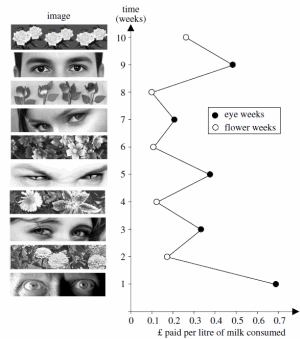
    When the students in a UK university coffee room saw a “voluntary” collection box as they got their coffee and tea, little did they know that they were guinea pigs of a psychology experiment! It was actually a “Honesty” box – meant to test how many of them paid for their drinks. The box was not the main tool in that experiment – there was this poster placed on the cupboard door above, which is right at the face of the person. Pictures of flowers were used as a poster for a week, but when it was replaced with a close up shot of menacing eyes, the collections increased dramatically. “People paid nearly three times as much for their drinks when eyes were displayed rather than” the flower image, writes Melissa Bateson in this study. See below, the results of the collection across weeks as the pictures were altered to mild mannered eyes in subsequent weeks! Though no one was watching (no CCTV cameras!), “the images exerted an automatic and unconscious effect on the participants’ perception that they were being watched”.

    honestybox

    The study concludes that the concerns of about reputation is a crucial factor when people decide to be honest.

    Many little cheaters

    We hit a threshold level for dishonesty which is not just influenced by our fear of losing reputation but also by our internal sense of integrity. This is the highlight of experiments on morality as described by the psychologist Dan Ariely in his famous book The Honest Truth about Dishonesty. Watch this TED talk if you are too busy to read the book.

    Participants were asked to write a math test and were allowed to verify the answers by themselves. They had to self-declare the results to the test conductor and were even encouraged to dispose the answer sheet in a paper shredder. Even when they had a good chance to cheat, only a small percentage of participants had stated they got all correct – the big cheaters. A vast majority of the participants indicated their answer count to be (only) slightly above their actual score (you see, the organizers knew the actual results; paper-shredding thing was just a trick). Even when the reward for the score was greatly increased, cheating levels of this large group of “little cheaters” did not increase much.

    Finally some facts: I have never cheated in my exams; I have paid all my taxes and have been (brutally) honest with my family, friends and my colleagues. My moral code has been mostly intact.

    But as I reflected on the ad, picturing the kid’s eyes light up with awe as he looks at his father, it dawned upon me that it is a blessing to be someone who is looked up, followed and watched, since we have a huge stake to lose by being dishonest.

  • Algebra for the faint hearted

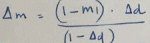
    Solve:

    equation

    Don’t worry, you have come to the right webpage and I promise this is not a treatise on mathematics. Be honest though, did you not sense a chill down your spine, when you glimpsed this algebraic equation? Even if you had been a bright student cracking such equations with aplomb, I bet you might have wondered, “Is this ever going to be useful in my real life?”

    Pressure instead of pleasure

    Most of us were fed such equations every day at school, when, all we wanted to do was to catch tadpoles. Especially when growing up in India, it was impossible for me to escape the scrutiny of teachers, parents and even neighbours when it came to scoring marks in maths exams. It was seen as the ultimate measure of one’s intelligence. I am not saying that learning maths was underwhelming nor am I questioning its purpose and application. As a matter of fact, there are many sites and blog posts illustrating the usage of such algebraic equations, trigonometry and the like.

    My argument is, we scare the kids and inflict pain on them with the way we introduce such concepts, when it could be actually so much fun for the kids to discover and learn intuitively.

    I share my recent experience – and the sheer pleasure – when I introduced the concept of algebra to my daughter, who will finish her primary school this year.

    Intuition vs techniques & short cuts

    Before getting into algebra, I wanted to ensure that her intuitive understanding of arithmetic is strong. For instance, she should be able to appreciate that the arithmetic operation of division (and thus fractions) is the same as the intuitive act of dividing a pizza and sharing the slices among us. I didn’t ask her that simple a question. I asked her this:

    Divide 50 by half.

    Did you have the number 25 flashing in your mind ? She too fell for it. Well, the answer is 100. The usual mathematical approach to explain the solution has been:

    Dividing 50  by (1/2) is the same as (50/1) x (2/1). Thus the answer is 50 x 2 = 100.

    However an intuitive way to understand this, is to use a real life example. Imagine 50 chocolate bars and consider you have to share those with a lot of children by cutting each chocolate by half. Now did 100 flash in your mind? I guess you didn’t have to strain your mind. Intuition. Which is our natural gift to learn maths (or anything) with a bit of fun.

    Understand infinity by intuition

    For instance, the concept of infinity is not easy to grasp by intuition. But let us try the same approach as above: If you slice an orange by half, you get two portions. If you slice it by one-thirds instead, you would get 3 portions. If you cut that fruit into thinner and thinner pieces (one-hundredth or even one millionth) you will be left with a large number of slices. Now attempt a thought leap to cut it into almost invisible slides (thinness=zero), you would get an infinite number of pieces.

    Thus 1/0 = ∞

    Marcus du Sautoy explains this and much more in his brilliant BBC TV series The Story of Maths. He narrates how the whole world, east and the west, have contributed to the evolution of mathematics across centuries.

    Algebra: plums, peaches, weights and the scale

    The word Algebra is derived from Arabic “al=jabr” meaning “re-union of broken parts” (source: Wikipedia). Marcus narrates how Chinese traders used an intuitive way to solve real world problems in the ancient times. One such problem is to determine the weight of a plum and a peach while they had the following situation:

    One plum and three peaches weigh 15 grams. Whereas, two plums and one peach together would weigh 10 grams. Their approach is as follows:

    The trader would place one plum and three peaches on one side of the scale, balancing with 15 grams on the other.  Now he would double on both ends of the scale by adding one more plum and three more peaches, which requires 30 grams to balance. Then he would go ahead and remove both the plums as well as one peach from the scale. Left with five peaches on one end, he would find that it takes 20 grams to balance the scale. Thus a peach would weigh 4 grams. It is then straightforward to deduct that a plum would be 3 grams in weight.

    This was a fun, intuitive way to solve a real world problem.

    Contrast this with the mechanical way of solving equations that I would have to teach her:

    Let a be the weight of a plum;

    Let b be the weight of a peach:

    Equation one:      a + 3b = 15

    Equation two:    2a +  b  = 10

    multiply equation one by 2:

    Equation three: 2a + 6b = 30

    Subtracting two from three gives us, 5b = 20, thus b = 4 and then you can use equation one to deduce a = 3

    Though this method would not torment her as such, I guess she would have little clue on what was accomplished in the end. At least with plums and peaches approach, even if she fails to solve the problem, she is only going to run away, with a healthy snack in hand!

    Maths by story tellers:

    I found Dan Meyer‘s blogs and Salman Khan‘s videos to be quite popular. They are some of the the new age gurus who have brought about a paradigm shift in the way maths is taught. When I assumed that this transformation is restricted to the US and developed countries, it was inspiring to watch the story of a math teacher in Morocco (Math in Morocco: Where Math Grows on Trees) which shows the passion with which he teaches an array of mathematical concepts by taking the children through a journey of growing olive trees in the school, measuring its produce, carrying the olives to a nearby traditional olive press powered by a camel.

    Must admit, I find myself immersed and lost in these stories a lot more than in teaching her any maths.

    We both love stories. Maths can wait!

  • How to get ready and miss a flight

    How to get ready and miss a flight

    “Get up and get ready! Don’t you have a flight to catch ?”, yelled my morning alarm at 4:00 am. I say, Snooze. But hey, you can’t snooze your wife, can you ?

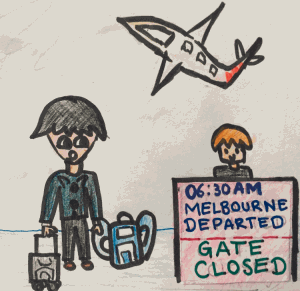
    All I had to do that day, was to reach Melbourne (from Canberra, where I live) in time for the workshop. The hour long flight departs at 6:30, which gives enough time some breakfast before the 9:30 am start. And if you know a bit about Canberra and its airport, you would know, you cannot miss your flight. Unless you start too late. There are no usual challenges like in other cities: bad traffic, long queues in the airport, etc. You find more staff in the airport than the travellers. And if there is no check-in luggage, it is sufficient to reach 30 minutes prior to the departure. (it takes just 15 from my place in the taxi).

    I was ready at 5, called a taxi at 5:45. And I missed the flight. For the first time in my life.

    Why didn’t I leave early? What was i doing (watching TV!). I never missed a deadline when I was in a rush. But this time it was different: I was ready well ahead of time but took it easy and kept pushing forward the task of calling the taxi.

    Under-estimation. Over-confidence. Sheer laziness. Lack of common sense. Un-professional. I cursed myself for basically, being dumb.

    It dawned upon me that this not the only occasion where I was late or being in a terrible rush. I had always been fascinated by the Just-in-time technique that was introduced to us as part of the training at my first job. However, I had been overlooking the effects of the ensuing uncertainty when you live on the edge. Joining a meeting on the dot, dropping off the kid at school gate just before the bell rings, completing my tasks at work in a hurry etc.

    But then, I have been reasonably successful at education and career. Having said that, all through my school and university days, I recalled, I never managed to stick to a schedule. Last minute revisions, late night push to cover more units before the exams, were typical. The nervous energy and the adrenaline rush contributed as much to my results as the preparation itself. Which begs the question: how did I survive when I had been so un-organized ?

    I procrastinate. Though it sounds better than saying I postpone things, it basically “is the avoidance of doing a task” (Wikipedia “pro”: forward; “cras”: tomorrow). Researching further, I was lead into a world of interesting people. Found this list of famous and highly successful procrastinators: The Dalai Lama, Victor Hugo, Leonardo da Vinci among others. Da Vinci in particular “had the reputation as a daydreamer who never actually finished anything”. His most famous work Monalisa took 16 years in the making. When he died, he was heard appealing to God, “Tell me if anything ever was done”.

    I didn’t have to paint Monalisa, though. Just had to perform well in the exams, pass an interview, get a job and complete my work assignments. I did day-dream (Google came about when my career started) and laze around while still getting the job done. Boy, it was always stressful trying to finish when you start so late!

    Further exploration on this subject lead to some bizarre stuff. Stanford Professor John Perry has written a whole book about this embarrassing behavior and ended up being awarded the Ig Nobel prize. I say, anyone who set the title of his book as “Art of Procrastination : A Guide to Effective Dawdling, Lollygagging, and Postponing, Including an Ingenious Program for Getting Things Done by Putting Them Off” deserves an award.

    He basically suggests to make a list of tasks that you have to do and keep that “Important” task aside. This suddenly eases the mind but he asks us to do any of the other tasks from the list. A nice trick to actually do things when we are busy procrastinating. He explains, “With this sort of appropriate task structure, the procrastinator becomes a useful citizen” and “an effective human being.” I like that.

    It makes sense. When we continue to avoid doing something we planned, perhaps it is worth listening to our instincts and question the purpose, motivation and relevance of that task. When we actually want to do something, we never delay.

    I chanced through this funny TED talk by Tim Urban “Inside the mind of a master procrastinator”, where he espouses the idea that we often fall for visible deadlines as the most important things in our life. While we completely overlook (he calls it long-term procrastination) “all kinds of important things outside of your career that don’t involve any deadlines, like seeing your family or exercising and taking care of your health, working on your relationship” etc.

    I eventually reached Melbourne with the next flight, missing the first session of the workshop and the breakfast. But I felt well-nourished that day.