Category: career

  • A beautiful mindset

    I have struggled with the word strategy all through my career. No, I haven’t struggled to make a plan or define a logical sequence of activities, but this whole strategising thing is something else that bothered me. How do you successfully get through to the other side of a challenging project to deliver, or an uncertain future for the product and team, or an unexpected change in career? Dealing with, and winning at these require more than grit or luck. Pure logic doesn’t help beyond a point. I have often heard from colleagues that life resembles a chess game, one to be mastered.

    I am bad at chess.

    My other problem is with the word, Art. There is an art for anything these days: “Art of speaking..”, “Art of writing…”, “Art of winning…” and of course, the ultimate “Art of living”. All my life, I was more into science and math, and I was particularly bad at art.

    Bad at art, and worse at chess, I have no hope then.

    I am good with reading books however, and to my pleasant surprise I landed on this book recently that carried both these words in its title: The Art of Strategy, A Game Theorist’s Guide to Success in Business and Life.

    One of the authors of this book is a professor in the US but of Indian origin, which made me think: after all, wasn’t the Indian civilisation that gave birth to Chaturanga, the predecessor of the modern chess game? Even the famous epic Mahabharatha revolves around a game of dice gone wrong for the Pandavas. India is also the place of Chanakya the philosopher-guru who authored Artha-Shastra – a treatise similar to the more famous Art of War.

    The definition of strategic thinking was very helpful: “the art of outdoing an adversary, knowing that the adversary is trying to do the same to you”, “art of convincing others, and even yourself, to do what you say.”, “art of putting yourself in others” shoes so as to predict and influence what they will do.

    Out of the many strategies and approaches, the common theme for me was the element of surprise, as a winning ingredient in any strategy, especially dealing with bullies. The authors explain the best strategy to confront a powerful and intimidating bully at school, at work, or even a dictator: a sudden, visible, unexpected act of defiance by the collective.
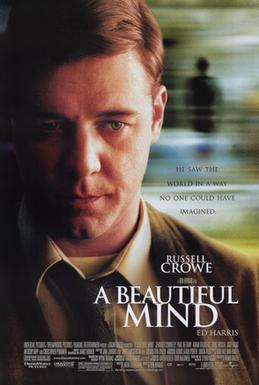
    The book as such is hard to finish, but there are some interesting parts not to be missed, especially the stories from world war, movie references (The Beautiful Mind, for example), and other real-life examples. The definitions of various game theory constructs eg. zero sum game, dominant strategy, Nash equilibrium etc. ) are well explained, until they loose you by going deep into the mathematics.

    Yet, there is more to unpack from this book. It says at one point, “All of us are strategists. It is better to be a good one, than a bad one”.

    That sounds to me a practical, if not a beautiful mindset.

  • A page from a book is more than that

    I notice my family, friends and acquaintances, not reading books.

    Some of them don’t have time in their lives right now, to dedicate an afternoon to even begin to read from a book they bought many years ago. This blog is not for them.

    A few don’t like to read books, they tell me. They have apparently lost interest in the written word. I am writing this piece, directly looking at them. Yes, I know who you are.

    I am kidding. I promise, I won’t preach why you should read. Nor would I prescribe a bunch of books on this last day of the year. I am kidding again.

    This is more about two moments from my 2021 trip around the sun. One acted as an anchor, giving me a sense of what I loved doing, and another that brought out the force in me, and gave direction.

    The Greeks again

    In February this year, on a lazy Saturday afternoon, I saw a tweet by a speech consultant @JohnfBowe. His article explained how two thousand years ago, the Greeks figured out that public speaking – the art of rhetoric – is a foundational skill to be acquired by everyone. Yeah, for once, it is not all about philosophy when it comes to the ancients.

    I ended up buying his book. It begins with the story of his cousin whose life takes a dramatic turn after joining Toastmasters. The guy never left basement until he was fifty nine years old, but soon got married, and overcame shyness (not necessarily in that order), helped by the world’s largest organisation devoted to the art of public speaking.

    John’s book made me reflect on the way I do presentations. Content is king, they say. I no longer start my preparations researching for what to include. The recipient(s) of the message take centre stage, more than the message itself. Audience is king.

    I reached out to the nearest club in Canberra. I wasn’t shy, but curious. I was welcomed into the Woden Valley Toastmasters club as a guest, a pivotal moment for me this year. I soon became a member, learning how to talk more clearly, persuasively but mainly, to keep the focus on my audience, what would be valuable to them. And to ramble less.

    Incidentally, around the same time in March, I got an opportunity to present SAP’s product strategy at a customer’s town hall meeting addressing roughly 150 members of their IT team. I remember spending more time on the question: What do I want them to think and feel, when I finish talking.

    A random tweet guided me to the book about ancient Greeks, eventually taking me to the Toastmasters, on my way to a successfully delivered talk.

    Winning is the (only) way

    Later in July, I faced a sudden bout of confusion and uncertainty about the way my role was perceived at work.

    One book brought back the fighter in me. It wasn’t a random tweet this time, but a slice of podcast conversation with the NBA star Chris Bosh talking about a book that shaped his thinking: The way and the power – Secrets of Japanese Strategy. Its about how a samurai master deals with confusion and uncertainty; one who controls his mind. One who would not lose. I ordered it immediately.

    I can’t say much more. But reading a couple of chapters, it felt as if I had flipped a switch in my mind. I woke up one morning and decided to win. Not merely adapt or survive or manage a situation. To win.

    You want the whole meal, not juice

    Why bother with a book these days, if one can acquire such insights through tweets and podcasts? I sense, reading a book – even skimming through a few pages – is way different than trying to grasp ideas distilled by someone else – a secondary process. It is the difference between eating a wholesome meal and drinking a juiced up version.

    A book could change the way you think about this world. Your world.

    Three sixty five days from now, on another new year eve, I will want to hear from you about the pages and words that influenced you.
    For the ones in my cohort too busy to read: One page consumes three minutes out of one thousand four hundred and forty minutes in a day. A typical book has three hundred pages.

    I rest my case.

  • Press Any Key to Continue…

    Press Any Key to Continue…

    My boss put two questions in front of me recently, during the half-yearly review meeting. “What is the aspect of the job that gives you joy” – a nice, ego-boosting leading question that lead to a delightful conversation.

    Her next question stumped me: “What is going to be your pet-project?”. “The one activity you could do on your own, during free time. Something you could come home to, when you have had an especially bad day”.

    I drew a blank.

    Homecoming

    This question is significant today, as we perceive time, work and life very differently than just a few months ago. During the pre-COVID era(?), a knowledge worker like me would have separated work and life – at least physically, straddling across office and home each day. We used to talk about work-life balance. These days, there is not much of a discussion about balance. It’s all a blur at the moment.

    A good blur, at least for me. I no longer need to get up worrying about ironing the shirt or to drive to work to be in time for the first meeting of the day. Time is aplenty. (My wife isn’t too excited though – having to come home each day only to see unwashed stained tea cups – one on the table, two lying on the floor and one missing).

    Sorry, I digress. The point is, a different sort of homecoming is necessary to keep our sanity.

    But, a pet-project ? You see, this phrase has two words that sound dangerous to the lazy-me: a pet needs maintenance, while a project needs diligent work towards completion.

    Spend, Manage or Invest ?

    On a serious note, what would i do with a bit of extra time ? Time = Money, they say. There was this crude poster i saw recently that compared how the poor, middle-class and rich deal with money:

    – the ones who have less, SPEND.

    – the ones who have moderate amount, MANAGE.

    – the ones who have excess, INVEST.

    How do i invest this little excess time? Typically i am bored, i look for interesting things in twitter (will write a blog one day, about the gems i discovered by following a few interesting people in twitter during this year), read a bit of philosophy/self-help books, watch movies (these days i’m into Turkish rom-coms). I also play a bit of amateur sports. However, i’m not serious about any of these things. I dabble.

    Making Choices

    To be serious about a pet-project, i have to generate a list of options, make a choice, invest time and energy, report on its progress, and show some result.

    Choice! If i have a, b, c, and d as choices, it is mainly a question of what appeals to me the most. What if there is something outside this list that suits me better? How do i know what i don’t know ?

    One would argue, it is not easy to make decisions even with clearly defined, discrete choices. The red or the blue pill, as Morpheus asks Neo in The Matrix.

    When my daughter and my nephew were toddlers, they used to fight for the best toy. Once, faced with a red and a green plastic trumpet, the kids couldn’t come to an agreement who gets what. It ended like this: my girl grabbed both the trumpets and offered the guy to choose one of those. As soon as he decided on the green one, she knew exactly what she liked. She snatched that very green trumpet from the hands of the baffled boy, and threw the red one to him.

    What to look for ?

    Life is easier as a child. I am more indecisive than ever before and struggling to answer a simple question, with no clear list of options, nor a play-mate to try out a decision tree.

    Perhaps this question should be framed as: what would you “work” on, given unlimited time & resources without any constraint whatsoever?

    I looked around for some quick inspiration – maybe mentors could help? Or the so-called thought leaders – like Paul Graham – who says in his blog, What Doesn’t Seem Like Work, “The stranger your tastes seem to other people, the stronger evidence they probably are of what you should do.” He ends by asking, “What seems like work to other people that doesn’t seem like work to you?”

    Unbounded and Unflattened

    When i look back at my life so far, someone or something has always driven me somewhere. A rank to achieve, a course to finish, a job to get, a project to complete, a step to climb in the corporate ladder, a problem to solve for a customer, etc. Even when i indulged in creative pursuits, there had always been constraints or a boundary.

    I am not sure how to wrest myself out of the set path – even if it is just for a hobby. Something different and random but not trivial; a pursuit that delivers pleasure but no expectation (i certainly don’t want additional responsibility and having to justify to anyone – including my nice and well-meaning manager, who surely will be reading this blog with a chuckle).

    Anything, that amounts to something in the end.

    Anything

    This reminded me of a story about Compaq computers: In the 1980s, their customer support team had to spend a lot of time explaining first-time computer users, who called up to ask “Where is the Any key in my keyboard?”. The users were confused by the message in the computer monitor that instructed them to “Press Any Key to Continue”.

    Where is my “any” key ?

  • An Original Copy

    “Can you prepare a document in two weeks’ time that maps our product offerings to the customer’s context?”. I didn’t understand why I was excited at this ask from the senior colleague. You see, in the past few years, I had been more assisting others to produce content – be it a solution proposal or a commercial document – as opposed to creating something on my own. Recent changes in the team meant I do a different role – one that requires me to prepare a collateral of innovation ideas, sales plays, case studies and customer stories.

    A week later, the excitement turned into a bit of nervousness. Up early on that weekend, I was coming to terms with the reality: I actually don’t know anything about this customer. Equally bad, I am out touch with recent innovations and product offerings. The feeling soon turned into anxiety, as I realised I have just a week to go and I hadn’t gathered certain details about this customer that I had expected to receive from a colleague.

    You can now imagine why I didn’t publish any blogs recently.

    Finishing a cup of coffee at 5:30 am, a moment of serendipity ensued. I gazed around the bookshelf and spotted my project report from the post-graduation days. Bayesian Theory based Troubleshooting Tree. We didn’t call it Machine Learning back then. “I did create a lot of content back then”. Rewinding further to the under graduate days, the mind wandered around the times of second year engineering, particularly of those anxious days before the Computer Programming exam.

    “Help me with Math and I teach you Computer Science”, a great deal offered by my class mate who was a computer nerd but (surprisingly) dreaded the mathematical elements of the Electro Magnetic Radiation course. He had some past experience in writing code, while here I was, having never touched a keyboard. I had to deal with this upcoming test on C, C++ and FORTRAN, while still confused by some basics of programming. For instance, I never got the difference between an “IF” and a “FOR” construct.

    I duly followed my part of the deal. We spent couple of weekends before the exam working out many mathematical equations and more importantly, some techniques in constructing answers to impress, and pass, of course. He was elated.

    When it was his turn to help me survive the programming test, however, he acted weird. Suddenly his PC went kaput. The subsequent weekend, his mom gave him an errand. Or he fell sick. I was left with facing a prospect of failing an exam for the first time in my life. I realised my class mate had ditched me. Prayers didn’t help either.

    On the day of the exam, seated on the front row of the bus to college, I still had an hour to do something. My neighbour was next to me – who was not (yet) a friend but one who went to the same college – and was busy going over a rugged old book on computer programming. I wondered out loud, how learning a different programming language (BASIC, if you remember) will help him write exam on C language. He then lectured me on how programming is all about logic, common sense and algorithms, and that syntax is just a means to an end while semantics is all that was important. As the time was ticking by, he shared some techniques like drawing boxes and arrows to construct a flowchart, and alerted me to write English sentences in a pseudocode before writing complicated coding statements in C++.

    All those things my bus friend taught me ended up saving my soul that day. I just had to translate what he said to the questions. I took quite a bit of creative liberties in answering that day. I wrote and wrote; didn’t finish until the last bell rang at 3 hours and 1 minute.

    How do I do it again, 25 years later for a different test ? A second bout of caffeine infused a bit of hope. I told myself, i can prepare that document, if I just stick to those exact techniques from those college days.

    I perhaps need more reminiscing from the past.

    I remembered how I made my own version of subject notes, in those days before internet and google: by corralling content from the original Russian author who wrote complex stuff about electron devices, simplify the language and complement by adding notes borrowed from those always-diligent-girls in the first row of our class. And splattering the boring textual content with mathematical equations, electronic network diagrams and name-dropping of jargons here and there.

    I also recall how a few class mates who had never interacted with me otherwise, would come up and say thanks. Little did I know that copies of my notes had reached far off places.

    This wandering trip to the past was just the kick I needed to get started with the document. During the next three hours, I googled and found many interesting details about this customer and their goals, strategies and what not. I also searched for content from internal corporate sites. Eventually I came up with a decent package. It was much easier than I had thought. The moment I realised I was creating something that does not exist, I began feeling lighter. And like those engineering subject papers, I ended up producing a comprehensive document that I felt proud of: an appealing construct of words, images, ideas and proposals.

    In the end, the deliverable was reasonably well received. While I still have apprehensions whether this is going to be greatly useful, it did serve a purpose: to make a start, a pitch and create something original, if I dare say that word.

    Because, it is quite controversial these days to claim anything original. We are inundated with content created by millions of people past and present. The fonts, colours, words, ideas and possibilities – are all out there. You just need to make a new sentence. Create a new perspective by mixing up things. There are several techniques in Lateral Thinking and Design Thinking that justify, or even encourage this copying – or building upon ideas from others.

    I sense what makes your copy original is the context that you bake in. Its a paradox, we all have our own signatures in our stories, creations – whether they are mails, documents, presentations, talks, even texts.

    Remember, you are unique.

    Just like everyone else in this world.

    PS: the scores from the Computer Programming exam from 1996: The mysterious class mate made 88 out of a 100. I surprised him as well as myself: a cool 78. Unfortunately, the bus friend who helped me out, ended up with much less. Perhaps, he stuck to the truth while I wrote a novel. In the end, he turned out be a better coder than many of us and is quite successful in the silicon valley nowadays.

  • Bookshelf tales – Hard landing on a Tipping point

    (This is part 2 of my Bookshelf tales. For part 1, click this link).

    All the preparations didn’t go in vain. I passed the interview and received my first job offer. With a lot of excitement, I moved to a new city to begin my career with Baan (a great company) along with three of my classmates and forty others in that batch (a great company).

    The day we landed, I noticed my friend unpacking more books than clothes from his luggage. He filled out half the wardrobe shelf with his books. Seven Habits of Highly effective People was one of the first books I borrowed from him. I remember feeling inadequate at that moment – after having ignored a friend’s dad’s advice before I left home. He was reminiscing on his bachelor days in Hyderabad many years ago and suggested that I avoid eating out and to do a lot of reading. I perhaps paid more attention to be one own’s cook than to pick up a book.

    Eventually, I began collecting (and reading) some books. I write about three of those, that provide colour and context to my first four years.

    The Goal” (…and how my trainer eliminated the job of a canteen clerk)

    “What is the goal of a company?”. Mr. Karan Rastogi, the trainer asked us as he began unravelling the concepts of Enterprise Resource Planning (ERP). Most of the answers were around producing goods that are useful to society or something in those lines. Mr. Rastogi clarified however, the main goal of any enterprise was to make money.  To be accurate, to create value – for shareholders, employees, and the society at large. It was all going over my head anyway. To make it easier for us, he narrated a story from his management consulting days.

    He was once asked by a major manufacturing company in the northern part of India to identify ways to reduce cost of operations. He learnt that all employees were provided subsidised food and tea at their canteen. A clerk was employed to manage tokens and the cash register. Initially, the workers were quite happy – being able to buy a meal for less than 50% of the cost outside. Soon there were complaints about the quality of food and the long queues in front of the billing counter. Mr. Rastogi initially performed a lot of algorithmic calculations based on Operations Management but soon came to a simple conclusion: it is best to fire the clerk and eliminate his job function, and provide free meals. The loss of revenue was more than made up by the increased employee morale (when they pay nothing, they didn’t complain even when the food was terrible).

    He suggested that we read a novel by Eliyahu M. Goldratt: The Goal, which is rated as one of the top 25 books in Business Management. Read how the central character in the book learns complex concepts like Theory of Constraints, Bottlenecks etc, from real life experiences as he resurrects his career as a struggling Shopfloor Manager. In particular, I enjoyed the part where he goes on a mountain hike with his children and their friends, as they follow each other in a sequence on the way up. Hours later, he finds the last few kids arriving much later than others – due to a fat kid in the middle who slowed down everyone behind. With the insight: “A chain is only as strong as its weakest link”, he goes back to work and fixes his production chain, thereby reducing inventory and increasing profit, thereby keeping his job and getting back with his wife.

    The Tipping Point

    As I was browsing through a book shop, I picked up this book that was at the end of the shelf and about to fall. What an odd (but appropriate) title, I thought. Tipping Point. A tip is a point after all. And the author’s last name is Gladwell. Well, I didn’t regret buying it though. It introduced me to the world of social sciences, especially how influential ideas spread virally in a social network (long before the age of Facebook). And more importantly, to non-fiction books that are as gripping as novels.

    “The Power of now”

    A bit of hard landing occurred in the first job as I struggled to deal with expectations. It was much easier to shine as a topper in a class room but not so in the real world. I also had to deal with a literal hard landing.

    One morning, I found myself flat on a hard, newly laid tar road, thrown from my Yamaha RX 135 bike as I narrowly avoided colliding with a patient exiting from an eye hospital, riding his bicycle across the road (he was still carrying some bandages in his face). I had four seconds to respond and I thought I did well not to kill him, even when he unknowingly tried his best to come straight at me with a single eye.

    In an eerie sort of coincidence, I had bought this book “Power of Now” only a couple of weeks before. While I was recovering from a surgery to my broken wrist, I thought it wouldn’t a bad idea to dip into this book about mindfulness and stuff. I couldn’t resist wondering why this happened to me. What if I had joined my friend in his bike that day. What if I had paid more attention during those four seconds. Or maybe earlier.

    A colleague tried to assuage me, “in our roads, even if you are 100% careful, you are only 50% safe.” That made me laugh while still at pain. My uncle’s friend saw me reading this book and said, “Kid, you have many years to go before you indulge in philosophy stuff. You need to do earthly things and struggle in life first.”

    That rang a bell. A year later, I was married and it was many months before I touched any book, especially philosophical ones.

  • Bookshelf tales – the first few pages

    Bookshelf tales – the first few pages

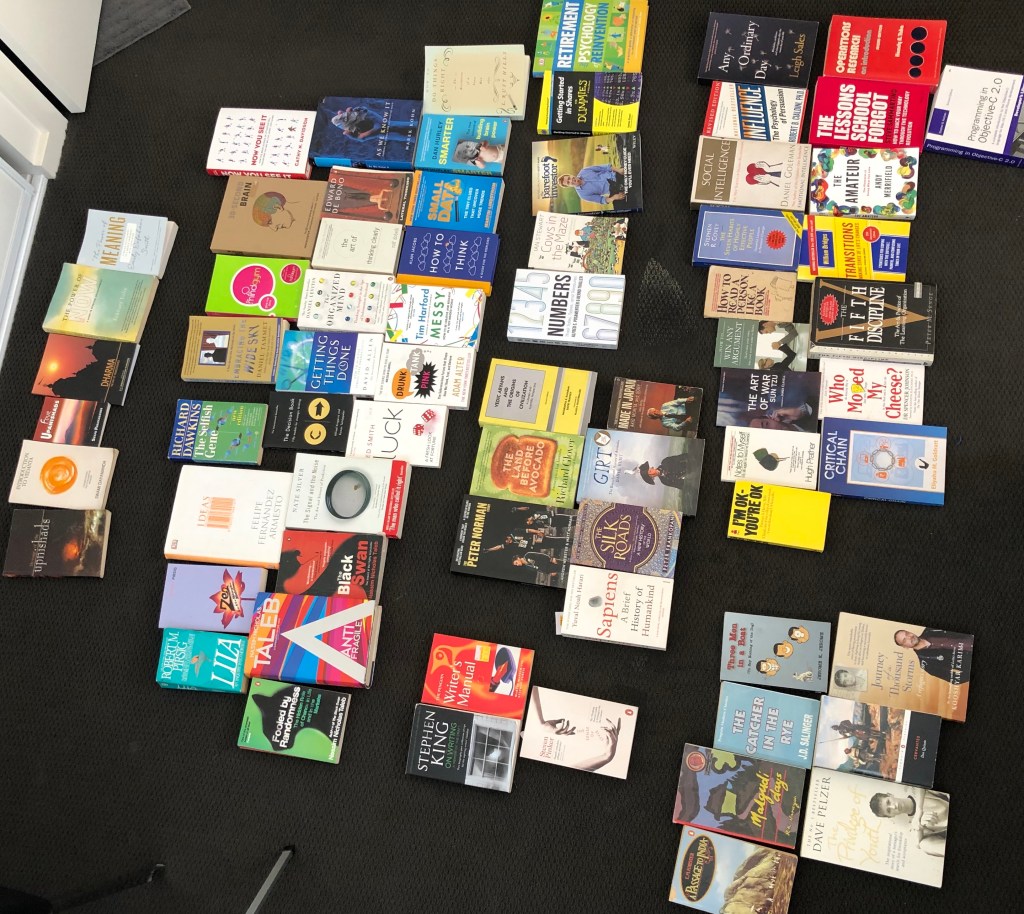
    A friend asked me if I could recommend some of the interesting books I have read over the years. I used that chance to finish an activity I had been running away from – to sort and categorise the books in my shelf. After a nice breakfast on the new year’s eve, I spread all books down on the floor. Looking over them, I wondered how I ended up with such a wide collection of bound pages containing many others’ thoughts and ideas, that I must have inhaled via tens of thousands of words over many a quiet afternoon. Some of these books were gifted to me; a few, I bought on friends’ recommendation; a lot were picked up at random, while waiting to board a train or a flight. Many of the pages are still to be read. A few, to be re-read.

    A couple of hours later, I ended up with a much cleaner bookshelf. And with a dust-triggered-repeated-sneezing-and-running-nose. Also with a mind-refresh of some hilarious but life-defining experiences associated with these books. I share some of these stories as a blog series, starting with this one.

    These books helped me once hide my insecurities and inferiority complex, pass a job interview, to converse better with strangers and to broaden my thinking. Also, to brag about stuff from time to time. More importantly, they made me = me++.

    Urgent: improve your personality. Interviews are coming!

    I look back at myself – Ramanathan of 1998. An eager but shy university student in Coimbatore, anxious about the upcoming season of job interviews. I was shaping up to be good engineering graduate alright, but I struggled to finish speaking a sentence in English – especially when standing in front of my class. We were expecting a couple of IT companies to visit our college to hire final-year graduates. They were going to test us on our math, analytical and verbal skills. They might also check if we were good at engineering. Most of us were worried about getting exposed on our (lack of) communication skills.

    As part of preparations, a bunch of enthusiastic class mates got together to organise group discussions. Candidates are seated in a group and given a topic to talk about. They are judged on what they spoke, but also the way they influenced the group’s final decision on the topic. While my smarter companions debated complex topics like Kyoto protocol, democracy, impact of foreign aid, etc. with ease, I would find myself blabbering nervously. I didn’t just struggle for words. I would often mis-pronounce even when I fished out a word for the occasion. Often, I didn’t have much to say, as I felt out of my depth on many worldly matters.

    It was clear. The “test” was not just going to be about one’s measure of arithmetic, vocabulary or ideas. It was a judgement on the whole personality. And here I was, a clumsy, slouching lean fellow who wouldn’t shave very often, bite nails when nervous. That was most of the time.

    Once I was in an activity where each one had to speak on any topic for two minutes. The group would take notes and provide feedback for improvement. I chose an easy topic: Time Management. I had made notes while I waited for my turn and when I spoke, I was able to explain the various techniques like planning, keeping a sense of time etc. They said I spoke reasonably well but were brutal in their assessment of my appearance: I was dibbling my finger, didn’t look at the audience and they also pointed out that I overshot my allotted time by three minutes as I laboured on about time management.

    My friends shared some tips and tricks, and alerted me about my annoying habits. For instance, it took a whole month of practicing to avoid retorting with “aaaah?” or “whaat?” instead of “Pardon, me?”.

    A class mate suggested that we organise a Personality Training Session for the whole class and gave me a reference of Mr. Suresh Punjabi, an expert who (even this day) conducts trainings for students in Coimbatore. We decided to try this first on our second year juniors. I got permission from our shy and equally nervous professor – he possessed enough weirdness to qualify as typical nutty-professor (would write a separate blog series on him one day). When Mr. Punjabi arrived at our college, I observed that he didn’t wear a turban. I also observed my professor being more eager to introduce him to our newly joined Principal. I wasn’t sure. I had not met this new principal yet and was pretty sure that would be the case with my professor too.

    Soon, we both welcomed our guest and ushered him into our principal’s room. The four of us were standing but no one said anything for a good five minutes, each waiting for some one else to break the silence. I assumed the principal waited for either me or the professor to tell him who the stranger is. Mr. Punjabi looked at me. I was looking at my professor who appeared shy, nervous and embarrassed at the sudden attention that he created for himself. With a quiet voice, still facing down, he threw these words towards the principal, pointing his finger roughly towards a direction between me and our esteemed guest. “Sir, please meet Mr. Suresh Punjabi”. The principal looked at me and shook my hand, “Thanks for coming, Mr. Punjabi”.

    Eventually, when we let him begin his session in the classroom, Mr. Punjabi took us through some of the basics of communication, appearance, manners and stuff. He also emphasised on learning how to wear a tie. Conversing with him on the way back, I felt more assured about myself. I vowed to never let the principal-room-situation occur again: to never be that invisible. To never stand there just blinking and being tentative.

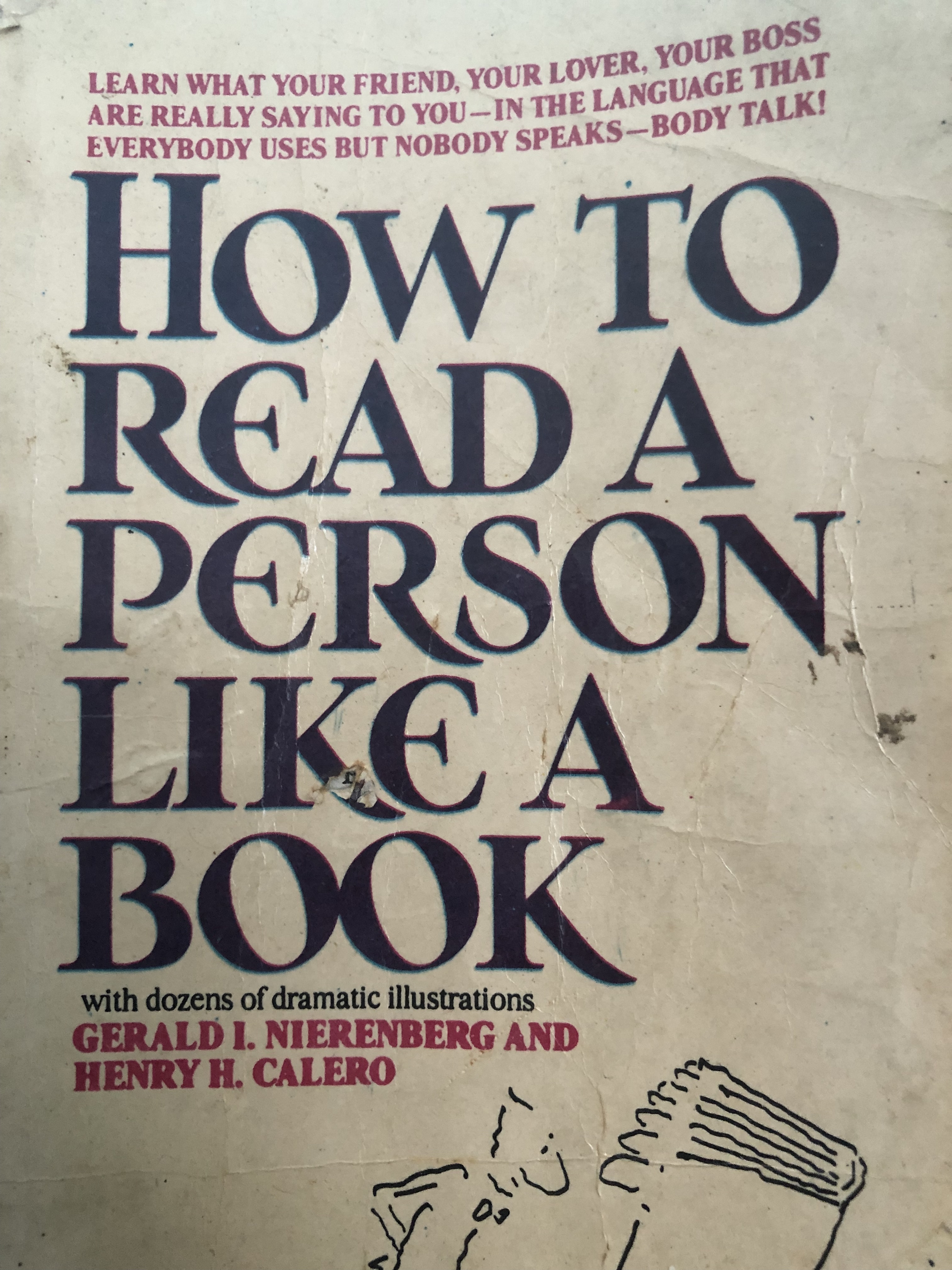
    Around the same time, I found an interesting book in my father’s bookshelf that usually had a collection of Dale Carnegie’s books and old copies of Readers Digest. How to Read a Person like a Book, was all about non verbal communication, body language – and the mastery of it. It had all the answers for me.

    img_1447

    Twenty years on, I still preserve this book. Yeah, the pages are rugged but the lessons are fresh, and still being learnt. Few years ago, when I switched roles from being in product development, to more of customer-facing project management, I paid the price for forgetting some of these lessons.

    While at a customer site, representing a group of engineers, I was annoyed by the customer who mistook my colleague as the project lead, talking to him most of the time, while I was left to wait for emails. It took a while to figure out: my colleague would always present himself in a suit and a tie, while I would often land in a semi-formal attire with a casual demeanour. That was a game-changer moment for me.

    But in 1998, this book enabled me to punch above my weight.

    When my class mates arranged for another round of preparatory group discussion, I felt I would fare better. Partly because the topic sounded easier, Also, by then, I had avoided keeping my hands nervously in my pocket when speaking; I no longer feared making eye-contact with class mates and didn’t bother if they faced me with a smirk. I slowly began opening up.

    I remember the feedback from the class mate – the designated judge that day. “Your gestures were awesome. You listened very well, often nodding your head positively, encouraging your opponents to speak. You didn’t interrupt anyone but, you didn’t say anything till the end”.

  • To carry an oil lamp to buy a trash bin

    The task was simple that evening, many years ago. We were four classmates beginning a new chapter in our lives: out of home, first job, new city, new apartment and the world to conquer. Two of us had to go get a trash bin for the house. The shop wasn’t far away and I wouldn’t complain anyway since this guy is quite a talker. He can explain the planets and cosmos while in the same breath turn philosophical or venture into the weird ways of the human mind. He once asked me, “think, what if you vanish one day and no one in this world remebered you”. We start walking the 300 metres to the bazaar. We see a small temple on the side of the road and he beings to wonder why religions exist in this world. I try to tell him we better hurry up before it rains.

    The small road leads to the bigger road at the intersection. We only had to cross the signal to get to the home furnishing shop. But then we see this new music shop crop up on our left and we walk right into it. This guy had introduced the western pop genre to me. And as someone used to listening mainly south Indian film music, the name savage garden sounded more like a filthy place full of violent beasts than a music album (until I fell in love with the animal song). With a couple of new music cassettes (it was 1999; CDs will come much later) as we started walking back home, we both realized our folly. We started telling each other how stupid it felt to be forgetful and wandering away from the simplest task of buying a waste bin . We discussed the root causes while at the same time began fearing the ridicule from the other two waiting for us.

    Why do we forget things and miss out on simple tasks or goals? Are we not serious enough? I am not even talking about life changing goals. Simple tasks that doesn’t need much thinking or planning. The office receptionist was laughing at me the other day, while making alternative arrangements as I had lost my id card and car park access card on consecutive days. I still don’t know where I kept them but I do recollect the thought stream in which I was drowned in during those days.

    Life as a tourist:

    Nassim Taleb has popularised the french word flâneur which loosely means wandering, idling or being explorative. It describes a tourist (who does not have a fixed itinerary) as opposed to a tour guide (who has mapped out a plan). Taleb explains the need to have a variety of options in life, career etc., so that you can take decisions opportunistically at every step, revising schedules or changing destinations. In the words of Yogi Berra “if you don’t know where you are going, you will end up somewhere else.” What if “somewhere else” turns to be more interesting and lucky?

    I feel strange when people talk about a one-year goal, three-year vision, five-year target etc. I never thought I would be in an IT job even a year before joining my first job when I was only worried about getting good grades in the electronics degree. You have no clue where you going most of the time but you usually have some sense of direction. I used to be quite stressed out about not being able to control the outcomes and worry about slipping away from the “plan”. These days, I only keep a view on the high level goals and leave the steps to its own dynamics.

    It feels like freedom as I go unstructured and unplanned once in a while, loosing myself into the world of new information, people, random corridor conversations, unexpected outcomes etc. It is OK since it feels more human and real. There is a parable about a guru teaching his disciple about methods of focussing the mind. He hands him a lamp brimming with oil that could spill if shaken even a tiny bit, and instructs him to walk around the temple. When the student succeeds at the daunting task, the guru asks him if he had a chance to marvel at the scenery: chirping of the birds in the tree, the smell of fresh flowers in the pond or the aesthetics of the temple. The student blinks as the guru points out the ultimate skill: the need to experience the world around as we focus on the task at hand.

    But 19 years ago, as my friend and I were walking on a road to buy a trash bin, we didn’t have to carry an oil lamp. As we were talking, we soaked-in the sights, smells and the sounds and lost ourselves in them. The trash bin remained in the shop.

    The other two roomies couldn’t control their laughter as we narrated our yet another failure to “get things done”. We told them how much we had been cursing at ourselves for being so absent-minded. Until when one of them wondered out loud, “when you guys started self-pitying, why didn’t it occur to you to just turn around, cross the road and walk into that bin shop?”

    Please visit the Home Page to read my other blogs…

  • One Word Answer

    “What is the meaning of life, the universe and everything?”. “Forty Two”, replied the supercomputer Deep Thought, in the science fiction comedy, The Hitch Hiker’s Guide to the Galaxy. I thought it was a joke when I watched this movie many years ago. A joke I wouldn’t understand.

    I am not known for keeping my responses crisp and short. You see, I already used two words to describe my predicament. It is my usual attempt to answer more than what the questioner might want to know. At work, I have been “advised” by my colleagues and managers to keep it simple. I am still trying.

    Some of us are able to pack a lot of content in the span of a few words. When we say less, it can also sound mysterious and can sometimes work in our favour.

    It isn’t funny however, when there is space for just one word while addressing matters of emergency. Fire fighters and police officers have a chance to shout a few words as they deal with life-and-death situations. Take for instance the recent death of a bungee jumper as she fell at the wrong time, when the instructor with poor English knowledge said “No jump” which she heard as “Now jump”. Or take the case of the Indian businessman charged with making a bomb threat in Mumbai (Bombay, previously) as he made a phone call to the airlines before his flight. Due to a bad line, he only managed to finish a part of his sentence “BOM-DEL flight”.

    A non-life-threatening word incident came to my mind as I went nostalgic about the first few days of my career that started in Hyderabad. After a session on the basics of Enterprise Resource Planning, the trainer wanted feedback from each of the 40 odd trainees. And we had to use a single, unique word to describe how it was conducted. I was fretting as I waited in the second row for my turn since the words “Interesting”, “Useful”, “Educational” etc were already taken by the lucky first benchers. I don’t even remember what I ended up saying but I recall the exuberance in the room when the last guy mentioned a word that had more than one meaning: “Impossible”.

    And to the bewildering answer of 42 to the big question about life and its meaning –  there are many theories. The author himself admitted it was a random number, trying to lay to rest many of the stories. I liked this one, however: Turns out, the ASCII code for the wildcard character “*” is 42. Wildcards in computer programming are used to represent one or more things. That is, “whatever you want it to be”. Sounds like a good short reply to the biggest question of it all.

    But, I was shy and confused during the first few days. I wanted to talk to a lot of people, learn many things, all at once. The MD of the Hyderabad delivery unit was an awesome communicator  and a nice guy. Little did I expect him to recognise me a few days later, when he greeted me calling my name as we entered the men’s room. The awkward silence that occurred when we were taking a leak at our respective commodes was broken by his enquiry, “So…Ram, how’s it going?”.  The one word answer that I uttered in the context of training sessions lead to a few seconds of silence before we both laughed. “Smooth”, I had said.

  • …and some dharma

    This is the part II of the blog that I started writing last week.

    A couple of weeks ago, I participated in a review session involving internal auditors who checked the sales contract document authored by my colleague – a sales lead who I collaborate with by providing a significant portion of the content. What started as an innocuous discussion, turned quickly to an intense scrutiny of many sections of the document, that gave rise to multiple follow up actions and meetings for the week. It also lead to the sticky question: who is responsible for the inadequate quality of content. Made me step back and ask a few hard questions to myself.

    The glorified title I have – Engagement Manager – hides a lot of trivial activities to be carried out. For instance, it takes a hell a lot of talking, emailing, negotiating,  waiting, worrying and sometimes escalating – to get people from various teams and geographies at short notice to agree on a business proposal. My mom once asked, “You seem to be talking all day, non stop. What do you actually do?”

    My role is not trivial however. Ever since I moved into this new job function, i have been super excited by the many facets that come part of it: beyond just being an expert of my line of business, I need to bridge the world of sales and delivery. I act like a diplomat sometimes, representing the huge remote delivery organisation that I was once part of, exhibiting adequate amounts of caution and risk management during the sales process. At the same time, I keep reminding myself that I’m part of the sales set up which requires me to be a catalyst and a collaborator. I feel like a amphibian.

    While the fun derived from working with great minds across the organisation (and our demanding customers) keeps me afloat, one is constantly challenged to come up with new ideas and business models that test the limits of our current processes and, the answer relies on innovation and speed.

    Alas, speed and accuracy are not the closest of cousins. I guess I got a bit carried away with the peripherals of my job and need to focus on the core part of it. The issue at hand was not just how to fix the quality issues being reported in the document, but also why I did not check the content in prior. Though it is not always feasible to compartmentalise responsibilities between us, my initial reaction was to shift the blame. Deep down however, the lurking sense of guilt hurt me badly.

    The mind looked for an easy and lazy way out of this problem. Maybe I’m over worked and burdened with the data deluge. Who am I kidding. I’m paid to pay attention. Isn’t that the most important aspect among others? I remember reading about the sense of duty illustrated by the thousands of inspection workers of Indian Railways. Every day they walk along the vast stretch of rail tracks looking for faults, hammering away any loose bolts. They are paid a pittance for the value they create.

    The lesson learnt is to keep focussing on the signal among the noise. Easier said than done. As I scrambled to figure out how to avoid such mishaps in future, my colleague went ahead and fixed the document.

    Later that week, a useful one-on-one conversation with my manager helped conclude this episode. I briefed him on the incident and asked how I could split responsibilities with my colleague. I explained the brain fade that occurred to me, and wondered out loud if the workload and the multi-dimensional aspect of my role were key contributors. He heard me out completely and shared some suggestions. He concluded the call saying, “But your role can be described much simpler than what you think: a gate-keeper.” I also felt the words he didn’t utter. Keep the good shit in and the bad shit out.

  • How to spot your friendly neighbourhood Mentor

    “Who is a Mentor?”, asked the trainer from The Smith Family – a charity organization that helps children from struggling background – as part of a corporate program I recently signed up to. I realised I had been too self-centred and decided it was high time I did something more than work, at work. If selected, I would be a mentor for a couple of school terms, spending an hour a week doing Q&A with students.

    Indian culture has had a word for this: Guru, which is loosely translated to the term Teacher. But a mentor is not just a teacher; a role model, a guide who helps us navigate this complex world. Co-traveller sounds more apt to me, since no one knows everything for sure. We just need to help each other out with what we learn along the way.

    I ended up answering her, “A mentor is someone who acts as a good reference point for others to emulate and learn”.

    I came away feeling nostalgic, reflecting on my own reference points during the growing up years. Would start with my parents who lived their ideals, working hard and keeping it simple. While I remember my mom helping me and my sister with homework during the primary school years, my father was instrumental in me venturing beyond regular academic stuff. He enrolled me for karate and Hindi lessons and later when I finished high school, he put me onto a personality development workshop conducted by an inter-religious organisation. Those were unheard of in the 1990s in a city like Coimbatore.

    I also remember being tutored by members of our large extended family when I was much younger. The many uncles and aunts who lived close by, the cousins who were in high school already were more helpful than my teachers at school, as I struggled with the spelling of King Dhritarashtra, perplexed with English grammar, confused by negative numbers, mugging up the definition of the species spirogyra. One of the summer vacation trips turned out to be an academic tour, with my cousin tasked with helping me pass an upcoming Hindi exam. And later when I was appearing complacent in my first job, my cousin brother alerted me about the Java wave that swept the IT world. I still remember trying to copy his elegant way of presenting himself for work, especially those blue stripped formal shirts.

    Neighbours turned out to be excellent teachers. Not the ones next to our house who were the quarrelling type. Im talking about the passionate Maths Vaathiyaar, who also taught Chemistry as a private tutor when he was not working for the government. He was more a family friend than a teacher; he was the one who instilled pride and confidence in my work. He also helped me score a 100 in Math and Chemistry. In fact my aspiration to get into a premier engineering institute was fuelled and fostered by such neighbours – and dad’s colleague’s son who was already studying there.

    Friends and colleagues teach a lot by not teaching. I owe my English speaking skills to a bunch of mates – one of them a neighbour too, whose terrace was our joint. Another friend’s friend even offered his house for more preparations as we pruned our linguistic skills for the job interview. Later, I got inspired to take reading as a serious hobby from my room mate who famously brought more bags of books than clothes to live in a new city as we started our careers together.

    We spend a third of our life time at work and thus it is important to recognise the formal and unconscious learning and positive influences we receive from colleagues, subordinates and bosses. I have learnt as much from people who I managed as from the many seniors I worked for.

    It is a tough mental exercise to list all my mentors in one go. I feel I have missed mentioning many more reference points. Our journey is shaped by the many masters we may never fully acknowledge. The true way to repay (Guru Dakshana) though, is for us to walk the path along these points, live a good life.

    Reminds me of a quote attributed to Dalai Lama: The Buddha says, “I am a finger pointing to the moon. Don’t look at me; look at the moon.”