Author: Ram

  • Algebra for the faint hearted

    Solve:

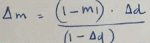
    equation

    Don’t worry, you have come to the right webpage and I promise this is not a treatise on mathematics. Be honest though, did you not sense a chill down your spine, when you glimpsed this algebraic equation? Even if you had been a bright student cracking such equations with aplomb, I bet you might have wondered, “Is this ever going to be useful in my real life?”

    Pressure instead of pleasure

    Most of us were fed such equations every day at school, when, all we wanted to do was to catch tadpoles. Especially when growing up in India, it was impossible for me to escape the scrutiny of teachers, parents and even neighbours when it came to scoring marks in maths exams. It was seen as the ultimate measure of one’s intelligence. I am not saying that learning maths was underwhelming nor am I questioning its purpose and application. As a matter of fact, there are many sites and blog posts illustrating the usage of such algebraic equations, trigonometry and the like.

    My argument is, we scare the kids and inflict pain on them with the way we introduce such concepts, when it could be actually so much fun for the kids to discover and learn intuitively.

    I share my recent experience – and the sheer pleasure – when I introduced the concept of algebra to my daughter, who will finish her primary school this year.

    Intuition vs techniques & short cuts

    Before getting into algebra, I wanted to ensure that her intuitive understanding of arithmetic is strong. For instance, she should be able to appreciate that the arithmetic operation of division (and thus fractions) is the same as the intuitive act of dividing a pizza and sharing the slices among us. I didn’t ask her that simple a question. I asked her this:

    Divide 50 by half.

    Did you have the number 25 flashing in your mind ? She too fell for it. Well, the answer is 100. The usual mathematical approach to explain the solution has been:

    Dividing 50  by (1/2) is the same as (50/1) x (2/1). Thus the answer is 50 x 2 = 100.

    However an intuitive way to understand this, is to use a real life example. Imagine 50 chocolate bars and consider you have to share those with a lot of children by cutting each chocolate by half. Now did 100 flash in your mind? I guess you didn’t have to strain your mind. Intuition. Which is our natural gift to learn maths (or anything) with a bit of fun.

    Understand infinity by intuition

    For instance, the concept of infinity is not easy to grasp by intuition. But let us try the same approach as above: If you slice an orange by half, you get two portions. If you slice it by one-thirds instead, you would get 3 portions. If you cut that fruit into thinner and thinner pieces (one-hundredth or even one millionth) you will be left with a large number of slices. Now attempt a thought leap to cut it into almost invisible slides (thinness=zero), you would get an infinite number of pieces.

    Thus 1/0 = ∞

    Marcus du Sautoy explains this and much more in his brilliant BBC TV series The Story of Maths. He narrates how the whole world, east and the west, have contributed to the evolution of mathematics across centuries.

    Algebra: plums, peaches, weights and the scale

    The word Algebra is derived from Arabic “al=jabr” meaning “re-union of broken parts” (source: Wikipedia). Marcus narrates how Chinese traders used an intuitive way to solve real world problems in the ancient times. One such problem is to determine the weight of a plum and a peach while they had the following situation:

    One plum and three peaches weigh 15 grams. Whereas, two plums and one peach together would weigh 10 grams. Their approach is as follows:

    The trader would place one plum and three peaches on one side of the scale, balancing with 15 grams on the other.  Now he would double on both ends of the scale by adding one more plum and three more peaches, which requires 30 grams to balance. Then he would go ahead and remove both the plums as well as one peach from the scale. Left with five peaches on one end, he would find that it takes 20 grams to balance the scale. Thus a peach would weigh 4 grams. It is then straightforward to deduct that a plum would be 3 grams in weight.

    This was a fun, intuitive way to solve a real world problem.

    Contrast this with the mechanical way of solving equations that I would have to teach her:

    Let a be the weight of a plum;

    Let b be the weight of a peach:

    Equation one:      a + 3b = 15

    Equation two:    2a +  b  = 10

    multiply equation one by 2:

    Equation three: 2a + 6b = 30

    Subtracting two from three gives us, 5b = 20, thus b = 4 and then you can use equation one to deduce a = 3

    Though this method would not torment her as such, I guess she would have little clue on what was accomplished in the end. At least with plums and peaches approach, even if she fails to solve the problem, she is only going to run away, with a healthy snack in hand!

    Maths by story tellers:

    I found Dan Meyer‘s blogs and Salman Khan‘s videos to be quite popular. They are some of the the new age gurus who have brought about a paradigm shift in the way maths is taught. When I assumed that this transformation is restricted to the US and developed countries, it was inspiring to watch the story of a math teacher in Morocco (Math in Morocco: Where Math Grows on Trees) which shows the passion with which he teaches an array of mathematical concepts by taking the children through a journey of growing olive trees in the school, measuring its produce, carrying the olives to a nearby traditional olive press powered by a camel.

    Must admit, I find myself immersed and lost in these stories a lot more than in teaching her any maths.

    We both love stories. Maths can wait!

  • How to get ready and miss a flight

    How to get ready and miss a flight

    “Get up and get ready! Don’t you have a flight to catch ?”, yelled my morning alarm at 4:00 am. I say, Snooze. But hey, you can’t snooze your wife, can you ?

    All I had to do that day, was to reach Melbourne (from Canberra, where I live) in time for the workshop. The hour long flight departs at 6:30, which gives enough time some breakfast before the 9:30 am start. And if you know a bit about Canberra and its airport, you would know, you cannot miss your flight. Unless you start too late. There are no usual challenges like in other cities: bad traffic, long queues in the airport, etc. You find more staff in the airport than the travellers. And if there is no check-in luggage, it is sufficient to reach 30 minutes prior to the departure. (it takes just 15 from my place in the taxi).

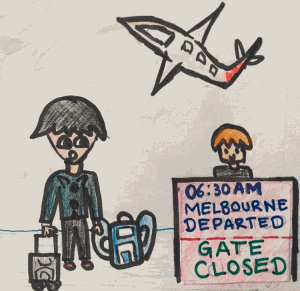
    I was ready at 5, called a taxi at 5:45. And I missed the flight. For the first time in my life.

    Why didn’t I leave early? What was i doing (watching TV!). I never missed a deadline when I was in a rush. But this time it was different: I was ready well ahead of time but took it easy and kept pushing forward the task of calling the taxi.

    Under-estimation. Over-confidence. Sheer laziness. Lack of common sense. Un-professional. I cursed myself for basically, being dumb.

    It dawned upon me that this not the only occasion where I was late or being in a terrible rush. I had always been fascinated by the Just-in-time technique that was introduced to us as part of the training at my first job. However, I had been overlooking the effects of the ensuing uncertainty when you live on the edge. Joining a meeting on the dot, dropping off the kid at school gate just before the bell rings, completing my tasks at work in a hurry etc.

    But then, I have been reasonably successful at education and career. Having said that, all through my school and university days, I recalled, I never managed to stick to a schedule. Last minute revisions, late night push to cover more units before the exams, were typical. The nervous energy and the adrenaline rush contributed as much to my results as the preparation itself. Which begs the question: how did I survive when I had been so un-organized ?

    I procrastinate. Though it sounds better than saying I postpone things, it basically “is the avoidance of doing a task” (Wikipedia “pro”: forward; “cras”: tomorrow). Researching further, I was lead into a world of interesting people. Found this list of famous and highly successful procrastinators: The Dalai Lama, Victor Hugo, Leonardo da Vinci among others. Da Vinci in particular “had the reputation as a daydreamer who never actually finished anything”. His most famous work Monalisa took 16 years in the making. When he died, he was heard appealing to God, “Tell me if anything ever was done”.

    I didn’t have to paint Monalisa, though. Just had to perform well in the exams, pass an interview, get a job and complete my work assignments. I did day-dream (Google came about when my career started) and laze around while still getting the job done. Boy, it was always stressful trying to finish when you start so late!

    Further exploration on this subject lead to some bizarre stuff. Stanford Professor John Perry has written a whole book about this embarrassing behavior and ended up being awarded the Ig Nobel prize. I say, anyone who set the title of his book as “Art of Procrastination : A Guide to Effective Dawdling, Lollygagging, and Postponing, Including an Ingenious Program for Getting Things Done by Putting Them Off” deserves an award.

    He basically suggests to make a list of tasks that you have to do and keep that “Important” task aside. This suddenly eases the mind but he asks us to do any of the other tasks from the list. A nice trick to actually do things when we are busy procrastinating. He explains, “With this sort of appropriate task structure, the procrastinator becomes a useful citizen” and “an effective human being.” I like that.

    It makes sense. When we continue to avoid doing something we planned, perhaps it is worth listening to our instincts and question the purpose, motivation and relevance of that task. When we actually want to do something, we never delay.

    I chanced through this funny TED talk by Tim Urban “Inside the mind of a master procrastinator”, where he espouses the idea that we often fall for visible deadlines as the most important things in our life. While we completely overlook (he calls it long-term procrastination) “all kinds of important things outside of your career that don’t involve any deadlines, like seeing your family or exercising and taking care of your health, working on your relationship” etc.

    I eventually reached Melbourne with the next flight, missing the first session of the workshop and the breakfast. But I felt well-nourished that day.