Author: Ram

  • An Original Copy

    “Can you prepare a document in two weeks’ time that maps our product offerings to the customer’s context?”. I didn’t understand why I was excited at this ask from the senior colleague. You see, in the past few years, I had been more assisting others to produce content – be it a solution proposal or a commercial document – as opposed to creating something on my own. Recent changes in the team meant I do a different role – one that requires me to prepare a collateral of innovation ideas, sales plays, case studies and customer stories.

    A week later, the excitement turned into a bit of nervousness. Up early on that weekend, I was coming to terms with the reality: I actually don’t know anything about this customer. Equally bad, I am out touch with recent innovations and product offerings. The feeling soon turned into anxiety, as I realised I have just a week to go and I hadn’t gathered certain details about this customer that I had expected to receive from a colleague.

    You can now imagine why I didn’t publish any blogs recently.

    Finishing a cup of coffee at 5:30 am, a moment of serendipity ensued. I gazed around the bookshelf and spotted my project report from the post-graduation days. Bayesian Theory based Troubleshooting Tree. We didn’t call it Machine Learning back then. “I did create a lot of content back then”. Rewinding further to the under graduate days, the mind wandered around the times of second year engineering, particularly of those anxious days before the Computer Programming exam.

    “Help me with Math and I teach you Computer Science”, a great deal offered by my class mate who was a computer nerd but (surprisingly) dreaded the mathematical elements of the Electro Magnetic Radiation course. He had some past experience in writing code, while here I was, having never touched a keyboard. I had to deal with this upcoming test on C, C++ and FORTRAN, while still confused by some basics of programming. For instance, I never got the difference between an “IF” and a “FOR” construct.

    I duly followed my part of the deal. We spent couple of weekends before the exam working out many mathematical equations and more importantly, some techniques in constructing answers to impress, and pass, of course. He was elated.

    When it was his turn to help me survive the programming test, however, he acted weird. Suddenly his PC went kaput. The subsequent weekend, his mom gave him an errand. Or he fell sick. I was left with facing a prospect of failing an exam for the first time in my life. I realised my class mate had ditched me. Prayers didn’t help either.

    On the day of the exam, seated on the front row of the bus to college, I still had an hour to do something. My neighbour was next to me – who was not (yet) a friend but one who went to the same college – and was busy going over a rugged old book on computer programming. I wondered out loud, how learning a different programming language (BASIC, if you remember) will help him write exam on C language. He then lectured me on how programming is all about logic, common sense and algorithms, and that syntax is just a means to an end while semantics is all that was important. As the time was ticking by, he shared some techniques like drawing boxes and arrows to construct a flowchart, and alerted me to write English sentences in a pseudocode before writing complicated coding statements in C++.

    All those things my bus friend taught me ended up saving my soul that day. I just had to translate what he said to the questions. I took quite a bit of creative liberties in answering that day. I wrote and wrote; didn’t finish until the last bell rang at 3 hours and 1 minute.

    How do I do it again, 25 years later for a different test ? A second bout of caffeine infused a bit of hope. I told myself, i can prepare that document, if I just stick to those exact techniques from those college days.

    I perhaps need more reminiscing from the past.

    I remembered how I made my own version of subject notes, in those days before internet and google: by corralling content from the original Russian author who wrote complex stuff about electron devices, simplify the language and complement by adding notes borrowed from those always-diligent-girls in the first row of our class. And splattering the boring textual content with mathematical equations, electronic network diagrams and name-dropping of jargons here and there.

    I also recall how a few class mates who had never interacted with me otherwise, would come up and say thanks. Little did I know that copies of my notes had reached far off places.

    This wandering trip to the past was just the kick I needed to get started with the document. During the next three hours, I googled and found many interesting details about this customer and their goals, strategies and what not. I also searched for content from internal corporate sites. Eventually I came up with a decent package. It was much easier than I had thought. The moment I realised I was creating something that does not exist, I began feeling lighter. And like those engineering subject papers, I ended up producing a comprehensive document that I felt proud of: an appealing construct of words, images, ideas and proposals.

    In the end, the deliverable was reasonably well received. While I still have apprehensions whether this is going to be greatly useful, it did serve a purpose: to make a start, a pitch and create something original, if I dare say that word.

    Because, it is quite controversial these days to claim anything original. We are inundated with content created by millions of people past and present. The fonts, colours, words, ideas and possibilities – are all out there. You just need to make a new sentence. Create a new perspective by mixing up things. There are several techniques in Lateral Thinking and Design Thinking that justify, or even encourage this copying – or building upon ideas from others.

    I sense what makes your copy original is the context that you bake in. Its a paradox, we all have our own signatures in our stories, creations – whether they are mails, documents, presentations, talks, even texts.

    Remember, you are unique.

    Just like everyone else in this world.

    PS: the scores from the Computer Programming exam from 1996: The mysterious class mate made 88 out of a 100. I surprised him as well as myself: a cool 78. Unfortunately, the bus friend who helped me out, ended up with much less. Perhaps, he stuck to the truth while I wrote a novel. In the end, he turned out be a better coder than many of us and is quite successful in the silicon valley nowadays.

  • Bookshelf tales – Hard landing on a Tipping point

    (This is part 2 of my Bookshelf tales. For part 1, click this link).

    All the preparations didn’t go in vain. I passed the interview and received my first job offer. With a lot of excitement, I moved to a new city to begin my career with Baan (a great company) along with three of my classmates and forty others in that batch (a great company).

    The day we landed, I noticed my friend unpacking more books than clothes from his luggage. He filled out half the wardrobe shelf with his books. Seven Habits of Highly effective People was one of the first books I borrowed from him. I remember feeling inadequate at that moment – after having ignored a friend’s dad’s advice before I left home. He was reminiscing on his bachelor days in Hyderabad many years ago and suggested that I avoid eating out and to do a lot of reading. I perhaps paid more attention to be one own’s cook than to pick up a book.

    Eventually, I began collecting (and reading) some books. I write about three of those, that provide colour and context to my first four years.

    The Goal” (…and how my trainer eliminated the job of a canteen clerk)

    “What is the goal of a company?”. Mr. Karan Rastogi, the trainer asked us as he began unravelling the concepts of Enterprise Resource Planning (ERP). Most of the answers were around producing goods that are useful to society or something in those lines. Mr. Rastogi clarified however, the main goal of any enterprise was to make money.  To be accurate, to create value – for shareholders, employees, and the society at large. It was all going over my head anyway. To make it easier for us, he narrated a story from his management consulting days.

    He was once asked by a major manufacturing company in the northern part of India to identify ways to reduce cost of operations. He learnt that all employees were provided subsidised food and tea at their canteen. A clerk was employed to manage tokens and the cash register. Initially, the workers were quite happy – being able to buy a meal for less than 50% of the cost outside. Soon there were complaints about the quality of food and the long queues in front of the billing counter. Mr. Rastogi initially performed a lot of algorithmic calculations based on Operations Management but soon came to a simple conclusion: it is best to fire the clerk and eliminate his job function, and provide free meals. The loss of revenue was more than made up by the increased employee morale (when they pay nothing, they didn’t complain even when the food was terrible).

    He suggested that we read a novel by Eliyahu M. Goldratt: The Goal, which is rated as one of the top 25 books in Business Management. Read how the central character in the book learns complex concepts like Theory of Constraints, Bottlenecks etc, from real life experiences as he resurrects his career as a struggling Shopfloor Manager. In particular, I enjoyed the part where he goes on a mountain hike with his children and their friends, as they follow each other in a sequence on the way up. Hours later, he finds the last few kids arriving much later than others – due to a fat kid in the middle who slowed down everyone behind. With the insight: “A chain is only as strong as its weakest link”, he goes back to work and fixes his production chain, thereby reducing inventory and increasing profit, thereby keeping his job and getting back with his wife.

    The Tipping Point

    As I was browsing through a book shop, I picked up this book that was at the end of the shelf and about to fall. What an odd (but appropriate) title, I thought. Tipping Point. A tip is a point after all. And the author’s last name is Gladwell. Well, I didn’t regret buying it though. It introduced me to the world of social sciences, especially how influential ideas spread virally in a social network (long before the age of Facebook). And more importantly, to non-fiction books that are as gripping as novels.

    “The Power of now”

    A bit of hard landing occurred in the first job as I struggled to deal with expectations. It was much easier to shine as a topper in a class room but not so in the real world. I also had to deal with a literal hard landing.

    One morning, I found myself flat on a hard, newly laid tar road, thrown from my Yamaha RX 135 bike as I narrowly avoided colliding with a patient exiting from an eye hospital, riding his bicycle across the road (he was still carrying some bandages in his face). I had four seconds to respond and I thought I did well not to kill him, even when he unknowingly tried his best to come straight at me with a single eye.

    In an eerie sort of coincidence, I had bought this book “Power of Now” only a couple of weeks before. While I was recovering from a surgery to my broken wrist, I thought it wouldn’t a bad idea to dip into this book about mindfulness and stuff. I couldn’t resist wondering why this happened to me. What if I had joined my friend in his bike that day. What if I had paid more attention during those four seconds. Or maybe earlier.

    A colleague tried to assuage me, “in our roads, even if you are 100% careful, you are only 50% safe.” That made me laugh while still at pain. My uncle’s friend saw me reading this book and said, “Kid, you have many years to go before you indulge in philosophy stuff. You need to do earthly things and struggle in life first.”

    That rang a bell. A year later, I was married and it was many months before I touched any book, especially philosophical ones.

  • Bookshelf tales – the first few pages

    Bookshelf tales – the first few pages

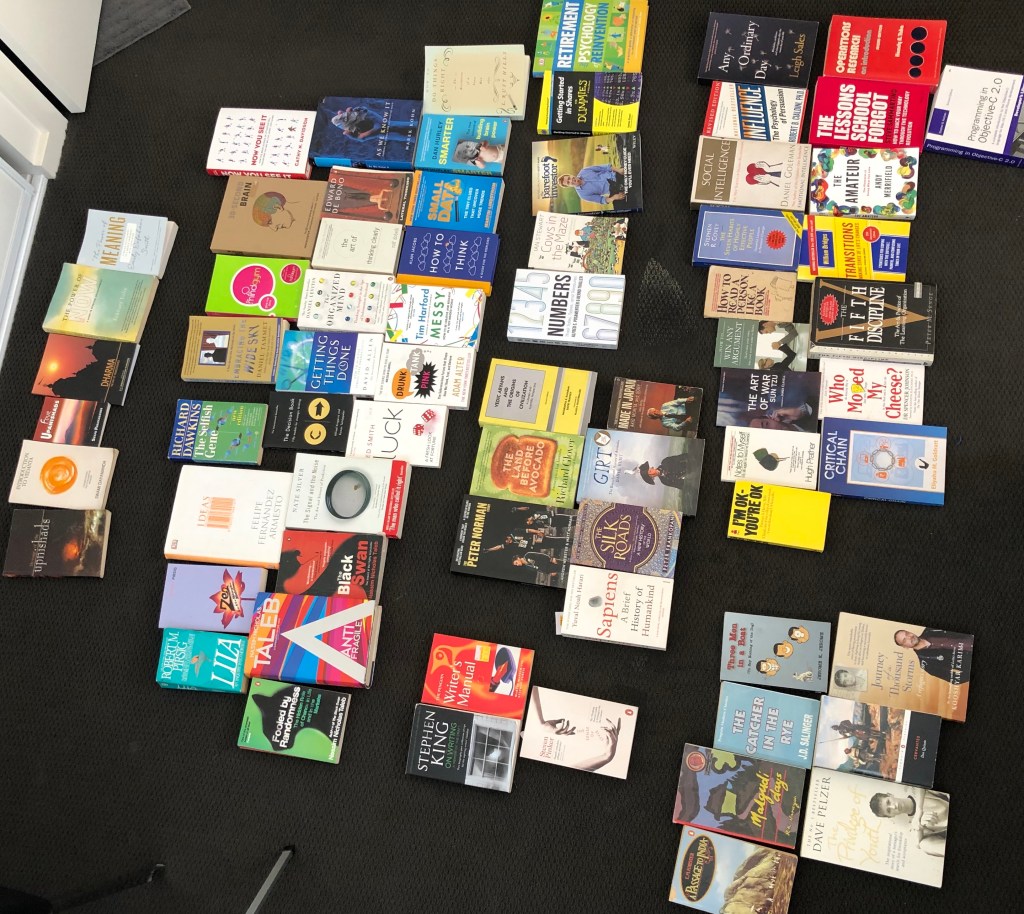
    A friend asked me if I could recommend some of the interesting books I have read over the years. I used that chance to finish an activity I had been running away from – to sort and categorise the books in my shelf. After a nice breakfast on the new year’s eve, I spread all books down on the floor. Looking over them, I wondered how I ended up with such a wide collection of bound pages containing many others’ thoughts and ideas, that I must have inhaled via tens of thousands of words over many a quiet afternoon. Some of these books were gifted to me; a few, I bought on friends’ recommendation; a lot were picked up at random, while waiting to board a train or a flight. Many of the pages are still to be read. A few, to be re-read.

    A couple of hours later, I ended up with a much cleaner bookshelf. And with a dust-triggered-repeated-sneezing-and-running-nose. Also with a mind-refresh of some hilarious but life-defining experiences associated with these books. I share some of these stories as a blog series, starting with this one.

    These books helped me once hide my insecurities and inferiority complex, pass a job interview, to converse better with strangers and to broaden my thinking. Also, to brag about stuff from time to time. More importantly, they made me = me++.

    Urgent: improve your personality. Interviews are coming!

    I look back at myself – Ramanathan of 1998. An eager but shy university student in Coimbatore, anxious about the upcoming season of job interviews. I was shaping up to be good engineering graduate alright, but I struggled to finish speaking a sentence in English – especially when standing in front of my class. We were expecting a couple of IT companies to visit our college to hire final-year graduates. They were going to test us on our math, analytical and verbal skills. They might also check if we were good at engineering. Most of us were worried about getting exposed on our (lack of) communication skills.

    As part of preparations, a bunch of enthusiastic class mates got together to organise group discussions. Candidates are seated in a group and given a topic to talk about. They are judged on what they spoke, but also the way they influenced the group’s final decision on the topic. While my smarter companions debated complex topics like Kyoto protocol, democracy, impact of foreign aid, etc. with ease, I would find myself blabbering nervously. I didn’t just struggle for words. I would often mis-pronounce even when I fished out a word for the occasion. Often, I didn’t have much to say, as I felt out of my depth on many worldly matters.

    It was clear. The “test” was not just going to be about one’s measure of arithmetic, vocabulary or ideas. It was a judgement on the whole personality. And here I was, a clumsy, slouching lean fellow who wouldn’t shave very often, bite nails when nervous. That was most of the time.

    Once I was in an activity where each one had to speak on any topic for two minutes. The group would take notes and provide feedback for improvement. I chose an easy topic: Time Management. I had made notes while I waited for my turn and when I spoke, I was able to explain the various techniques like planning, keeping a sense of time etc. They said I spoke reasonably well but were brutal in their assessment of my appearance: I was dibbling my finger, didn’t look at the audience and they also pointed out that I overshot my allotted time by three minutes as I laboured on about time management.

    My friends shared some tips and tricks, and alerted me about my annoying habits. For instance, it took a whole month of practicing to avoid retorting with “aaaah?” or “whaat?” instead of “Pardon, me?”.

    A class mate suggested that we organise a Personality Training Session for the whole class and gave me a reference of Mr. Suresh Punjabi, an expert who (even this day) conducts trainings for students in Coimbatore. We decided to try this first on our second year juniors. I got permission from our shy and equally nervous professor – he possessed enough weirdness to qualify as typical nutty-professor (would write a separate blog series on him one day). When Mr. Punjabi arrived at our college, I observed that he didn’t wear a turban. I also observed my professor being more eager to introduce him to our newly joined Principal. I wasn’t sure. I had not met this new principal yet and was pretty sure that would be the case with my professor too.

    Soon, we both welcomed our guest and ushered him into our principal’s room. The four of us were standing but no one said anything for a good five minutes, each waiting for some one else to break the silence. I assumed the principal waited for either me or the professor to tell him who the stranger is. Mr. Punjabi looked at me. I was looking at my professor who appeared shy, nervous and embarrassed at the sudden attention that he created for himself. With a quiet voice, still facing down, he threw these words towards the principal, pointing his finger roughly towards a direction between me and our esteemed guest. “Sir, please meet Mr. Suresh Punjabi”. The principal looked at me and shook my hand, “Thanks for coming, Mr. Punjabi”.

    Eventually, when we let him begin his session in the classroom, Mr. Punjabi took us through some of the basics of communication, appearance, manners and stuff. He also emphasised on learning how to wear a tie. Conversing with him on the way back, I felt more assured about myself. I vowed to never let the principal-room-situation occur again: to never be that invisible. To never stand there just blinking and being tentative.

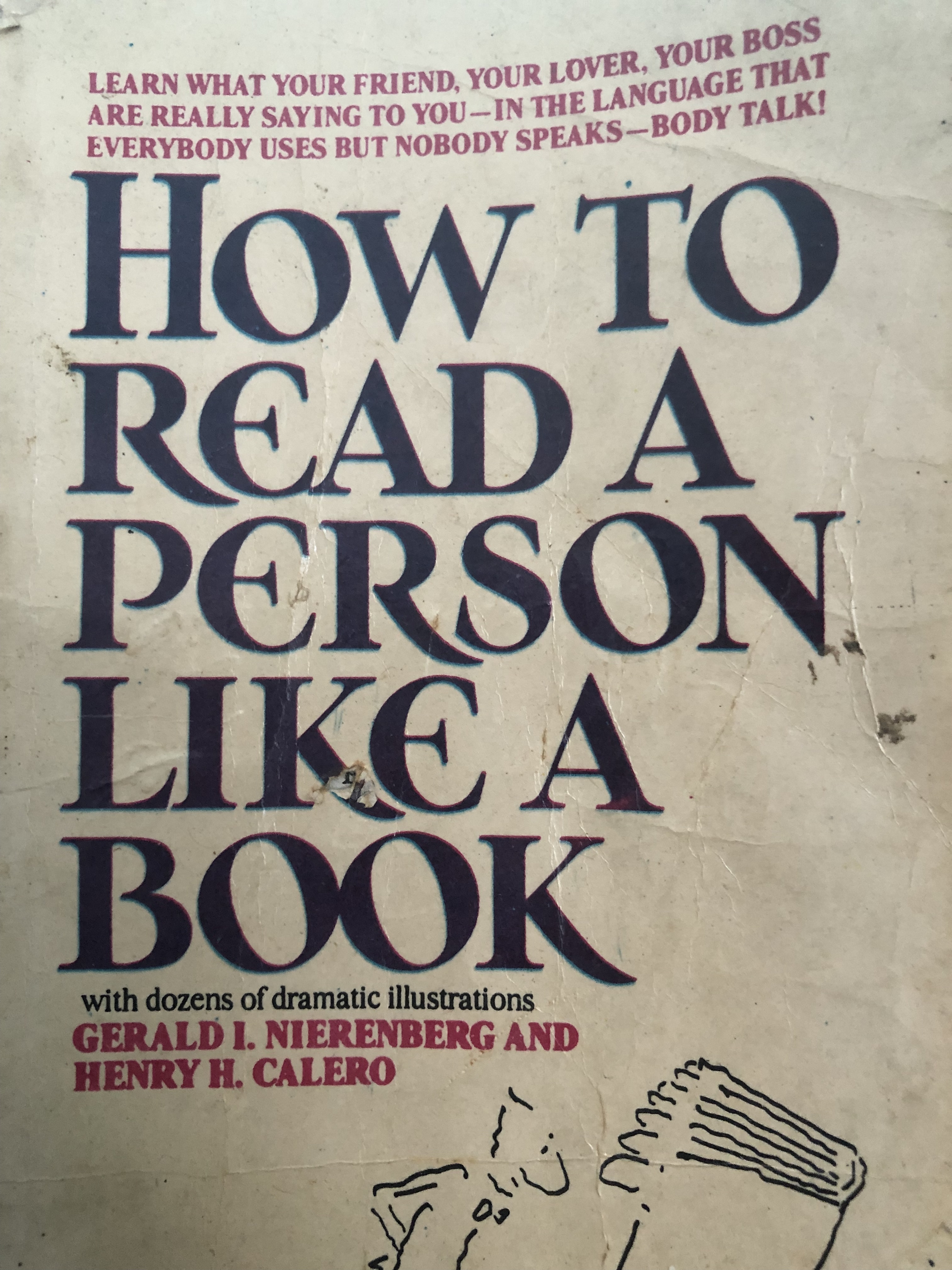
    Around the same time, I found an interesting book in my father’s bookshelf that usually had a collection of Dale Carnegie’s books and old copies of Readers Digest. How to Read a Person like a Book, was all about non verbal communication, body language – and the mastery of it. It had all the answers for me.

    img_1447

    Twenty years on, I still preserve this book. Yeah, the pages are rugged but the lessons are fresh, and still being learnt. Few years ago, when I switched roles from being in product development, to more of customer-facing project management, I paid the price for forgetting some of these lessons.

    While at a customer site, representing a group of engineers, I was annoyed by the customer who mistook my colleague as the project lead, talking to him most of the time, while I was left to wait for emails. It took a while to figure out: my colleague would always present himself in a suit and a tie, while I would often land in a semi-formal attire with a casual demeanour. That was a game-changer moment for me.

    But in 1998, this book enabled me to punch above my weight.

    When my class mates arranged for another round of preparatory group discussion, I felt I would fare better. Partly because the topic sounded easier, Also, by then, I had avoided keeping my hands nervously in my pocket when speaking; I no longer feared making eye-contact with class mates and didn’t bother if they faced me with a smirk. I slowly began opening up.

    I remember the feedback from the class mate – the designated judge that day. “Your gestures were awesome. You listened very well, often nodding your head positively, encouraging your opponents to speak. You didn’t interrupt anyone but, you didn’t say anything till the end”.

  • Bulk Fiction

    “You are losing the ability to focus on things closer to you”.

    The optometrist’s diagnosis for my recurring headache sounded rather philosophical. As he prescribed reading glasses, he assured me that my eyesight is alright and this is all quite normal in the forties, and I needed to wear them only for reading.

    A couple of days later, I realised I didn’t remove them except when at sleep. It struck me then, “reading” encapsulates plenty of things one does during the day: looking at numbers and texts on my PC when at work, catching a glimpse of the twitter feed on iPhone, reading books over the weekend. Even watching TV/movies involves a bit of reading (subtitles).

    Its not just the insane amount of blue-light exposed to my eyes that was worrying. All the stuff I inhale into my mind each day. what’s going on ? And, whats going in? Beyond work, how do i control the intake of the non-essential content? I began applying some mental filters.

    Fiction vs Non-Fiction

    We could classify all the TV programs, movies, books, social media that we consume into these two buckets: fiction vs non-fiction. Imagined stuff vs reality. To be blunt, the false vs the truth.

    Why do we love watching movies when we know most of them aren’t real? Motion pictures were a revolution in the last century, as disconnected and disadvantaged people were suddenly exposed to a world full of people they had never encountered, of stories never heard before, of places they may never visit. And the information flow that would have not occurred otherwise, though laced with myths, exaggerations and influences.

    But in this age of information overflow, why do we flood our grey cells with fiction? Agreed, imagined stories are fun while most documentaries are boring. We seek drama, meaning, pleasure and escape from reality. Movies and novels deliver those.

    There is another reason why acclaimed writers prefer fiction. Arundhati Roy, a Man Booker Prize winner and a fearless political activist, says she gets more creative liberty (and less trouble from the mob) as she indulges in fiction to tell a real story. In that sense, she claims fiction isn’t untruth. The reader is smart enough to relate to and reflect on the characters and derive their own meanings.

    No wonder these imagined movies and novels leave us emotionally richer and mentally relaxed. Albert Einstein wanted us to remember, “Imagination is more important than knowledge”, and sure enough, many sci-fi novels and movies paved the way for real scientific breakthroughs.

    How about we dabble with a bit of reality? Alas, we are surrounded by the cacophony of news, political events, wedding announcements of celebrities, and cat videos. The irrelevant and ugly truth presented to us each day are the very reasons we run away to a fictitious, imagined world.

    True Stories

    However, it is important to run into the real world from time to time, not away from it. Its not a strain, believe me. There are heaps of true, inspiring stories in the form of documentaries, biographies, podcasts and news. You could start with any domain: sports, science, lives of ordinary, unknown people.

    I indulge in watching test match cricket and tennis(especially when Federer plays). I love the commentary, particularly the way Ian Chappell brings better words to describe the same event I had witnessed. And the words and perspectives of the film critic Baradwaj Rangan are more entertaining than the movie itself.

    A few years ago, i enjoyed watching the documentary, making of Lagaan (Oscar-nominated movie) as much as the movie itself, if not more. The reel drama about a bunch of villagers achieving the impossible bet of winning a cricket match against the British officials, is more than matched by the real life struggle of a passionate (and crazy) team attempting to make a movie in an unforgiving desert.

    If you are intimidated by the term quantum mechanics or multiple universe, watch this fantastic animation story about the famous Young’s double-slit experiment about the nature of light. God, if such videos were available during our school-years. If you want a more entertaining science story, check this out: the story of how man walked from the jungles of Africa all the way across different parts of the world.

    There is this uplifting story of an ordinary bloke, Barry “Nugget” Rees, who never played cricket as such but became accepted as part of the Australian cricketing fraternity, that makes you look at these cricketers in such a positive light (this was before the sand-paper scam).

    Living in the age of fake news, we are permeated by maya(Sanskrit for illusion). The more we filter out the trivial stuff and focus on the what-if’s and aha-moments, the richer we become.

    I came across this quote some time ago: Small minds discuss People; Average minds discuss Events; Great minds discuss Ideas.

  • Philosophy lessons when waiting in a queue

    I watched my dad’s eyes as he took in the sights and (lack of) sounds of a new place (parents visiting us here on a short trip to Australia), as I took him out for a drive to a shopping mall, on the very day we landed. Later that day he remarked how well people were following the queue – whether one is driving on a busy road or waiting for the turn to pay. He was impressed by the absence of irritation or restlessness shown by the people waiting – and particularly the person at the counter who did not pay attention to any one else than the person in front.

    This resembles my own experience during my first trip abroad, to The Netherlands. I too noticed how everyone patiently waited for their turn at a doctor’s clinic, without any fuss, though being unwell.

    We get used to queues and waiting situations from the day we are born. There is an order and sequence to everything; At school and at home, we are taught to wait. However, when we are among a crowd of people wanting the same thing at the same time, the raging animal inside us tests our discipline and social manners.

    Manners were the last thing I worried about during my first near-death experience while waiting in a long queue at a movie hall, many years ago. With my cousins and friends I was thrilled initially, as we got permission to go by ourselves – and been given some money to spend. We decided to buy the cheapest ticket and had spent away the rest of the money, eating some junk. The queue was benign and orderly until when the ticket counter opened. There was a sudden rush behind us. Some strongly built and goon-like men were jostling us inside the closed corridor, which was covered on the one side with a brick wall and a steel fence on the other. My shoulders hurt – as I felt a leg clamped on me; one of my cousins screamed for help. There was no way out of that cramped space, and going back was most definitely not a viable option. We survived the stampede that day, and got our prize: a ticket to watch a fantastic movie.

    Key take-away: when people say they don’t quit or when they are called “finishers”, perhaps they didn’t have any other choice.

    I promised some philosophy in the title and here it is, but you will encounter some mathematics first.

    When you see two queues with the same number of people, you hope to choose the one which gets you faster. How many times have you been left frustrated being stuck in the “wrong” queue? Don’t stress. Murphy’s law states, “If something can go wrong, it will”. Extending that to queueing, this blog tries to analyse and explain using probability theory, that essentially, “Whatever queue you join, no matter how short it looks, it will always take the longest to you to get served.

    You learn that all queues lead to the same result. This is not very different from the core of Hindu philosophy: Any of the four paths can lead you to attain Moksha (enlightenment and liberation): Bhakti Yoga (Devotion), Karma Yoga (Action), Gnana Yoga (Knowledge), Raja Yoga (Meditation).

    From queues to spiritual progression: that’s a giant leap of thought, you say. If you are not the spiritual type, I have some practical lessons to survive a queue.

    I once had to wait for six hours in a queue to submit my application for a passport. My uncle dropped me at 6 am on an already hot and humid Chennai morning. A friend who had endured this previously had advised me to take some snacks and also gifted me a novel. I didn’t possess the patience or interest to read a non-academic book. I started watching people and tried looking at the blue skies, chirping of birds and the horns and smells of morning traffic (the office opened only at 9). The guy in front of me struck a conversation, which soon turned into an interview: where are you from? why do you need a passport when you are not even twenty? where are you planning to travel? I mumbled and stumbled for a while and then took a decision that changed my life. No, I didn’t kill him. I took the book out, sat down on the floor and devoured it. Weeks later, I received my passport, but in the meanwhile i got addicted to thick, fat novels.

    Lesson: what you do when you have nothing else to do, defines you.

    Sometimes, you wont even know where a queue begins, moving towards or ends. It is best to leave it to chance, rather than to put any mental effort. For instance, if im lazy, I stick to the same lane when driving, even if the next lane is free.

    This strategy won’t always work.

    Once during a family trip to the historic Charminar monument, we joined a queue going to the top of one of the minarets. Twenty minutes of slow paced movement on a circular staircase took us to a narrow space at the top. I was intrigued by another queue that began from where we just finished. I thought to myself, this might lead to a nice spot to take some pictures. People moved much slower than during the climb. It was too late when we realised, we were actually on the queue that goes down back to the ground. Now, don’t tell me, it is the journey that matters and not the destination.

    Insight: Don’t be surprised to find yourself where you started. Life is a circle.

    Back to that day in the doctor’s clinic in the Netherlands. My stomach (and other related organs) were struggling to deal with the new diet. A colleague booked me a doctor’s appointment and arranged for a taxi.

    I arrive to find the room crowded with patients seated ahead of me. Across the room, I see the doctor’s face whenever the door opens to let a patient in or out. A glimpse of my to-be-saviour. An hour later, I am unable to sit straight, shivering with some fever as well. When you are sick, the time moves slowly.

    The receptionist was busy. I ask myself, should I explain my situation and beg her to let me ahead of others. I remind myself, im in a different country, and I better stick to the ways and systems here. There is no need to worry.

    I get more hopeful as I see the last person left in the room being called. When he comes out fifteen minutes later, im relieved. The doctor’s door is kept fully open now. He looks tired and stretches his back. He picks up a book and begins reading it seriously. I stare at him hoping he will make eye contact. The receptionist comes to me with a strange look in her eyes and asks my name. She doesn’t pronounce it well but checks her records. She makes some phone calls, while I am left to wonder what’s going on. She then confirms the worst, even as the doctor continues to flip many more pages.

    I had reached the wrong clinic.

    I don’t find any lessons in this experience. I was just stupid not to have checked with her as soon as I arrived.

  • To find a problem to solve…

    I was so bored towards the end of the day during a short, official trip to Wellington last year that I started reading my own blogs. I soon ventured into my journal entries. For more than a year now, I have been diligently jotting down anything that comes to mind – thoughts, tasks, worries, ideas, incidents, insights – in a spreadsheet. A lot of stuff from work, home and social life.  It has been a game changer for me. Many of my blogs have been composed of these random notes. I also learn so much about myself.

    What struck me was, its all about me, “my” world: my family, my work place, my friends and acquaintances. I wondered if and when would I ever find time or energy to even think about the issues of others – those not related to me personally or professionally.

    No, im not talking about throwing some money away for a charity. I am referring to the act of utilising our knowledge, skills, network and time to create something to make a small difference in someone’s life.

    I didn’t know where to start. I had tried to look for volunteering activities previously: signed up for a mentoring gig but soon realised it was not fully engaging me. While I did not seek additional stress beyond what was already produced by work and life, I still wanted to push myself a bit intellectually.

    I was searching for opportunities when I got reminded of this advice from Arunachalam Muruganandam – the grass roots innovator of low cost sanitary napkins for rural India – when he spoke as part of the panel that included Bill Gates, addressing the “great challenges facing the world” or something like that (scroll to 50 min into this video). “Don’t look for opportunities. Opportunities are lying in the form of problems. Take a problem, use your knowledge and be a solution provider”.

    Think about people whose occupation is all about troubleshooting and fixing others’ problems: doctors, car mechanics, plumbers etc. Even astrologers and godmen. Though many of these professionals perform this as part of a transaction, there is a hierarchy among them in terms of value and respect accorded by the society. Medical professionals would be at the top of this pyramid, since we trust them with our lives. In my own experiences, I have often admired their ability to deal with our problems while being surrounded by a stressful environment.

    However, the kind of problem solving I was thinking about was different: one that came with no obligation, expectation or judgement. Should inspire me, test me, but with no time pressure involved.  Just the pleasure of doing something useful. Where no one’s watching me.

    The previous week, I had watched a reality TV program which featured a kid from a poor family who was also blind. He sang so beautifully. That took me back to the school days and I remembered once writing a test on behalf of a visually impaired classmate (he would speak the answer to me and I would write it, verbatim). I had always wondered how he would read books which didn’t have the braille version.

    I began a search in google: “Coimbatore blind”. It’s my hometown, after all. Clicked on the first link – which was a video interview with Mr. Saravanan who had sight until he was an adult but lost his vision completely over a period of time. I found his number from the video and called him. He spoke to me about his challenges to become physically and financially independent. About how he was promised many things by many people, organisations and the government, over the years. Though he had received some support and assistance, he felt he could achieve a lot further. He never gave up though. Living with his parents, he is independent however, running a coaching centre in the outskirts of Coimbatore, offering students a whole bunch of things: yoga, spoken English, communication skills, spiritual advice etc. He has a computer and a smart phone which help him get connected to the world.

    I explained my background and the intention to help him in some way I could. His expressed his main challenge as being missing out on reading books. Only a small percentage of books have the braille version. He narrated his difficulties in having to travel some distance to read a book of his choice, but the library’s text-to-speech reader device was available only intermittently.

    I found the problem I was looking for.

    As an IT person, I thought it should be so easy to solve this problem. After all, Apple devices, Kindle and so many apps offer AI capabilities (SeeingAI from Microsoft, for instance) and surely, it must be possible for him to just place a device on top of the page and listen on.

    Alas, it was not so simple. Obviously, not all books are available in the digital form. Definitely, not all Tamil books. I also realised, many of these technologies are proprietary, expensive and worse, not so reliable. Even otherwise, how would he read the contents of a letter posted to him?

    After a month of research, I resigned to the fact that I just have to buy him the right product. A time-tested and reliable reading device (Pearl) which is used in schools and universities across the world. I also ordered the software that supports Tamil character recognition. It was a challenge for Saravanan to get this installed and configured all by himself, talking over the phone with the Mumbai based dealer that shipped the device. He later told me the Tamil OCR software didn’t work at all. Nevertheless, he was beginning to read English books.

    It was a bit disappointing in the end that I couldn’t solve his problem fully; and the way I wanted to. With my skill, knowledge and all that. Living at the other end of the world, I was only able to afford some time and money.

    It has been a year now. I try to keep in touch with him and occasionally call him. Earlier this month, during our trip to India, my wife and I met him face to face for the first time.

    He “read” us a page from a book that was kept under the scanner.

  • Chasing faint memories from a distant past

    These days, im spending more time in the past. Not sure if that’s due to reduced anxiety levels I have about the future. As you might have noticed from my blogs, I’m a sucker for nostalgia. The further I travel to the left of the timeline however, the more intriguing and demanding it becomes, since it is a struggle to recall events from the baby years of my life.

    It strikes me that I don’t think much about my (paternal) grand father these days. Maybe since my grandma filled the space – she continued the journey with us for thirty three more years. I don’t even have his picture at my new home.

    I feel compelled to write about him. For the sake of my kid who will otherwise know much less about her ancestors. And for my own sake. I borrowed his name, after all.

    I will start with what I have. A few incidents and images of him are indeed registered in my head.

    I remember him walking me from the school. Wait. No, he is lifting me up on his hips as he collects me from the primary school, walking back home along the road. He does not talk much. I remember him being tall. When you are a kid, everyone else looks taller. Gee! I don’t recall much more of him.

    Then, I get flashed with another image: We are somewhere a temple in Ernakulam, standing on the elevated slab / base which has a big tree. I see my aunt (his daughter) teasing him to jump to the ground. My grandpa ignores the challenge stating he could have readily done that, if he was a bit younger.

    Now, that is amazing. I don’t think anyone narrated this incident to me. When you really scratch your head, the grey cells do play out a scene from the past. If you think I am hallucinating (I hope I am not), take a look at the recent breakthroughs in neuroscience, about the way we remember the past and recollect from our memory.

    But I cannot forget the day he passed away. I was just seven years old. In the morning, I was sent to school and don’t remember if I had said “bye” to him. Later, I watched my uncle walk in to the classroom requesting my teacher to let me go home early. I saw a crowd of relatives and neighbours in the very small living room. I see “him” lying on the floor. There were many other aspects of that day that clouds my memory, but I remember this weird feeling, as clear as sky: I tried to cry like everyone else, but couldn’t.

    He was not known for displaying his emotions. A shy and often silent person that he was, he had a tough life. I try to recall the narrations I have heard as a child from my father, about his dad’s life:

    My grandpa’s family owned a restaurant near the bus station in Erode. As an independent adult, he ran the kitchen in the weekly train between Erode and Ernakulam and must have impressed a certain gold merchant who decided to get his last daughter married to this tall and handsome man.

    Moving to the city of the bride, he sets up his own restaurant in the main streets of Ernakulam. Not much later, he faces revolt within the larger family which unfortunately leads to the sale of his only asset. With cooking as his only skill and, faced with limited opportunities in that small city, he takes up the job of the chief-cook in the same shop.

    I wonder how he felt that day he was downcast as an employee from being an employer . It must have crushed him. Not surprising then to learn that he packed his bags, took his wife and son (my dad) to a bigger city:Coimbatore. There he would work for many hotels and eateries – some of them still thriving even today. He has made dosas in Bombay Ananda Bhavan, spun jelabis during Diwali, delivered pooris to students by 6 am, served the canteen at the famous Central theatre, together with a coffee specialist who later became a famous restaurateur.

    I asked my father why grandpa had to change so many jobs. It seems he flinched and revolted often against people in the kitchen who were lazy and indifferent about quality and hygiene. He once threw an entire vessel of sambar down the drain when he spotted a floating insect. The next dish he cooked was weeks later, in a different hotel, several kilometres away which he had to cover by foot. Those long walks continued for some years.

    My grandma somehow managed to run the show during intermittent job “breaks”. The four children growing up and taking odd jobs even as they were finishing studies, also helped.

    The only regret we all have is, by the time the family clawed back to the middle class level, he had left us. He didn’t see the first black-and-white TV we bought. He wasn’t around when we watched our first movie at home at 10 pm (African Safari). He didn’t get a chance to push a button on a machine that would crush rice and deliver flour in an hour – relieving him from the physical pain of handling a manual stone mill grinder. And he didn’t answer the first phone call we would receive at home. He missed the convenient motor bike rides. He didn’t sit in my car.

    I feel guilty from not retaining him in my mind. But it is actually worse: I miss the chance of a meaningful conversation with him. That would have added some colour to the teenage years of me and my sister. Even for today, as I deal with tricky questions on career and life as such. A man who lived for 67 years, migrated to various cities, walked much distance, silently and on barefoot, fed hundreds of thousands of mouths, would definitely have something to offer. It feels like I am missing an important book from my library.

    I will need to explore, talk to uncles and aunts. A bit more about my grandpa’s lineage might be even more interesting. The ancestry might be traced to one of the agraharams (village) in Palakkad. I vaguely recall an incident narrated by my dad about someone (grandpa’s uncle?), a police constable who lost his hands while trying to arrest illicit-liquor vendors during a night raid. That explains why grandpa, his brothers and cousins chose to arm themselves with cutlery instead.

    TN Seshan, a famous son of the Palakkad soil, the man who revolutionised the way elections are conducted in India, says, “Palakkad is famous for producing cooks, crooks and civil servants”.

    My grandfather was a cook. My father retired as a civil servant. That leaves me in a strange predicament.

  • True (rep)lies and the art of answering

    When the angry professor questioned my friend, why he had not worn the mandatory dull grey shirt and the uglier trousers (called the “lab uniform”) for the Electronics Laboratory class that day, I sensed we were going to witness an embarrassing conversation. We had seen and heard many different excuses tried out by others, with limited success, only to be subjected to further probing and public demeaning.

    I vaguely remember my friend’s reply now, after so many years. The truthful, detailed account that stumped everyone – and certainly convinced the professor who had no further questions.

    What about situations where we are not under pressure ?

    For instance, it is easy for me to respond a simple question from my colleague, “How was your weekend?” with an answer “Great!” – which is good enough for a coffee-corner chat. But if I really care to give a proper response, a truthful reflection on that question might reveal some finer (and boring) details about my life – how I struggled to finish grocery shopping in time, having gotten up too late on that Saturday morning and the fact that I simply did “nothing” on Sunday – lazing around, watching a stupid movie. I might realise, I need to do something worthwhile during weekends in order to offer a better response. But the other day, when I narrated to my colleague exactly those trivial things I did on the weekend, he simply loved it – especially the “doing nothing” bit. A more meaningful chat ensued, about how our lives are never free of responsibilities and that it is not feasible to “do nothing” unless we manage to stop the passage of time.

    A true answer or an excuse sounds weird but it can work sometimes. That’s my interpretation of the famous Copy Machine Study, where a student is asked to jump the queue of people waiting to get their turn to use a copy machine. In the first experiment, he is asked to tell the first person, “Excuse me, may I use the machine?”. No reasons to be given. In the next experiment, he expands, “Excuse me, may I use the machine, because I’m in a rush?”. In the third experiment, he is asked to state, “Excuse me, may I use the machine, because I want to make copies?”. Guess which version had the most success rate (in terms of being allowed to skip the queue). While the second one was the most successful, the third version had almost an equal amount of success. Due to the magic word “because”, as Robert Cialdini explains, “…when we ask someone to do us a favor we will be more successful if we provide a reason. People simply like to have reasons for what they do.”

    I too was once looking for a strong reason; to apply leave and travel back home from the onsite location as my family, especially my daughter was missing me a lot during those four months. Phone calls every night usually ended with my daughter wondering, when I would be back. It was a tough call to make for me: on the one hand, my whole team was toiling away; as a project lead, I could not be seen retreating until we got the job done. On the other hand, well, my daughter was missing me. It became easier however, on a particular day when she went to bed early and conveyed through her mom that she is all ok and cheerful and she understood that dad would be away for a long time.

    I flew back home that very weekend, having provided a stronger reason for the two-weeks leave request which was approved promptly: my daughter was no longer missing me.

    The next time you are asked for a reason or when you are about to offer an excuse, try looking for the flash of truth.

    PS: This was my friend’s reply to the professor as far as I can remember. “I had given the clothes for ironing to the dhobi (washerman) last weekend and when I went to collect them yesterday, I found his shop closed and I learnt that he has gone on a pilgrimage only to return after three days.”

  • Can you please pass that insult ?

    Getting up at 5 am on a Saturday and in front of the laptop without even the customary cup of coffee? The wife was startled and wondered what’s gotten to me. That, I would learn for myself a few hours later, as I finished authoring a detailed analysis of the project situation along with some suggestions to mitigate risks. When I pressed the Send button, the email carried more than just the slide deck I had attached. It also took away the residual feeling of something I struggled to put into words the whole night: Why did these guys exclude me from recent discussions?

    We all face situations where we have been left out. What we do in those situations determine who we really are. It tampers with our ego, causes a bit of anger and we take offence. Whether we are part of a team that builds a space ship or if we are jockeys racing horses, or simply playing a game together, sometimes the ingredient that stimulates us to produce an inspiring result is not the respect, trust, or love from others. It just might be an ounce of insult passed on to our side of the table.

    Recently my (now “ex”) tennis doubles partner asked me to consider not turning up for the finals we were going to play in a level three tournament in a modest club in our small city. That way he can partner with a reserve player to increase the chance of winning. (The irony was lost on him that I beat him in a singles match just the previous night). I didn’t go and I still don’t know whether they won. But I knew that was the end of that strange “friendship”. Have I become more serious about tennis? Oh boy! I began playing more often and I even try that single-handed cross-court backhand shot once in a while, forgetting I’m still an amateur who is yet to learn how not to dance while hitting the ball.

    I am not a saint, though. And this has to come out of the system today: I did contribute to someone becoming an inspired table tennis player many years ago by means of my disrespectful behaviour.

    At the end of a relaxed day at work in the Hyderabad office, I was busy playing a game with another colleague. I didn’t pay attention to my friend as he appeared near the table. He was still learning to hold the racket and here I was already able to move the ping pong ball across the net. My colleague and I continued to play games without giving a chance to my friend who waited for an hour in vain. Six months later he surprised (shocked!) me by beating the blues out of me. And sixteen years later he is still a friend (I hope).

    Getting rejected is an awful feeling. Not being given a chance is criminal. Alas, nature does that all the time. It also teaches us how to thrive.

    As a year 10 student, with my eyes looking at an unknown future (I was caught looking outside the window regularly), I was intrigued by this question posed by our class teacher: what do we want to do next?. “I want to prepare for the IIT entrance exams” (the premier engineering institution in India). It was not the laughter from my class mates that put me down. The teacher’s discouraging words: “Son, I don’t think you can do it” pushed me down but only momentarily. Two years later, I eventually failed to get into IIT. But those two thousand hours I spent preparing for that exam, prepared me for the future. In the end, the good old man’s words only increased my appetite to aspire.

    In the climax of the film Seabiscuit (name of the horse), the jockey is on his most important race of his career. The horse and the jockey are injured. They needed more than mere motivation to win. Then he comes with this trick: he asks his friend who is another racer to help by bringing his horse close to Seabiscuit during the race; close enough to tease and “give a look” at Seabiscuit in his eye. Those few seconds were just enough for the trailing Seabiscuit to get spurred and race to victory.

    We all need a kick in the back once in a while. It is a cliché but it sounds nice in this context: when you fall you better try to fall forward. We don’t know why we react the way we do when we are pushed. We cannot describe much in words or convince our loved ones. We choose and avoid some of the battles. But the scars choose us and we remember. We then do the only thing that makes sense when slighted or insulted.

    We fight.

  • To carry an oil lamp to buy a trash bin

    The task was simple that evening, many years ago. We were four classmates beginning a new chapter in our lives: out of home, first job, new city, new apartment and the world to conquer. Two of us had to go get a trash bin for the house. The shop wasn’t far away and I wouldn’t complain anyway since this guy is quite a talker. He can explain the planets and cosmos while in the same breath turn philosophical or venture into the weird ways of the human mind. He once asked me, “think, what if you vanish one day and no one in this world remebered you”. We start walking the 300 metres to the bazaar. We see a small temple on the side of the road and he beings to wonder why religions exist in this world. I try to tell him we better hurry up before it rains.

    The small road leads to the bigger road at the intersection. We only had to cross the signal to get to the home furnishing shop. But then we see this new music shop crop up on our left and we walk right into it. This guy had introduced the western pop genre to me. And as someone used to listening mainly south Indian film music, the name savage garden sounded more like a filthy place full of violent beasts than a music album (until I fell in love with the animal song). With a couple of new music cassettes (it was 1999; CDs will come much later) as we started walking back home, we both realized our folly. We started telling each other how stupid it felt to be forgetful and wandering away from the simplest task of buying a waste bin . We discussed the root causes while at the same time began fearing the ridicule from the other two waiting for us.

    Why do we forget things and miss out on simple tasks or goals? Are we not serious enough? I am not even talking about life changing goals. Simple tasks that doesn’t need much thinking or planning. The office receptionist was laughing at me the other day, while making alternative arrangements as I had lost my id card and car park access card on consecutive days. I still don’t know where I kept them but I do recollect the thought stream in which I was drowned in during those days.

    Life as a tourist:

    Nassim Taleb has popularised the french word flâneur which loosely means wandering, idling or being explorative. It describes a tourist (who does not have a fixed itinerary) as opposed to a tour guide (who has mapped out a plan). Taleb explains the need to have a variety of options in life, career etc., so that you can take decisions opportunistically at every step, revising schedules or changing destinations. In the words of Yogi Berra “if you don’t know where you are going, you will end up somewhere else.” What if “somewhere else” turns to be more interesting and lucky?

    I feel strange when people talk about a one-year goal, three-year vision, five-year target etc. I never thought I would be in an IT job even a year before joining my first job when I was only worried about getting good grades in the electronics degree. You have no clue where you going most of the time but you usually have some sense of direction. I used to be quite stressed out about not being able to control the outcomes and worry about slipping away from the “plan”. These days, I only keep a view on the high level goals and leave the steps to its own dynamics.

    It feels like freedom as I go unstructured and unplanned once in a while, loosing myself into the world of new information, people, random corridor conversations, unexpected outcomes etc. It is OK since it feels more human and real. There is a parable about a guru teaching his disciple about methods of focussing the mind. He hands him a lamp brimming with oil that could spill if shaken even a tiny bit, and instructs him to walk around the temple. When the student succeeds at the daunting task, the guru asks him if he had a chance to marvel at the scenery: chirping of the birds in the tree, the smell of fresh flowers in the pond or the aesthetics of the temple. The student blinks as the guru points out the ultimate skill: the need to experience the world around as we focus on the task at hand.

    But 19 years ago, as my friend and I were walking on a road to buy a trash bin, we didn’t have to carry an oil lamp. As we were talking, we soaked-in the sights, smells and the sounds and lost ourselves in them. The trash bin remained in the shop.

    The other two roomies couldn’t control their laughter as we narrated our yet another failure to “get things done”. We told them how much we had been cursing at ourselves for being so absent-minded. Until when one of them wondered out loud, “when you guys started self-pitying, why didn’t it occur to you to just turn around, cross the road and walk into that bin shop?”

    Please visit the Home Page to read my other blogs…